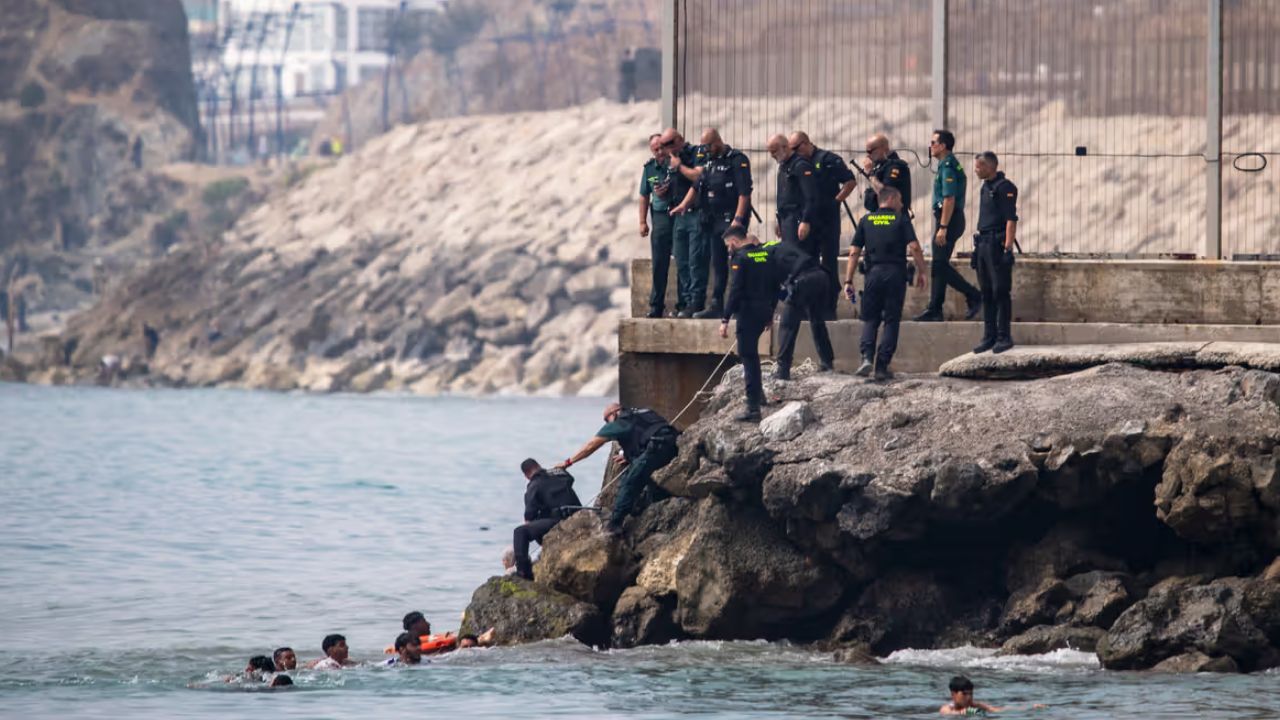



The number of confirmed fatalities has risen to 72 after an estimated 60,000 migrants attempted to cross the border from Morocco into the Spanish enclave of Ceuta over several days.
On Sunday, five additional bodies were recovered along the coastline as the territory began the process of recovery following the massive influx. According to Spanish authorities, medical teams have treated more than 1,000 people since the surge commenced on Thursday, reports Al Jazeera.
Miguel Angel Perez, the Spanish government’s representative in Ceuta, confirmed the fatality count and stated that while the situation had improved by Sunday, further work is required to restore normality. The Spanish news agency EFE has indicated that the death toll is expected to rise further.
The Spanish Civil Guard has initiated the identification process for the 72 victims. Carlos Atuchi, an official with the Civil Guard’s forensic science department, noted that the collection of DNA samples and fingerprints would be finished by the end of next week at the latest.

Authorities reported that the victims died either by drowning or from being crushed while attempting to scale a breakwater and border fence.
In response to the crisis, 22 European Union member states have called for collective border action, while Italy has suspended passport-free Schengen travel with Spain. To bolster security, Spanish officials have deployed additional police and army patrols and installed a 500-metre floating barrier off the coast.




Spain’s Minister of Foreign Affairs Jose Manuel Albares confirmed on Friday that “virtually all” of those who entered the enclave have been returned to Morocco. Records indicate that over 48,000 individuals returned within the first 48 hours of the crisis.
Morocco’s Interior Ministry attributed the mass crossings to human trafficking syndicates, misinformation shared on social media, and a misinterpretation of a Spanish judicial ruling concerning the return of migrants intercepted at sea. Moroccan officials confirmed 11 deaths on their side, mostly from drowning, and are currently verifying reports of other fatalities.
Juan Jesus Vivas, the leader of Ceuta, told the El Pais newspaper that the city’s morgue had received a total of 88 bodies. This figure includes victims from the recent surge as well as those who died during smaller, hazardous night-time swimming attempts over the previous two weeks.
Ceuta and Melilla serve as the only land borders between the European Union and Africa. Migrants frequently attempt to reach Ceuta by swimming approximately five kilometres from the Moroccan town of Fnideq or from the nearby town of Belyounech.
The Spanish government has defended its programme to grant residency to over half a million undocumented residents, rejecting allegations that the initiative encouraged the surge.
Officials clarified that individuals entering Ceuta irregularly are legally barred from travelling to mainland Spain or other areas within the Schengen zone.
Reflecting on the loss of life, Karima Abenaz, a French national in the enclave, expressed her grief. “It’s not right that, in the year 2026, women with children as young as two months old should be crossing the sea only to die,” she said.