From a post-war policy experiment to a core pillar of Bangladesh’s economic architecture, the Bangladesh Export Processing Zones Authority (BEPZA) has spent 45 years turning scarcity into scale. The authority entered its 46th year on Wednesday with a model that reshaped the country’s industrial trajectory.
The journey traces back to the late 1970s. Post-war Bangladesh faced limited foreign investment, negligible exports and scarce employment outside agriculture. At that time, then World Bank President Robert McNamara advised the creation of export-oriented industrial zones. The idea took policy shape under President Ziaur Rahman.
The BEPZA Act was passed in 1980. Operations formally began through a gazette notification on April 15, 1981. The first Export Processing Zone was established in Chattogram in 1983. That move translated policy into practice and positioned Bangladesh as an emerging destination for foreign investment.
Expansion accelerated in 1993 under the Khaleda Zia administration with the Dhaka EPZ. It triggered industrial growth in Savar and Ashulia. Subsequent zones in Mongla, Cumilla, Uttara and Ishwardi extended industrialisation beyond traditional centres by 2002.
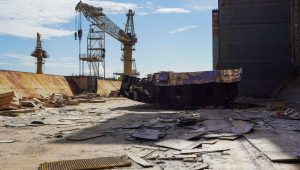
The conversion of Adamjee Jute Mills and Karnaphuli Steel Mills into EPZs in 2006 opened new pathways for industrial redevelopment.
Operating on less than 0.001 per cent of the country’s land, BEPZA now delivers 17.03 per cent of national exports and attracts 19.47 per cent of total foreign direct investment.

It generates between 15 and 20 per cent of export earnings annually. The figures highlight the scale of output from a tightly managed industrial footprint.
Over the decades, BEPZA has drawn $7.29 billion in investment and enabled exports exceeding $125 billion. It has created employment for 551,248 workers, a large share of them women. Nearly 2.1 million people depend on EPZ-linked income.
Each acre of EPZ land produces Tk13.82 crore annually and supports $3 million in investment, $51 million in exports and 226 jobs. In 2024-25, BEPZA’s direct and indirect contribution to the economy stood at around Tk34,800 crore. It now oversees 564 industrial units, including 448 in operation and 116 under implementation.
The model has evolved beyond garments, which still account for over 80 per cent of national export earnings. Only 32 per cent of its roughly 450 operational factories are now in apparel.




The remaining 68 per cent produce diversified goods including automobile components, camera lenses and electronics, as well as high-end products such as drones, Olympic-grade bicycles, international archery equipment and specialised anti-radiation military uniforms.
The shift is strengthening the global standing of the “Made in Bangladesh” brand, said BEPZA Executive Director Anwar Parvez.
Expansion continues through the BEPZA Economic Zone in Mirsharai. Eight firms are in full production, five are in trial and 34 are under implementation since work began in 2018. At the same time, new EPZs in Jashore and Patuakhali are progressing. Plot allocation is expected within the year.
Investment momentum remains strong. Deals worth $629.93 million were signed in the first nine months of the 2025-26 fiscal year. These are expected to create 63,967 jobs.
This builds on agreements with 38 firms in 2025. Investors from 38 countries, including China, Japan, South Korea, the United States and the United Kingdom, are involved.
Parallel to growth, BEPZA has embedded sustainability into its model. There are 27 LEED-certified factories, including eight with platinum status. Ishwardi’s Vintage Denim Studio is the country’s first LEED platinum factory. Central effluent treatment plants operate in key zones. Closed-loop wastewater systems are planned for new zones.
Water management relies on river-based sourcing from the Karnaphuli, Padma and Mongla rivers. Plans are underway to expand to the Shitalakkhya and Gomti rivers. Reservoir construction and rainwater harvesting are also being developed.
The transition to cleaner energy is gaining pace. Rooftop solar generation has reached around 32 megawatt peak against demand of 241 megawatts. BEPZA aims to meet 25 per cent of its electricity needs from renewable sources by 2030, said Anwar Parvez. The move is expected to reduce reliance on fossil fuels and ease pressure on the national grid.
Its “one window, same day service”, formalised under the One Stop Service Act, 2018, continues to anchor investor confidence. Labour welfare remains structured. The minimum wage stands at Tk12,800, higher than Tk12,500 outside EPZs. Workers also receive 30 to 40 per cent higher overall benefits.
Healthcare, day-care and subsidised education support workers’ families. An International Labour Organization-backed employment injury scheme and a dedicated helpline, 16128, ensure protection and grievance redress.
Institutionally, BEPZA has demonstrated strong financial discipline. It ranked top among 101 state-owned enterprises and autonomous bodies in managing financial risks in both the 2021-22 and 2022-23 fiscal years.
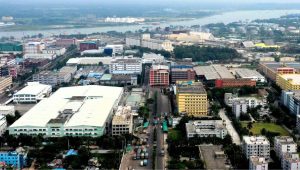
Beyond factory gates, EPZs have reshaped regional economies. They have driven demand for housing, transport, retail and services. They have also fostered forward and backward linkage industries such as accessories and chemicals.
These developments are reducing regional disparities and building integrated economic ecosystems across the country.
BEPZA’s trajectory shows how disciplined policy, efficient land use, diversification, sustainability and sustained investor confidence can turn a constrained economy into a globally competitive manufacturing base.
Prompt delivery of a package of services to investors remained a key to the authority’s success, which it aims to expand further, said BEPZA officials, according to Parvez.
“BEPZA’s contribution is not limited to attracting investment and boosting exports, but also extends to bringing marginalised communities into the economic mainstream through job creation and helping them become self-reliant,” said BEPZA Executive Chairman Major General Mohammad Moazzem Hossain, marking BEPZA Day 2026.