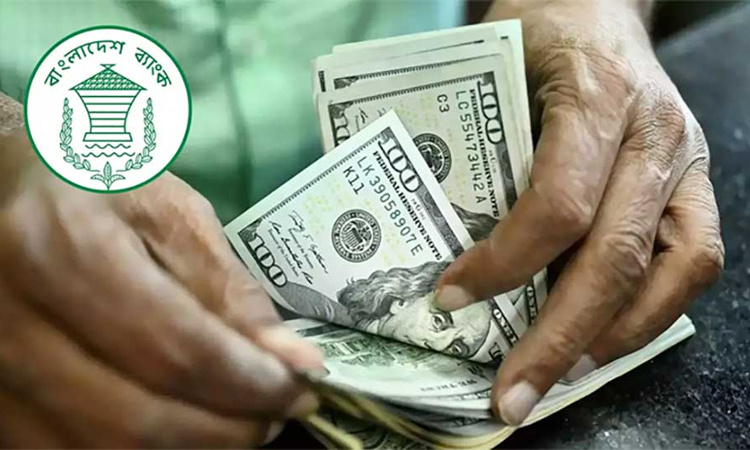

Bangladesh received more than $1 billion in remittances in the first nine days of September, sustaining momentum that policymakers hope will help lift foreign-exchange reserves to $40 billion by June 2026.
According to Bangladesh Bank, remittance inflows totaled $1.018 billion during 1–9 September, equivalent to about Tk12,420 crore at an exchange rate of Tk122. The figure is $185 million higher than the same period a year earlier, underscoring a steady expansion in migrant workers’ transfers.
Remittances have grown markedly over the past half-decade, rising from $18.2 billion in FY20 to $30.3 billion in FY25. The flow averaged $2.5–3.0 billion per month last fiscal year, peaking at a record $3.29 billion in March 2025.

Bangladesh Bank has taken advantage of the strong remittance supply. Between 13 July and 9 September, the central bank purchased $1.39 billion from commercial banks, based on auction data. Purchases exceeded $1.0 billion by early September, with large single-day operations including $313 million on 15 July and $265 million on 9 September. These interventions lifted gross reserves to about $30.66 billion as of 9 September, after a $1.5 billion Asian Clearing Union payment, up from $29.8 billion in July.
The taka has remained under pressure in recent years, losing more than 25 percent of its value against the dollar since 2022. After several rounds of adjustments, the official exchange rate now hovers near Tk122 per dollar, while banks and money changers often quote slightly higher rates. Analysts say keeping remittances flowing through formal channels is essential to contain further depreciation.




Beyond remittances, Bangladesh is banking on official financing. The IMF disbursed $1.33 billion in June, and two further tranches — estimated at around $1.0–1.1 billion — remain under the program. Additional budget support from the World Bank, Asian Development Bank, Islamic Development Bank, and IFC could add $1.5–3.0 billion over the next year, depending on approvals and disbursements.
To reach the $40 billion gross reserve target by June 2026, Bangladesh will need to add about $8.7 billion in ten months, which translates into an average monthly build of roughly $870 million. At the current pace of central bank purchases, which has averaged about $700 million per month since mid-July, reserves would likely climb to just under $39.5 billion — close, but short of the goal.
Factoring in the two remaining IMF tranches would lift monthly additions closer to $800 million, bringing reserves into the neighborhood of $40 billion. If Bangladesh Bank manages to increase its monthly purchases to $850–900 million and partner loans contribute at least another $2 billion, reserves could surpass the target, rising to between $41 and $42 billion by June.
The challenge is that external payments, particularly the Asian Clearing Union settlements of $1.3–1.9 billion every two months, periodically drain reserves.
To offset these dips, the central bank must accelerate dollar buying when the market is flush with remittance inflows. Sustaining remittances above $2.5 billion per month — and capturing 30–40 percent of that flow into official reserves — will be vital for maintaining momentum.
“Bangladesh is within striking distance of the $40 billion mark,” Md Mazedul Haque, chairman of the Policy Think and Economic Research Centre, told TIMES of Bangladesh. “But it will take a mix of strong remittance flows, disciplined imports, and timely multilateral disbursements to get there.”