A harsh new year’s reality confronts Finland. The nation, which has consecutively for eight years received recognition as the world’s happiest country, is now afflicted by unemployment and illness.
Finland now holds the statistically highest unemployment rate within the European Union, as per data released on Thursday by Eurostat, the statistical arm of the European Commission.
The figures indicate that in November, over a quarter of a million individuals were without work in Finland, constituting 10.6 percent of the labour force.
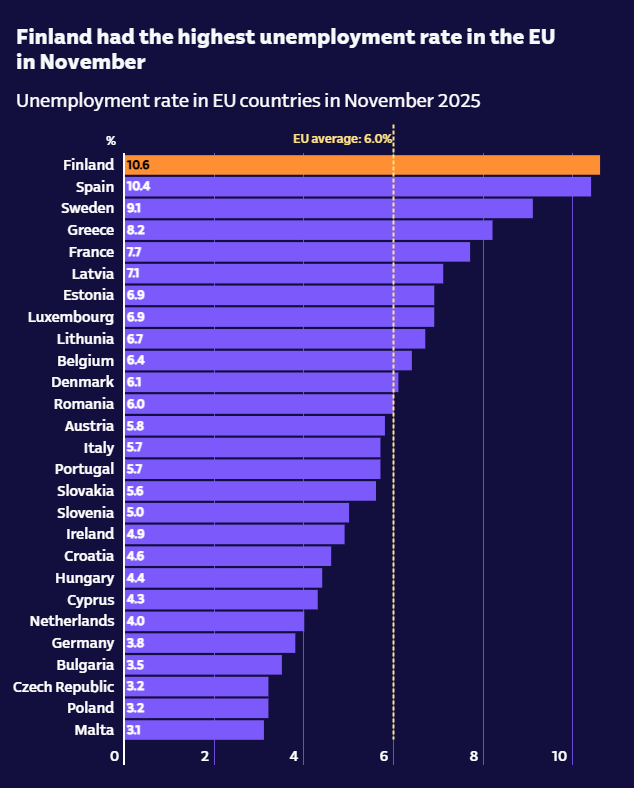

This percentage surpasses that of Spain, which previously occupied the unenviable top position in the EU’s unemployment rankings.
This grim scenario represents Finland’s highest jobless rate since the period following the 2009 global financial crisis, highlighting the Finnish economy’s weakened standing relative to other EU nations.




For context, the unemployment rate in the Netherlands during November stood at a mere 4 percent, while the average across the EU was 6 percent.
Long-term analyses further show that southern European nations like Spain and Greece, historically plagued by persistent high unemployment, have markedly improved their conditions over the past ten years.
At the same time, Finland’s trajectory – alongside Sweden’s – has shifted in the opposite direction.
The escalation in Finland’s unemployment can be partially attributed to the expansion of the country’s labour force, driven notably by a rise in international migration in recent years.
This influx, however, has occurred alongside an economic slump in Finland, making securing employment more challenging.
Furthermore, the Finnish government has implemented several policies that immigrant advocacy groups criticise for exacerbating difficulties for new residents.
Despite the recent Eurostat statistics, Finland’s Ministry of Economic Affairs and Employment maintains a forecast for improvement in the upcoming year.
In an official communication, the ministry highlighted that employment in Finland has risen by approximately 25,000 in the past year, with growing job opportunities in specific sectors.