






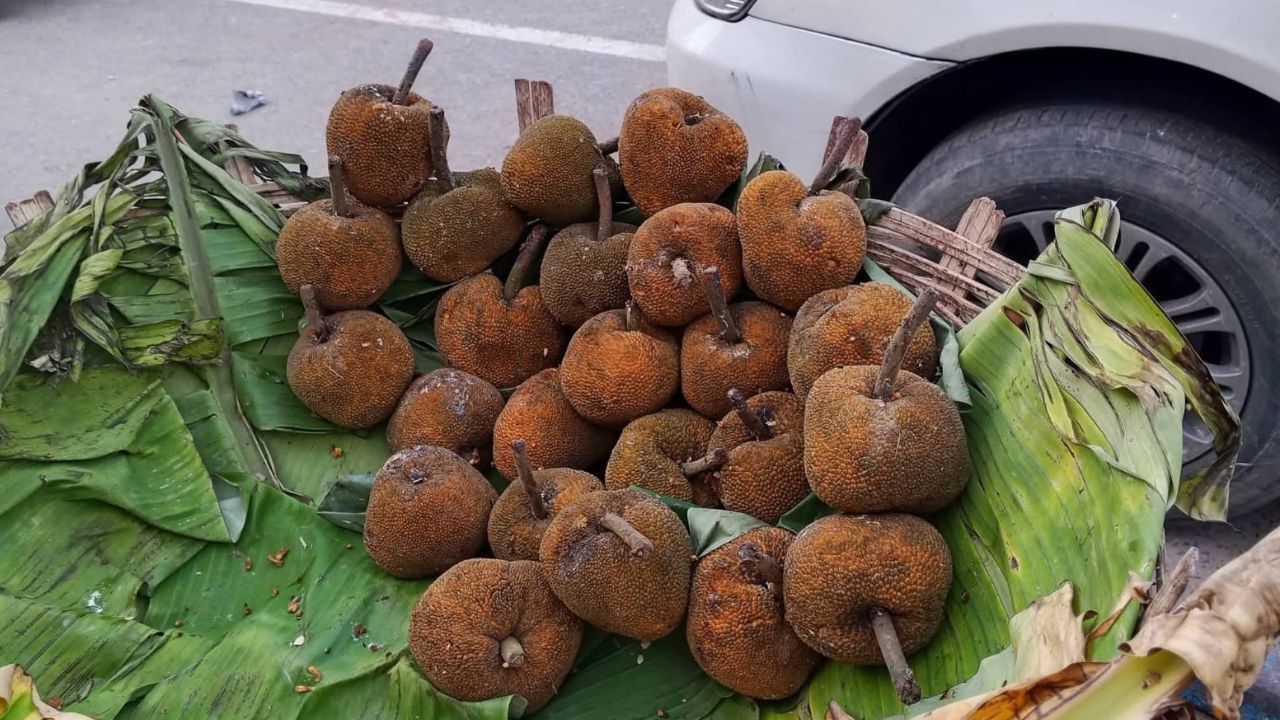
The chambal fruit, once abundant across the Madhupur Gar forest in Tangail, has become increasingly rare, with locals and forestry officials warning that one of the region’s most distinctive native species is edging towards extinction due to decades of illegal exploitation of the forest.
Also known locally as cham kathal, or wild jackfruit, the fruit was once a vital food source for monkeys, langurs, civets and other forest animals, while many forest-dependent communities relied on collecting and selling it for their livelihoods.

Where thousands of chambal trees once stood scattered throughout Madhupur Gar, only a small number now remain, according to residents and officials in the area.

A visit to the forest showed the extent of the decline, with the red hilly soils of Madhupur now largely given over to commercial crops such as pineapple, banana, papaya, turmeric, ginger and lemon.
While some naturally growing fruit trees survive, locals say uncontrolled activity by illegal forest exploiters has driven many indigenous species towards disappearance.
The remaining chambal trees can still be found in limited numbers in the Sadar Beat, Charaljani Beat and Rajabari Beat areas of the forest, where members of the indigenous Garo community know the fruit as cham kathal.
The Forest Department says it resembles the common jackfruit but is somewhat smaller, with a distinctive tangy yet pleasant flavour, and was once found across the forest before becoming increasingly scarce.
During the summer months, small quantities still appear at Madhupur Sadar Bazar and Jalchatra Bazar, where vendors display it alongside other seasonal produce. Those who recognise the fruit buy it readily, while younger customers often ask sellers what it is.
Roni Mia, from Beribaid village, said crowds gather at Madhupur market whenever cham kathal comes into stock. Nurul Islam, who collects the fruit from the surrounding hill forests, said it had once been available in large quantities during the season but had now almost vanished. “It is cheaper than many other fruits and sells for Tk15 to Tk20 each,” he said.
Md Mosharraf Hossain, deputy ranger of the National Park Sadar Beat, said around 3,000 to 4,000 chambal trees remained in the Rajabari Beat area. “Most of the trees are between 100 and 120 feet tall, with trunks measuring up to 8 to 10 feet in circumference.
They bear abundant fruit. Cham kathal is similar to the jackfruit found elsewhere in Bangladesh but has a slightly sour taste. It is very delicious,” he said.
Aziz Mia, a Madhupur resident, said he looked forward to the fruit’s arrival every year, adding: “Cham kathal is very tasty. Today I bought 10 fruits at Tk25 each.”
Local journalist Liton Sarkar recalled seeing many chambal trees across the Madhupur forest during his lifetime. “Monkeys, langurs and many other wild animals depended on this fruit for food. Now the trees are disappearing, creating food shortages for wildlife. As a result, many animals come onto roads in search of food and are killed in accidents,” he said.
Another resident, Arif Hossain, said the trees grow between 80 and 100 feet tall, with the fruit forming close to the branches, making it difficult to harvest without ropes or bamboo. He said chambal trees could still be found around Jalchatra Bazar, Telki, Dokhla, Gayra and along several hilly roads in Madhupur.
Upazila Agriculture Officer Rakib Al Rana said the fruit was now seen far less often than other native varieties, and was confined to certain hilly areas.
“The fruit resembles jackfruit and is very nutritious. It contains a high level of vitamin A, which helps prevent night blindness and supports healthy eyesight and skin. The seeds can also be processed and eaten,” he said.


