Bangladesh’s banking sector stands at a critical inflection point. Mounting default loans, eroding public confidence, governance failures, and operational inefficiencies have created a structural fragility that capital support alone cannot fix. The underlying issue is not merely financial — it is human. The quality of people, leadership behaviour, institutional culture, and talent governance mechanisms ultimately determine how effectively a bank withstands disruption and adapts to change.
Yet human capital remains the most underleveraged lever of transformation in the industry.
Three structural blind spots hold the sector back.
First: Recruitment is still largely driven by hierarchy and influence rather than competency, analytical skill, or performance record. This weakens every downstream function — risk management, credit evaluation, compliance, and customer service.

Second: Leadership pipelines are dangerously thin. Many banks rely on seniority-based promotions instead of evidence-based assessment of capability, agility, and integrity. The result is predictable: inconsistent decisions, operational complacency, and a culture of blame rather than accountability.
Third: HR systems in most banks are administrative, not strategic. Files move, meetings occur, reports are printed — but meaningful data does not drive decisions. To change trajectory, banks must reposition HR from a support function to a governance instrument.
A credible turn-around framework would rest on four pillars:
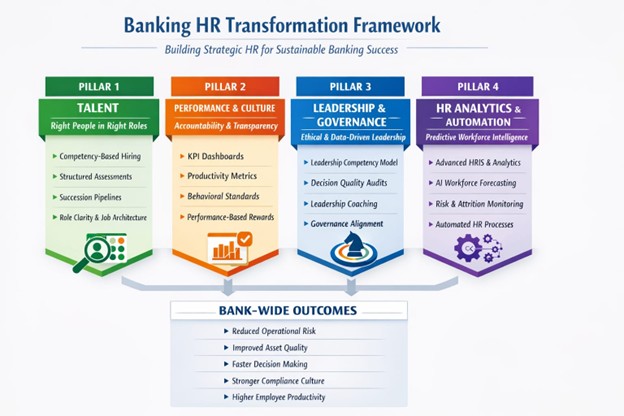




Build Merit-Based Talent Architecture: Banks need competency-driven recruitment and rigorous screening for analytical ability, ethical orientation, and risk judgement. Without the right people entering the system, no amount of training or supervision can compensate.
Create Transparent, Data-Driven Performance Culture: Every employee—from branch operations to corporate banking—should be evaluated using measurable KPIs aligned with risk, compliance, efficiency, and revenue productivity. Subjective appraisals must be replaced with dashboards, audits, and evidence.
Strengthen Leadership Accountability: The sector needs leaders who model integrity, communicate clearly, and make decisions based on data, not power dynamics. Leadership behaviour must be measurable, coachable, and tied directly to organizational outcomes.
Modernize HR through Analytics and Automation: Most banks still operate on fragmented HRIS setups that track leaves and salaries but fail to deliver real insights. A modern system should forecast manpower needs, identify skill gaps, monitor compliance risk, and predict workforce productivity.
When HR becomes analytical rather than clerical, decision-making becomes faster, cleaner, and more defensible. The wider financial system will not stabilize simply by restructuring loans or injecting liquidity. Sustainable recovery requires strong governance, competent leadership, and a workforce aligned with risk discipline and performance outcomes. If banking institutions want true transformation—not cosmetic rebranding—HR must be empowered as a strategic partner, not an administrative department. Turning the sector around is fundamentally a human challenge. Solving it begins with talent, culture, and accountability.
The writer is a HR professional