


The results of 2026 Secondary School Certificate (SSC) and equivalent examinations Chattogram Board have emerged as a significant cause for concern. The pass rate has dropped to 59.48 per cent, marking the lowest in five years.
A total of 28,771 students failed after being unsuccessful in only one subject, while the number of schools with a zero per cent pass rate has jumped to eight. The situation is most alarming in the Humanities department, where the pass rate stands at a mere 38.79 per cent.
Discussions with teachers, students, and board officials suggest multiple factors behind this academic decline – weaknesses in Mathematics and English, a shortage of skilled subject-based teachers, lack of teacher training, and students’ excessive dependency on mobile phones.
The impact of curriculum changes, and a comparatively stricter approach to the evaluation of answer scripts is also responsible for the debacle.
This year, out of 130,682 examinees under the Chattogram Board, 52,756 students failed. This is a sharp contrast to 2022, when the board’s pass rate was 87.53 per cent, indicating a 28.5 percentage point decrease within five years.
Failure in a single subject proves costly
The most worrying aspect of the results is the rate of failure in single subjects. This year, 28,771 students – accounting for 22.09 per cent of the total examinees and 54.53 per cent of all failed students – were unsuccessful in only one subject.
In 2022, this rate was 9.56 per cent, meaning the figure has more than doubled in just a few years. Teachers believe that foundational weaknesses in Mathematics and English are the primary causes.

Ashraf Uddin, a teacher at Hazera Taju School, noted that Humanities students are traditionally somewhat weak in Math and English, a gap that has become more pronounced this year.
He also attributed the decline to excessive mobile phone use and a tendency to spend more time on non-academic activities.
Teacher shortages and grading strictness
According to teacher Mohammad Enamul Haque, many schools lack skilled subject-based teachers, a crisis that is particularly acute in remote areas.
There are also allegations that individuals without proper qualifications or registration have been appointed as teachers in some institutions.




He further argued that while questions were not necessarily too difficult, the stricter evaluation of answer scripts may have impacted the final results.
An anonymous teacher confirmed this, stating that evaluators were more stringent this year compared to previous years and were less lenient when awarding marks.
Student grievances
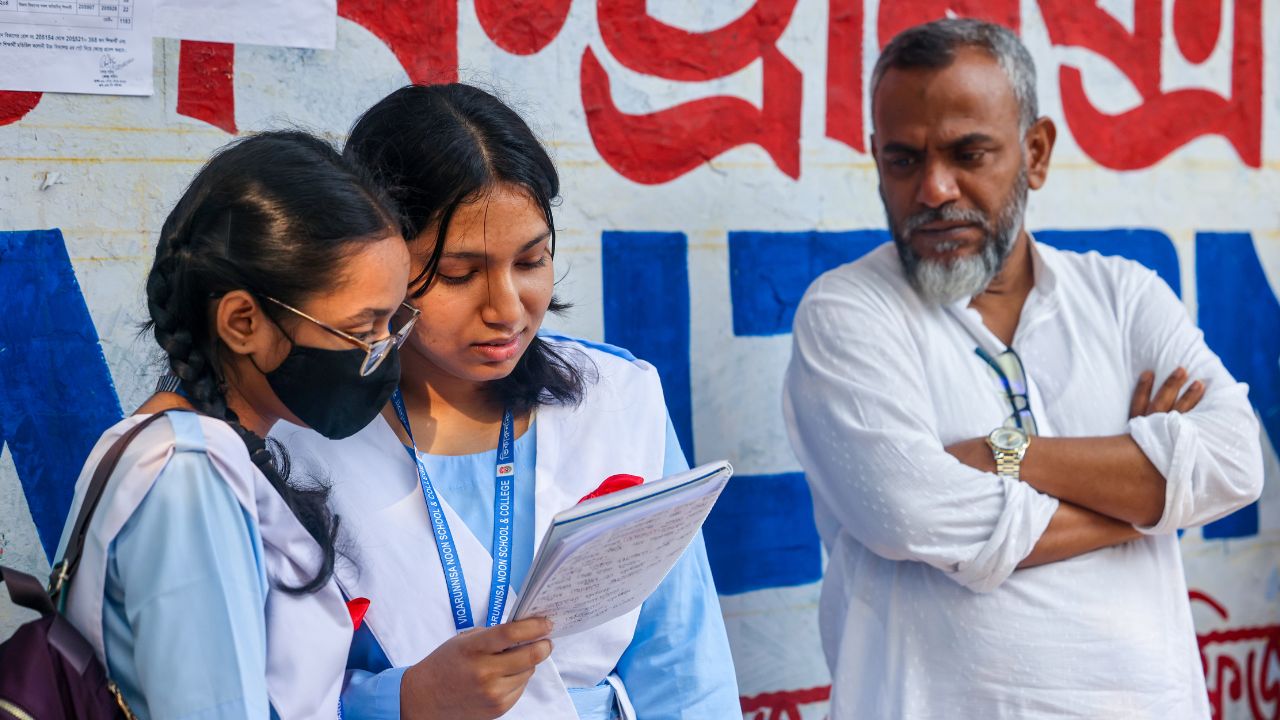
Following the publication of the results, a section of examinees expressed dissatisfaction with the question patterns and evaluation.
One student claimed that parts of the Mathematics paper did not align with their preparation, making it difficult to complete the exam within the allotted time.
Another student lamented that failing a single subject led to failing the entire examination, noting they would have prepared more rigorously had they realised the risks earlier.
Eight schools with zero passes
Eight schools recorded a zero per cent pass rate this year, with a total of 84 examinees from these institutions failing to pass. Only one such school existed last year, and none were recorded between 2022 and 2024.
The schools with zero passes include Jarulchhari Headman Para High School, Bhaibonchara Girls’ High School, Mahalchhari High School, Andharmanik Junior High School, Urirchar Junior High School, Tarabunia High School, Suzak Dajar Bazar Junior School, and Narayanhat Girls’ High School.
Most of these institutions are located in remote hilly regions of Khagrachhari, Dighinala, Langadu, Baghaichhari, and Barkal, as well as isolated char areas of Sandwip and remote parts of Fatikchhari.
Education stakeholders identified retaining skilled teachers, ensuring regular lessons, and maintaining student attendance as major challenges in these areas.
However, since these schools have very few examinees – sometimes only three or five – the failure of all candidates results in a zero per cent pass rate for the entire institution.
What’s the board’s explanation?
Dr Parvez Sajjad Chowdhury, controller of examinations at the Board of Intermediate and Secondary Education, Chattogram, told TIMES of Bangladesh that no single factor can be held responsible for the decline.
He emphasised the need to analyse subject-based weaknesses, teacher shortages, curriculum changes, student preparation, and evaluation methods, adding that the board will review the matter and take appropriate action.
Chowdhury further noted that results from schools with very few students – between three and five – would be reviewed separately to identify specific gaps in teaching, student attendance, or teacher shortages.
Board officials also suggested that curriculum changes and disruptions to studies caused by various social and political programmes prior to the exams might have played a role, though further data-driven analysis is required.
Muhammad Amir Uddin, associate professor at the Institute of Education and Research, University of Chittagong, told TIMES of Bangladesh that these results are a warning of a deep crisis in Chattogram’s education system.
He remarked that the failure of over 28,000 students due to a single subject proves the problem is deep-rooted.
Amir warned that unless subject-based weaknesses are identified and skilled teachers are recruited, trained, and provided to remote schools, the risk of similar academic disasters will persist in the years to come.