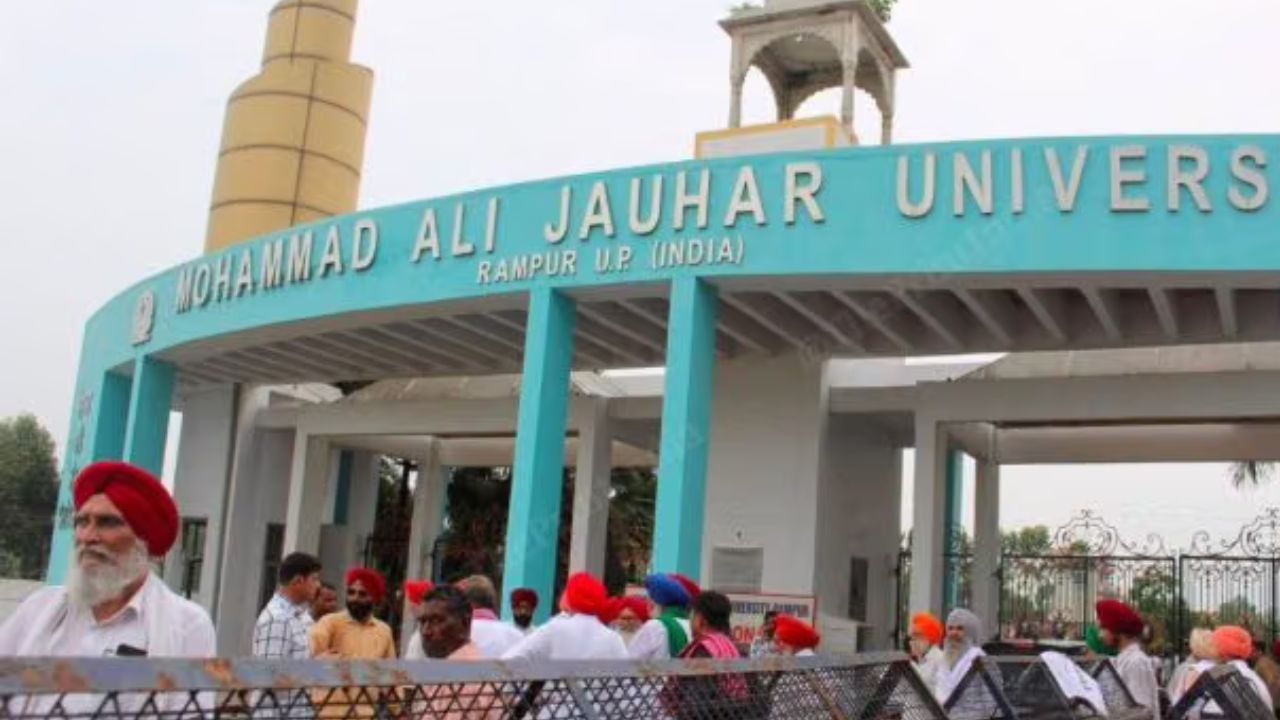



A 250-acre campus built to expand access to higher education in Uttar Pradesh’s Rampur district now faces an uncertain future.
Mohammad Ali Jauhar University, once promoted as a centre for modern learning, has become the focus of a contentious dispute involving allegations of unauthorised construction, claims of “vendetta politics” and growing concerns over the future of thousands of students, reports Al Jazeera.
The beginning of the university
The story of the university dates back to 2003, when Muslim politician Azam Khan established the Mohammad Ali Jauhar Trust. A ten-term legislator and outspoken critic of the Bharatiya Janata Party (BJP), Khan aimed to improve educational opportunities for disadvantaged communities in Rampur, a district with one of Uttar Pradesh’s lowest literacy rates.
The Uttar Pradesh legislature enacted a law in 2006 to establish the university officially.
Over the next several years, the institution developed into a vast campus around 12 kilometres from Rampur Railway Station. It houses a medical college, central library, mosque, hostels and several academic facilities.

Political change and mounting legal cases
The university’s circumstances changed significantly after the BJP, under Chief Minister Yogi Adityanath, assumed power in Uttar Pradesh in 2017.
Soon afterwards, the state government registered nearly 100 cases against Khan, covering allegations from land grabbing to hate speech, with many of the cases linked directly to the university.
Khan remained in prison for more than two years before the Supreme Court granted him bail in 2022. His legal challenges continued. In 2023, a court convicted Khan, his wife Tazeen Fatima, and their son Abdullah Azam Khan for using forged birth certificates. In May 2024, another court sentenced Khan to two years in prison for “provocative remarks” made during the 2019 elections.




Demolition order triggers crisis
The dispute intensified on 15 July when the Rampur Development Authority (RDA) ordered the demolition of 38 out of the university’s 40 buildings.
Ajay Kumar Dwivedi, the district magistrate and RDA vice-chairperson, said only the medical college and one academic block had approved building plans. According to the authority, all remaining structures, including the auditorium and faculty buildings, breached development regulations.
The university’s Vice Chancellor, Zaheeruddin, rejected the authority’s position. He argued that the campus came under the RDA’s jurisdiction only in September 2024, after construction had already been completed. He maintained that “approval was therefore not required at the time of construction and cannot be demanded now”.
Students launch protest
Following the demolition order, students and alumni began an indefinite sit-in protest, outside the university’s main gate. At the same time, students in New Delhi were staging demonstrations demanding the resignation of Education Minister Dharmendra Pradhan over unrelated issues, while protesters in Rampur focused on protecting their university.
Female students, who account for nearly half of the university’s enrolment, voiced particular concern. Iqra, a fifth-year law student, said many parents enrolled their daughters at the institution because they considered it a secure environment for Muslim women.
“If this university is demolished, girls like us will never get another chance to study anywhere else,” she said.
Students also stressed that the university serves a diverse community, noting that more than one-third of its students are Hindu.
Temporary relief, uncertain future
Political attention grew on Saturday when a delegation of Samajwadi Party parliamentarians joined the protest. Critics, including teacher Apoorvanand, described the proposed demolition as part of a “sustained campaign” against minority institutions.
The university secured temporary relief on Monday after the Moradabad Divisional Commissioner granted an interim stay on the demolition order. However, the respite proved brief. Within hours, Uttar Pradesh Police removed the protest site, dispersed the demonstrators and enforced Section 144 restrictions.
By Tuesday morning, police vehicles had replaced the protesters’ tents, leaving the university’s future dependent on the outcome of the ongoing legal proceedings.
Although the interim stay has temporarily halted the demolition, the university’s future remains uncertain as the legal battle continues.
For thousands of students, faculty members and staff, the dispute is no longer just about buildings or regulatory approvals—it has become a test of whether one of Rampur’s most prominent educational institutions can survive the political and legal challenges surrounding it.