During July of 2024, the streets of Bangladesh were filled with student protesters. Another battleground was quietly emerging online. It was not led by any television channel or politician. It was rather led by memes and satirical cartoons.
At that time, memes became a visual tool of resistance in Bangladesh, a country, where direct criticism was followed by danger.
Memes and satirical cartoons evolved into “low-risk tools of resistance” under the pressure of authoritarianism in Bangladesh in 2024. Memes also became one of the reasons why some youths that had very shallow knowledge of politics, became interested in it.
For Bangladeshi Gen Z, these were not just jokes. They were coded messages that allowed them to communicate freely during a time when freedom of expression remained compromised.
A satirical cartoon of the former Prime Minister, illustrated by Apu’s Cartoon during the July Uprising featured an exaggerated representation of Sheikh Hasina with sinister facial features.
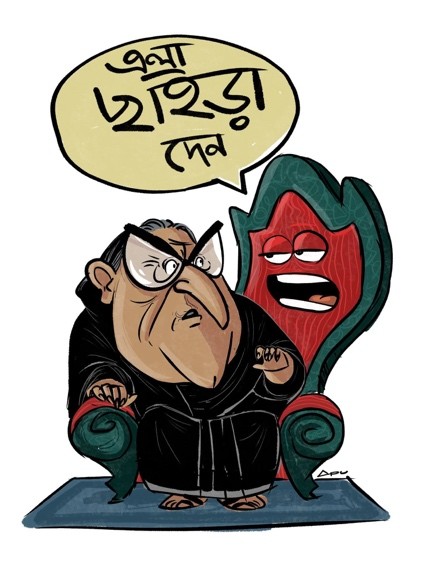
The cartoon depicted her stubbornness and refusal to leave her position despite public disapproval. The chair on which she was sitting symbolised Bangladesh and its people and their helplessness before her authoritarian rule. Her eyes were wide open from the shock of people finally speaking up.
Her open mouth showed panic from sensing that her rule was soon going to end. A pop up saying, “ela chaira den” symbolised public desperation for her to step down. The cartoon showed the former prime minister holding power by force and ruling over the people of Bangladesh despite public dissatisfaction.
Such imagery condensed complex political realities into instantly recognizable symbols. Under surveillance heavy conditions, subtlety mattered at that time. Thus, satirical cartoons allowed criticism without always naming it directly.
Unlike traditional activism, memes and satires spread quickly make little intellectual demand. But beneath the hummock of humor a massive bummock of political depth remains which is not evident at the first glance and contributes to the seemingly harmless nature of them.
Memes and satires are tools that normalised political discussion among youths who otherwise felt intimidated by formal political participation. A meme shared among friends could carry fear, anger, exhaustion and solidarity and other forms of emotions all at once.

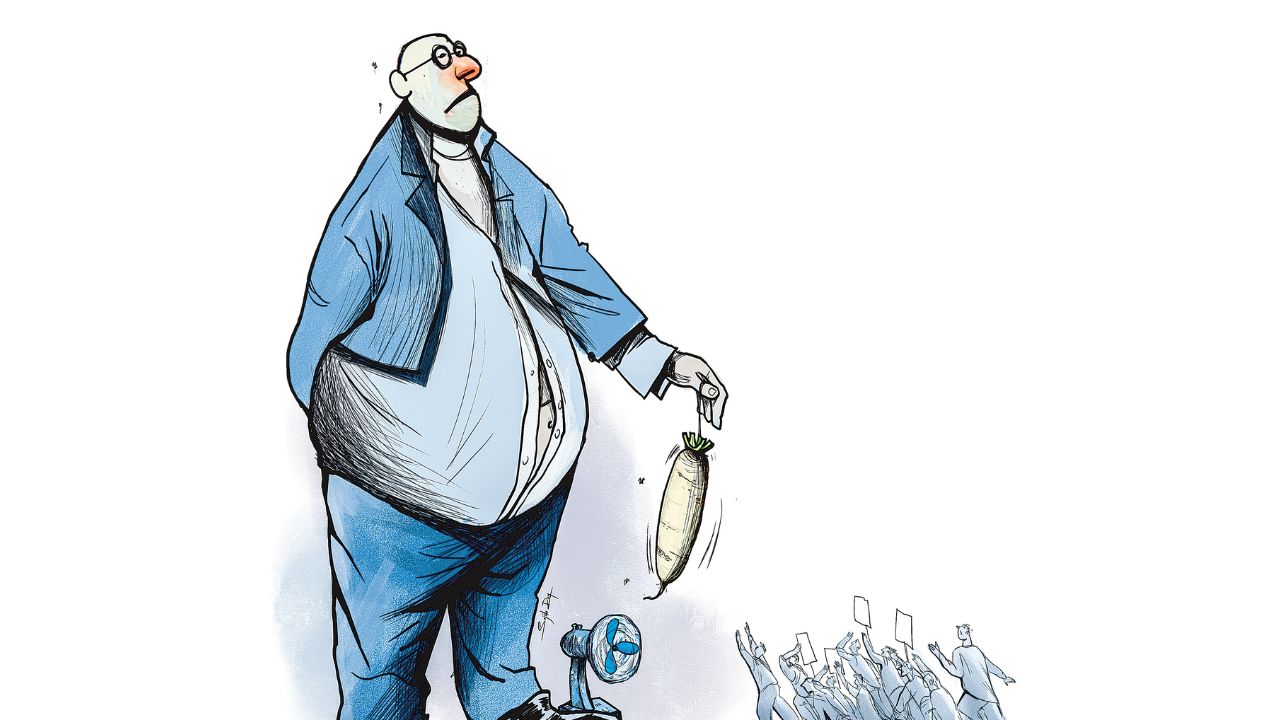
This became especially evident during the July movement of 2024, when anti-government protests intensified following crackdowns on student demonstrations. Young Internet users increasingly turned to humor to process their fear and frustration.
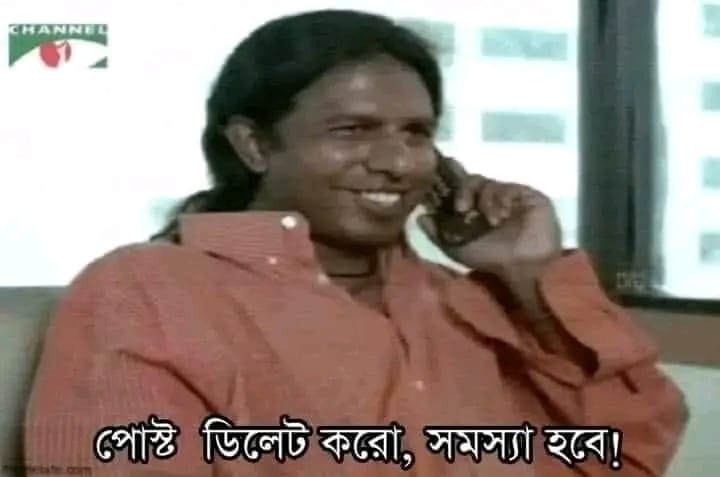
A meme captured the essence of growing anxiety among people accurately. It featured the comedic character Marjuk from the telefilm Choruivati. He was delivering a warning about political posting online. It reads, “Post delete koro, shomossha hobe!” His smiling expression contrasted sharply with the underlying threat. The joke landed because everyone understood it.
When July movement was ongoing, a phenomenon called “internalized surveillance,” the normalisation of self-censorship under political pressure was also evident. Yet memes and satirical cartoons were able to disrupt that silence. They transformed fear into shared political expression.
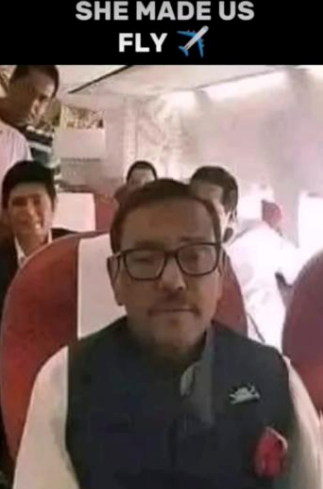
This meme criticised the politics of the former prime minister. It aimed to generate a negative image of her and her political party. The humour and political criticism present in this meme created a strong urge in people to share it with others.
This massive spread had the potential to create political consciousness among people and served as a means of political expression. Such virality facilitated higher engagement within ideologically homogenous groups which reinforced a reduced exposure to opposing viewpoints.
According to a 2025 study titled “The Role of Memes in Shaping Political Discourse on Social Media,” memes are not just vehicles of entertainment. Rather, they are potent vehicles for political ideologies. They are capable of simplifying complex issues, challenging authority and works as catalyse political movements.
The role of meme and satires were not merely confined to entertainment or relieving anxiety. They also created communities. sharing satirical contents fostered a sense of collective identity among Bangladeshi youths who were frustrated by the weight of political repression. In digitally mediated environments, reposting a meme became a subtle declaration of alignment, a way of saying, “I see what is happening and I am in this protest too”.
This mirrors trends that are observed globally. During Turkey’s Gezi Park protests in 2013, Hong Kong’s democracy demonstrations and even during the Arab Spring, internet humor frequently emerged alongside political unrest. The Bangladeshi protest against the political repression of 2024 joined the rally of that growing archive of digital resistance movements.
However, the urge to romanticise meme culture entirely should be avoided. Memetic politics possess certain limitations. Because memes often circulate within ideologically similar online circles, they can reinforce echo chambers instead of encouraging the creation scopes of broader dialogues. The same tools used to challenge authority can also spread misinformation, hostility or exclusion.
In other words, memes and satires democratise political expression. But it not always ensures democratic conversation. Still, in the current media landscape of Bangladesh, their importance cannot be invalidated. Traditional journalism faces growing constraints and formal political debate which often struggles under polarization and legal pressure. In that vacuum, memes have become an alternative public sphere fragmented, chaotic, humorous, but deeply influential.
Gen Z no longer views politics solely through speeches, rallies or newspaper columns. Political signifiers and their meanings are produced through visual culture such as, reaction images, satirical edits, ironic captions, and viral jokes that travel faster than official narratives can contain them.
For younger Bangladeshis, politics now unfolds in timelines, comment sections and pages. Authority is challenged not only through protest marches but also through ridicule and authoritarianism, perhaps more than anything else, fears ridicule.
Though government can censor newspapers, detain activists or shut down broadcasts, internet humour behaves differently. It slips through algorithms, reappears in screenshots, private chats, etc. A humorous post removed from one platform often resurfaces in another within minutes. Thus, they live on.
Chaita Tridib Orchi and Maliha Islam are undergraduate students currently studying in the Department of Mass Communication and Journalism at Bangladesh University of Professionals.