


For Rangpur resident Zikrul Haque, a weather forecast turned into a costly uncertainty.
He had come to Dhaka to spend a few days at his daughter’s home. His return ticket was booked, his bags were packed and he was ready to leave. But heavy rain began early on the day of his journey.
Checking the Bangladesh Meteorological Department’s (BMD) forecast on his mobile phone, Zikrul decided to stay back. The forecast warned of rain for the next several days, so he postponed his trip.
Five days later, he bought another ticket. But the night before his departure, he checked the forecast again. It showed another five days of rain ahead.
Once again, he cancelled his journey.
“If there is another five-day rain forecast after five days, why did I buy the ticket in the first place?” he asked.
Zikrul’s frustration reflects a wider public concern over the reliability of weather forecasts in Bangladesh, where people often find a gap between what the forecast predicts and what eventually happens.
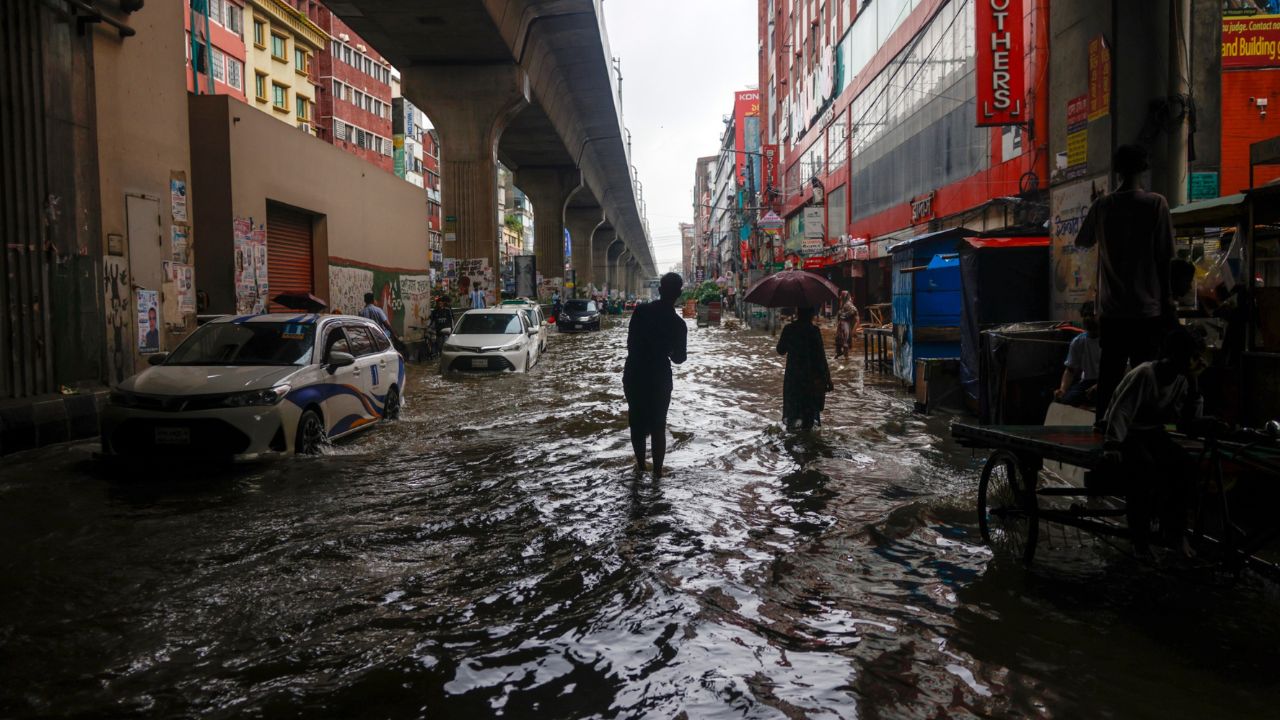
On 5 July, when the BMD warned of a depression forming in the Bay of Bengal, it forecast five days of rain. But rainfall continued for seven consecutive days, and the department later issued another forecast for five more days of rain.

Such mismatches have fuelled public criticism for years. There have been occasions when forecasts suggested no chance of rain during extreme heat, only for heavy showers to arrive the same day. In other cases, predicted rainfall failed to appear even after a week.
While forecasting errors exist worldwide, many countries have improved their systems through advanced technology and better data analysis.
Experts say Bangladesh still faces challenges in improving forecast accuracy.
Meteorologist Muhammad Abul Kalam Mallik of the BMD said forecasts should not be viewed as fixed predictions.
“Generally, a three-day forecast is considered the most accurate anywhere in the world. In Bangladesh, forecasts are issued for five to 10 days. However, these are not fixed. They are updated every three hours based on new information, including forecasts at upazila and district levels,” he told TIMES of Bangladesh.




A forecast issued today, he explained, may change tomorrow as new weather data becomes available.
“Weather is a continuous process. Forecasts are updated as soon as new information is received. Therefore, changes in forecasts are not unusual,” he said.
Mohammad Rabiul Awal, assistant professor and chairman of the Department of Meteorology at the University of Dhaka, said no country can produce a 100% accurate weather forecast.
“Generally, forecasts for the first four to five days are comparatively more accurate,” he said.
He said Bangladesh’s forecasts still lag behind this global benchmark by around one to two days.
According to Rabiul, atmospheric complexity, the “butterfly effect”, limitations in computing capacity and uncertainties in mathematical models all contribute to forecast errors.
He also pointed out that even when heavy rainfall is predicted, uncertainty may remain over issues such as river water levels and the speed at which floodwaters recede.
Radar failure adds to concerns
The debate over forecast accuracy intensified after reports emerged that all the five weather radars covering the Dhaka region had stopped working.
Media reports said four other radars in Rangpur, Moulvibazar, Cox’s Bazar and Khepupara in Patuakhali were also inactive.
An official involved with the Gazipur radar station, speaking on condition of anonymity, said the radar’s transformer was damaged by lightning on the night of 4 July.
Although power supply was restored through a rented transformer, the station later faced problems with its V-SAT communication system.
Radar data is transmitted to Dhaka through satellite communication. The lightning strike disrupted that communication link, preventing the smooth transfer of information.
A specialist team from Gazipur has been working to replace damaged equipment and restore the system, but continuous heavy rain has slowed the repair process.
Heavy rainfall also affects C-band satellite communication, making the task more difficult.
However, the official said the radar failure was not responsible for changes in long-range weather forecasts.
The Storm Warning Centre in Dhaka prepares forecasts, while radars mainly provide real-time observations.
“Radar does not provide forecasts for several days. It observes current atmospheric conditions and helps improve short-term forecasts, especially for the next six hours,” Mallik said.
A weather radar can cover an area of around 400 kilometres, he added. Even without radar information, forecasts can still be prepared using mathematical models, but radar improves accuracy.
He compared the role of radar in forecasting to medical testing.
“A doctor can make an initial assessment by looking at a patient’s symptoms. But blood tests or X-rays provide greater certainty. In weather forecasting, mathematical models are the initial assessment, while radar works like an additional test that makes the forecast more accurate,” Mallik said.
Experts say improving forecasting is not only about predicting rain more accurately. The bigger challenge is ensuring that reliable information reaches people quickly enough for them to prepare.