

Bangladesh’s cat food market has expanded rapidly in recent years, driven by growing pet ownership.
TIMES of Bangladesh analysed National Board of Revenue (NBR) import records, customs assessment data, foreign manufacturers’ price lists and domestic retail prices and found significant gaps between declared import values, customs-assessed values and manufacturers’ published prices for similar products.
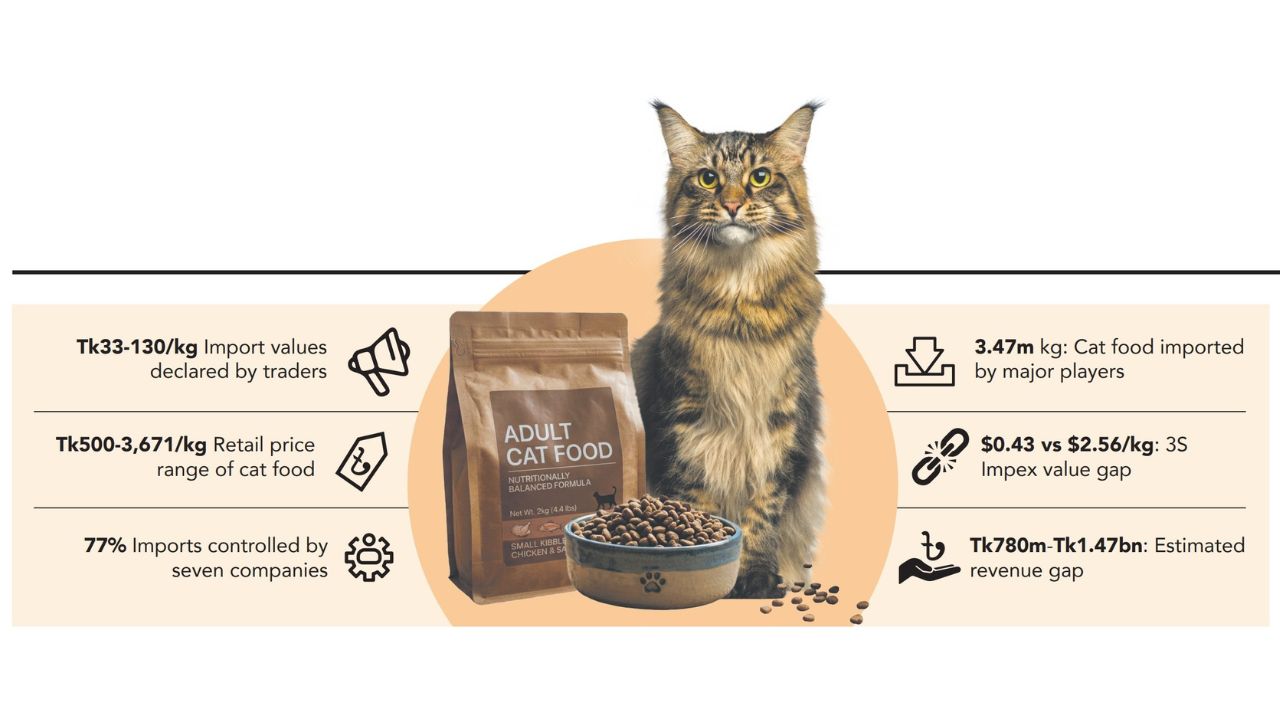
Imported cat food currently retails for Tk500 to Tk3,671 per kg, depending on the brand. Chinese brands sell for Tk500-1,133 per kg, Turkish brands for Tk567-900, Thai brands for Tk617-800, and premium European and American brands for Tk1,350-3,671 per kg.
However, NBR records show that importers declared values of Tk33-130 per kg, while customs generally assessed the products at Tk130-160 per kg. Importers attribute the gap to duties, logistics costs and supply chain expenses, but comparisons with customs assessments, manufacturers’ quotations and retail prices show wide disparities.
Under the 2025-26 Operative Tariff, cat food imported under HS Code 23091000 was subject to a combined duty and tax incidence of around 61.8 per cent.
NBR data show that importers declared an average value of Tk79 per kg for cat food in FY2025-26. Customs, however, assessed the products at Tk130 per kg and collected around Tk62 per kg in duties and taxes, putting the import value and tax burden together at about Tk141 per kg. Despite this, the same products are sold in the domestic market for Tk600 to Tk3,600 per kg.

Retailers told TIMES of Bangladesh that importers largely determine wholesale prices, leaving retailers with margins of Tk50-100 per pack. 24 Pet Zone said imported brands still dominate the market despite growing sales of locally produced cat food, while Basir of Abrar Bird House said retailers source products from major importers including Birds Palace, 3S Impex and Smart Trade Bangladesh.
Seven companies accounted for nearly 77 per cent of Bangladesh’s cat food imports in FY2025-26. Together, they imported 3.47 million kg of cat food and declared a total customs value of Tk208.57 million, equivalent to an average declared value of Tk60 per kg.
The companies analysed were Birds Palace, Oireed Trade International, M/S 3S Impex Bangladesh, TM Imports, Smart Trade Bangladesh, TRK Global Enterprise and Berlin International. They import brands including Wanpy, SmartHeart, Kaniva, Nature Bridge, Kitchen Flavor, Whiskas, Royal Canin, Felicia and Versele-Laga.
Manufacturers’ prices tell a different story
TIMES of Bangladesh contacted cat food manufacturers in China and Türkiye for CIF quotations of comparable products. None offered prices close to the values declared by Bangladeshi importers. The lowest quotation exceeded $2.40 per kg (around Tk300), while premium products were priced significantly higher.




Price lists from manufacturers in Belgium, Türkiye, Spain and China show EXW reference prices generally starting from $1.88 or the euro equivalent per kg. Çağatay quoted ProScience Super Premium Cat Food at $1.88-2.33 per kg, Avantis in Spain priced its Pure series at €2.44-3.89 per kg, China’s EASA Pet Food quoted Freeze-Dried Stuffed Cat Food at around $2.00 per kg, while Belgium’s Versele-Laga listed Opti Life at €3.86-6.18 per kg and Lara at €1.80-2.00 per kg.
3S Impex and Birds Palace cases
Customs records show that 3S Impex Bangladesh declared an import value of $0.43 per kg for a 46,206 kg shipment of dog and cat food imported from Turkish manufacturer Çağatay on 7 April 2026. Customs rejected the declaration and assessed the shipment at $1.00 per kg.
A Proforma Invoice from the same manufacturer obtained by TIMES quoted the CIF Chattogram price of ProScience cat food at around $2.56 per kg, or $2.21 per kg on an EXW basis. Although the documents relate to different transactions, they show a gap between the declared value, customs assessment and manufacturer quotation.
A similar pattern was found in Birds Palace imports. Versele-Laga’s 2026 price list shows Opti Life priced at €3.86-6.18 per kg and Lara at €1.80-2.00 per kg. However, Chattogram Customs records show Birds Palace declared values of €0.30-0.31 per kg for the same brand. Customs assessed the products at €0.83-0.86 per kg, still below the manufacturer’s published prices.
Birds Palace, the country’s largest cat food importer, imported more than 1,150 tonnes of cat food in FY2025-26 and declared an average import value of Tk33 per kg. Smart Trade Bangladesh, the sole importer of SmartHeart, declared an average value of Tk56 per kg, while customs assessed the products at Tk130 per kg.
Popular brands including Wanpy, SmartHeart, Jungle and Felicia sell for Tk600-900 per kg, and in many cases considerably higher, despite much lower declared import values.
Questions remain over pricing gap
The analysis of import records, customs assessments, manufacturers’ price lists and retail prices points to two possible explanations. Imported cat food may be entering Bangladesh at unusually low prices, raising questions over product specifications and quality, or declared values may not fully reflect actual transaction prices, creating risks of revenue leakage and possible trade-based money laundering.
If the actual import price was around Tk250 per kg but products were declared or assessed at significantly lower values, the potential revenue gap in FY2025-26 could range from Tk780 million to Tk1.47 billion, based on assumptions used in the analysis.
What customs says
Deputy commissioner of Chattogram Customs Md Rezaul Karim told TIMES that customs had also noticed unusually low declarations by some importers.
He said customs must first consider declared transaction values but may rely on database values for similar imports when necessary. The Risk Management Committee has proposed setting a minimum assessment value of $3 per kg for cat food.
“If credible evidence, including manufacturers’ invoices, shows a significant mismatch with declared values, customs can take legal action and, where appropriate, refer the matter for investigation under money laundering laws,” Karim said.
He said a 10 per cent supplementary duty was introduced following customs’ recommendation, adding that higher duties were also intended to encourage domestic production.
Four local brands — Oskies, Chonk, Envoy and Cat Cafe—are now producing pet food, although only Oskies and Chonk are licensed.
The analysis found significant gaps between declared import values, customs assessments, manufacturers’ reference prices and retail prices, requiring further scrutiny of actual transaction values.