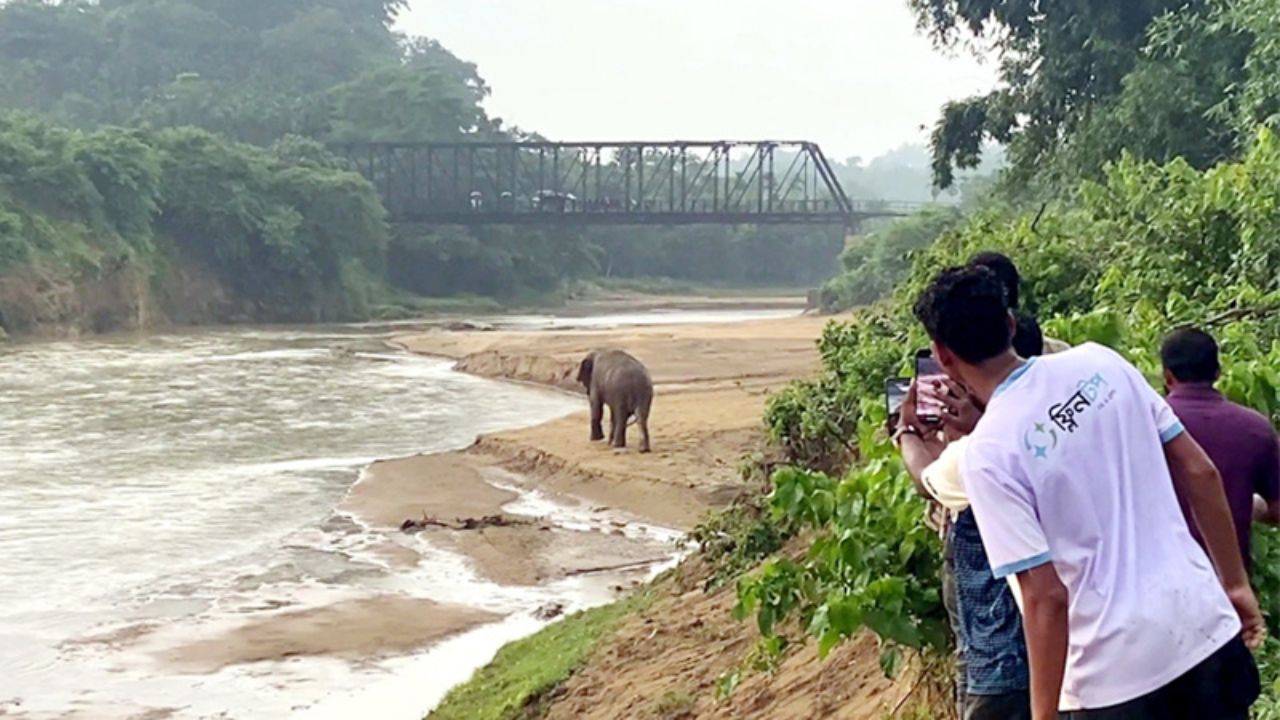

In the bordering hilly areas of Sherpur, wild elephant herds searching for food are facing a new threat as content creators and onlookers harass them in hopes of producing “viral” social media content.
This growing trend of provocation is making the animals increasingly aggressive, heightening the risk of fatalities and intensifying the long-standing human-elephant conflict.
In addition to the harassment, the use of electrified wires to protect crops remains a grave concern, leading to the deaths of several elephants.
Official records indicate that since 2014, 33 wild elephants have died in the bordering areas of Sherpur, while 34 people have lost their lives in conflicts with the animals during the same period.

Local residents in the Sreebardi, Jhenaigati, and Nalitabari upazilas report that elephant herds frequently move between hills in search of food. Recently, groups of individuals have been seen following the herds to throw stones, burst firecrackers, and use various methods to scare the animals solely to record videos for social media.
“Some youths stay behind the elephants just to make videos. They get close, set off firecrackers, scream, and throw stones,” Ali Hossain, a resident of Balijuri in Sreebardi, told TIMES of Bangladesh.
He noted that such actions cause the elephants to become frightened and enraged. Rahmat Ali, a resident of Kharamora, added that elephants are naturally peaceful and typically do not cause harm unless they are repeatedly disturbed.



The conflict is further exacerbated by the expansion of agricultural land into forest territories. Abdul Sobhan of the Chhoto Gojni area in Jhenaigati pointed out that many farmers install live electric wires to protect their crops, which proves fatal for the elephants.
He emphasised that protecting elephant corridors and increasing public awareness are essential for forest conservation.
Mugniur Rahman Moni, executive director of the environmental organisation Shine, told TIMES that elephants only exhibit aggressive behaviour when their natural movement is obstructed or when they are harassed.
He called for stricter monitoring and increased public awareness to end such provocations.
Md Sumon Mia, range officer of the Balijuri Range under the Mymensingh Forest Division, stated that the department is actively working to mitigate the conflict.
According to the officer, the Forest Department conducts regular awareness programmes, including public service announcements via loudspeaker, distributing leaflets, holding courtyard meetings, and deploying Elephant Response Teams (ERT).
He also mentioned that they advise locals on using safe, eco-friendly methods to drive away elephants.
Sherpur Deputy Commissioner (DC) Farida Yasmin emphasised the need for a coordinated effort between the administration, the Forest Department, local representatives, and the public to ensure peaceful coexistence.
She further noted that government compensation is available for those affected by elephant attacks, including financial assistance for injuries and damage to crops or homes.