Home Minister Salahuddin Ahmed on Thursday stated that the government is pursuing the legal return of deposed prime minister Sheikh Hasina, currently in India, so she may face the numerous cases filed against her.
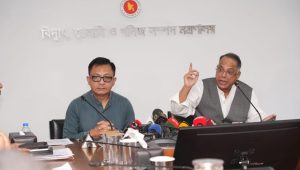
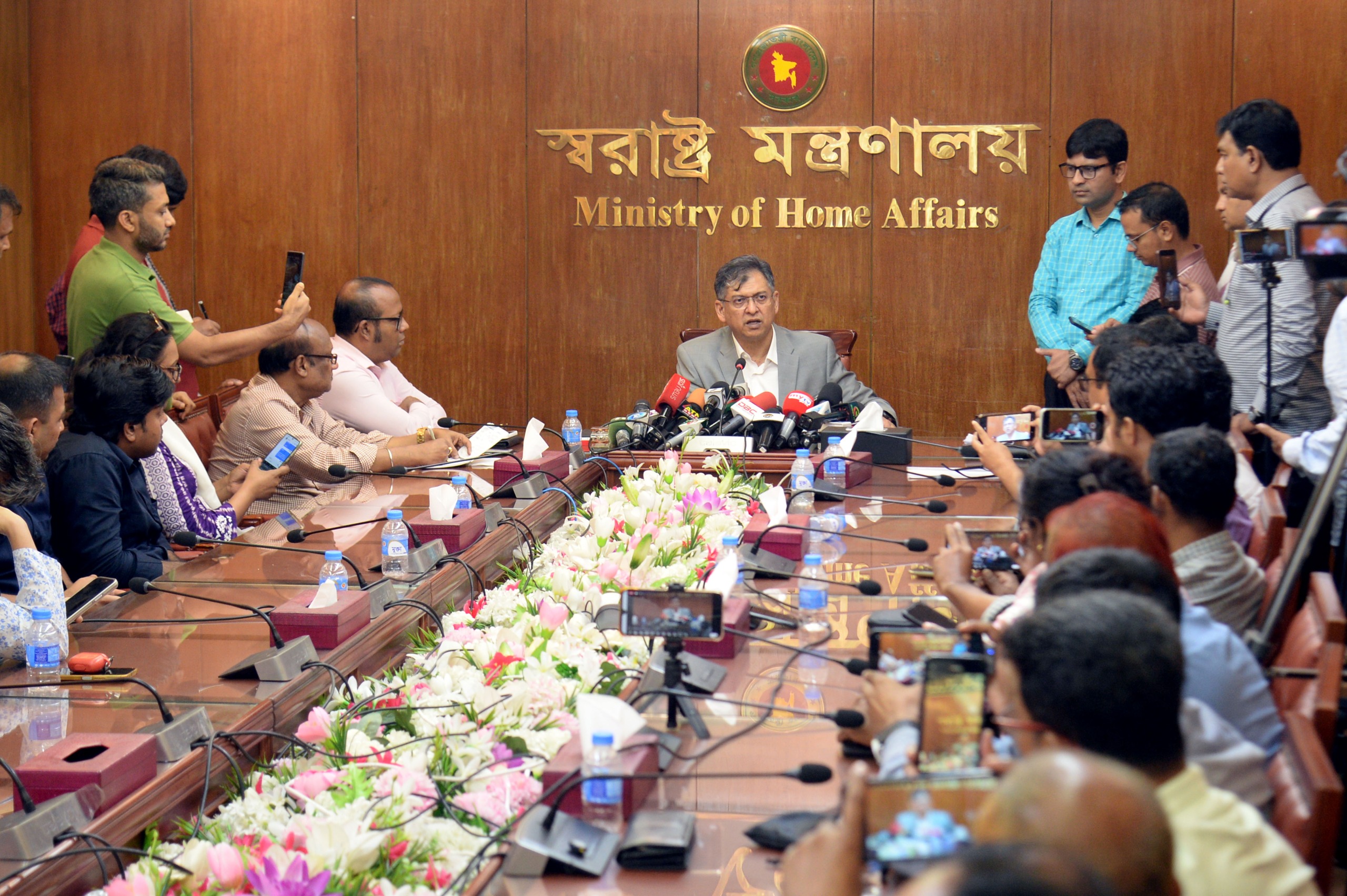
Speaking at a press briefing at the Home Ministry’s conference room in the Secretariat, Salahuddin addressed rumours regarding her return and the organisation of rallies.
“We also want her back, and that is through legal means,” the minister said. He confirmed that a formal request has been submitted through the Ministry of Foreign Affairs, urging that existing extradition agreements be followed.
Regarding the media broadcasting statements from the ousted prime minister, Salahuddin clarified that he is unaware of any current restrictions.
He noted that unless a specific court injunction exists against an individual, the media may broadcast their statements; however, if such an order is in place, those statements should not be widely promoted by the media.

Professionalism in criminal investigations
Salahuddin highlighted that since the current government took office, law enforcement has acted with “maximum professionalism”, taking immediate action in every heinous crime.
He cited the Ramisa rape and murder case in Mirpur as a recent example, where the primary accused, Sohel, and his wife were arrested within 24 hours.




The lead suspect has already provided a confessional statement under Section 164 of the Code of Criminal Procedure, and a charge sheet is expected in the shortest possible time.
Progress has also been made in long-pending investigations that were recently revitalised, such as the Tonu murder case at Victoria College, Comilla. One suspect has already been arrested and is undergoing DNA matching, while a second suspect has been identified.
Other successful operations mentioned included arrests related to a gang rape in Comilla, a young woman’s rape in Bogra, the five murders in Kapasia, and an expatriate’s murder in Manda, Dhaka.
Operational strategy and judicial reform
The Home Minister outlined a dual-track strategy: “pro-active” measures focusing on drugs, extortion, and terrorism to prevent crime, and “re-active” measures for the swift arrest and investigation of serious offences like murder and rape.
As part of efforts to maintain order, the Dhaka Metropolitan Police (DMP) has been conducting “thorough searches” and block raids in Mohammadpur, Sherebangla Nagar, and Adabor since the first week of May.
Operations in Jatrabari and Tejgaon on 18 and 19 May resulted in the arrest of 41 and 63 individuals respectively, including muggers and those with outstanding warrants.
On the subject of law reform, Salahuddin cautioned against creating new laws or special courts based on “temporary anger” or emotional responses.
He argued that instead of establishing new tribunals, it is more “financially and administratively logical” to increase the capacity and number of existing Women and Children Repression Prevention Tribunals (Nari O Shishu Nirjatan Daman Adalat) to ensure swift justice without the risk of abusing harsh laws.
Border security and regional issues
In response to queries about the implementation of the Citizenship Amendment Act (CAA) in West Bengal, India, Salahuddin described the CAA and the National Register of Citizens (NRC) as “entirely internal matters of India.”
However, he stressed that the Border Guard Bangladesh (BGB) remains on maximum alert to prevent any “illegal push-in” attempts across the border. Additionally, RAB-15 has successfully arrested long-term fugitives in the Chittagong and Ukhia-Teknaf regions.