


As the 13th national election in Bangladesh approaches, a disturbing trend has surfaced on social media involving the use of short, decontextualized video clips of political leaders to spread religious misinformation.
An analysis by Dismislab focusing on five specific videos of prominent political figures reveals that their words were edited to incite religious controversy. These clips, often lasting only a few seconds, have achieved massive reach; one video alone was viewed over 1.2 million times.
While the footage used in these campaigns is technically genuine – meaning no AI or deepfake technology was employed – the removal of original context fundamentally distorts the speakers’ intended meanings.
This tactic, identified by experts as “weaponising decontextualization,” portrays leaders as anti-religious, leading to aggressive online labeling where they are branded as “atheists,” “infidels,” or “religion exploiters.”
Because religious sentiment is a powerful force within the Bangladeshi electorate, accusing an opponent of religious insults is a highly effective way to trigger widespread hostility and debate.
Case study 1: SA Jinnah Kabir
A 28-second video of SA Jinnah Kabir, a BNP-nominated candidate for Manikganj-1, recently went viral after being shared by the verified Facebook page of the Bangladesh Awami League and other media-themed pages.
The clip alleged that Kabir threatened Hindus and Awami League supporters, claiming they would be unable to live in Bangladesh if they did not vote for the “Sheaf of Paddy.” This prompted a swift and hostile public reaction, with many calling for his arrest.
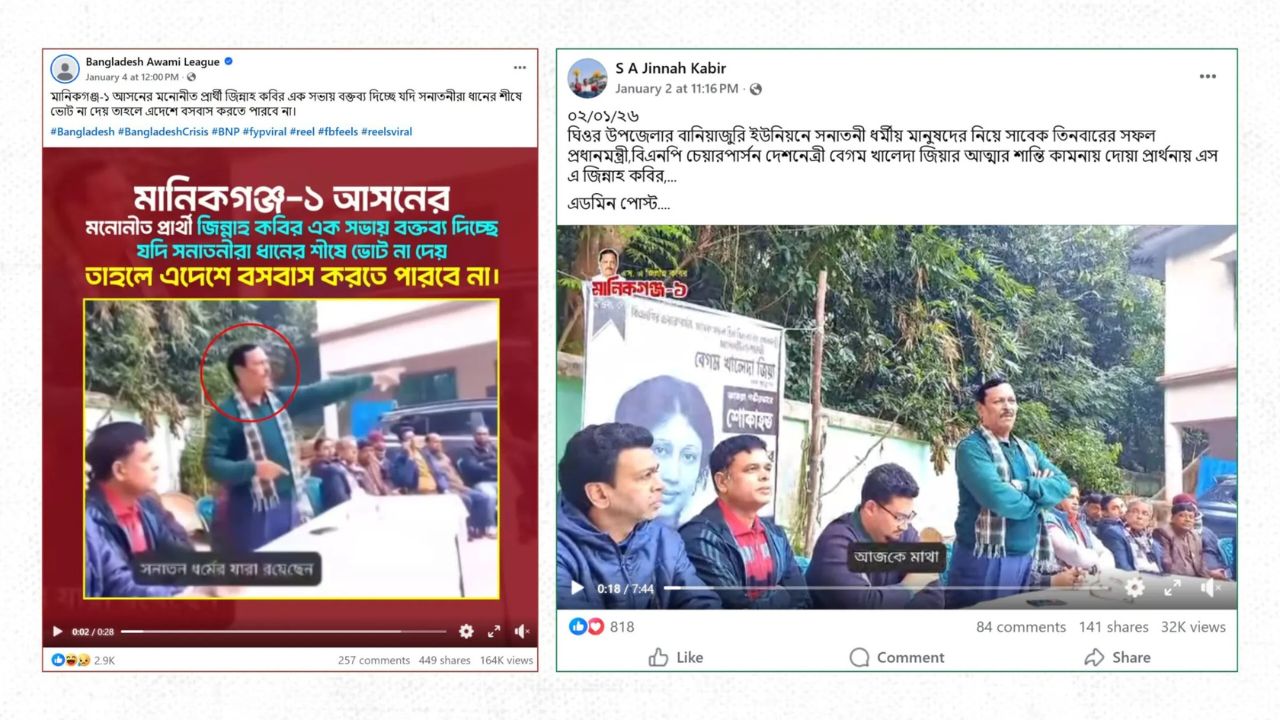
However, verification of the full eight-minute speech – delivered on January 2 to the Hindu community in Baniajuri Union – reveals a vastly different narrative. Kabir was actually engaged in a historical critique of Jamaat-e-Islami and its actions during the 1971 Liberation War.

He reminded his audience that Jamaat had opposed independence and was responsible for handing over Hindus to Pakistani military camps.
His “threat” was actually a warning that if a party like Jamaat regained power, the nation’s independence and the safety of its citizens would be at risk. Kabir has since filed a legal case, asserting the propaganda was a planned attempt to alienate minority voters from his campaign.
Case study 2: Raushan Ara Shirin
A 9-second clip of Raushan Ara Shirin, wife of BNP leader Harunur Rashid Harun, was circulated to support claims that she made “atheistic” remarks. In the video, she is heard stating, “We will never value religion; we will value people.”
This led to over 10,000 engagements, with social media users attacking her as a “vondho” (hypocrite) and “nastik” (atheist).
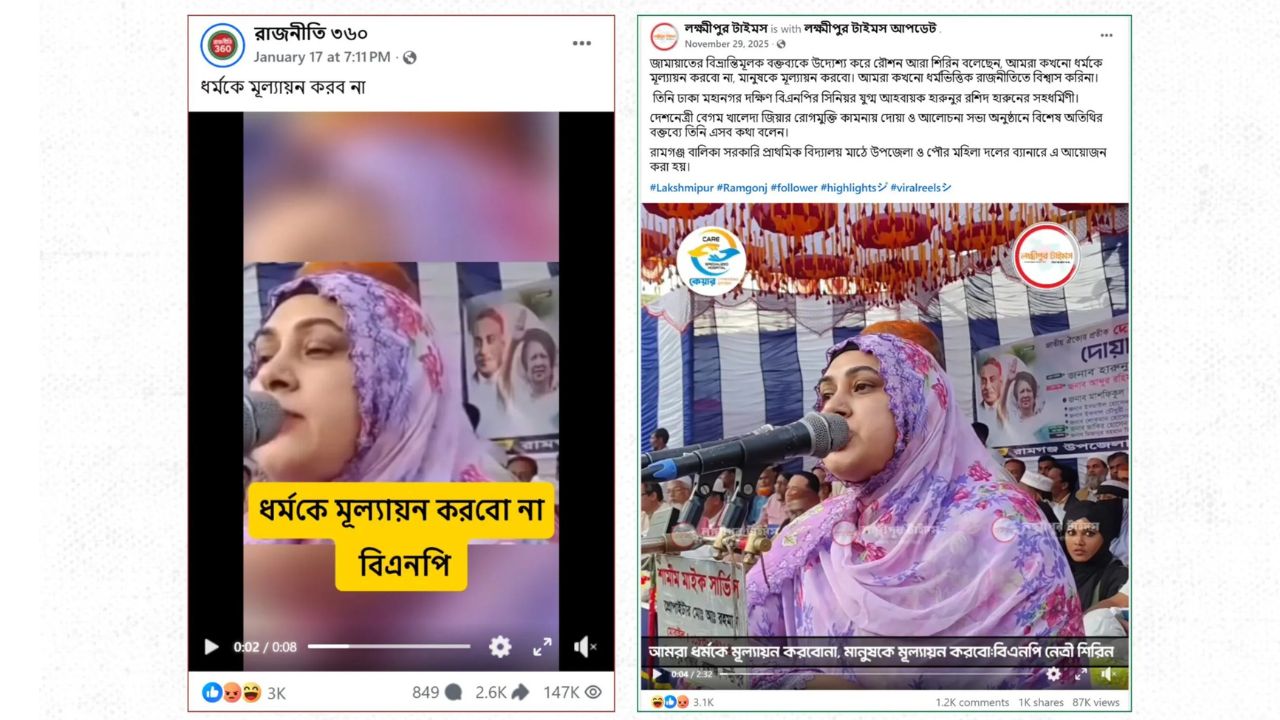
The full investigation shows the speech was delivered on November 29 at a Mahila Dal rally in Ramganj. In the complete two-and-a-half-minute video, Shirin was actually explaining the BNP’s stance against religious division.



She emphasised that a BNP government would ensure the security of all citizens regardless of their religious identity.
Shirin’s comment about “valuing people” was specifically a criticism of how Jamaat-e-Islami uses religion as a political weapon. She intended to advocate for humanistic values and equal treatment rather than a society without religion.
Case study 3: Syeda Asifa Ashrafi Papia
Former MP and BNP leader Syeda Asifa Ashrafi Papia was targeted with a 12-second clip from a rally in Chapainawabganj. The video appeared to show her claiming “Islam is very harmful to religion,” comparing the faith to the damage tobacco does to the body.
This led to widespread accusations of hate speech.
The full three-minute footage archived by Independent TV clarifies that Papia was using the tobacco analogy to describe Jamaat-e-Islami, not Islam itself.
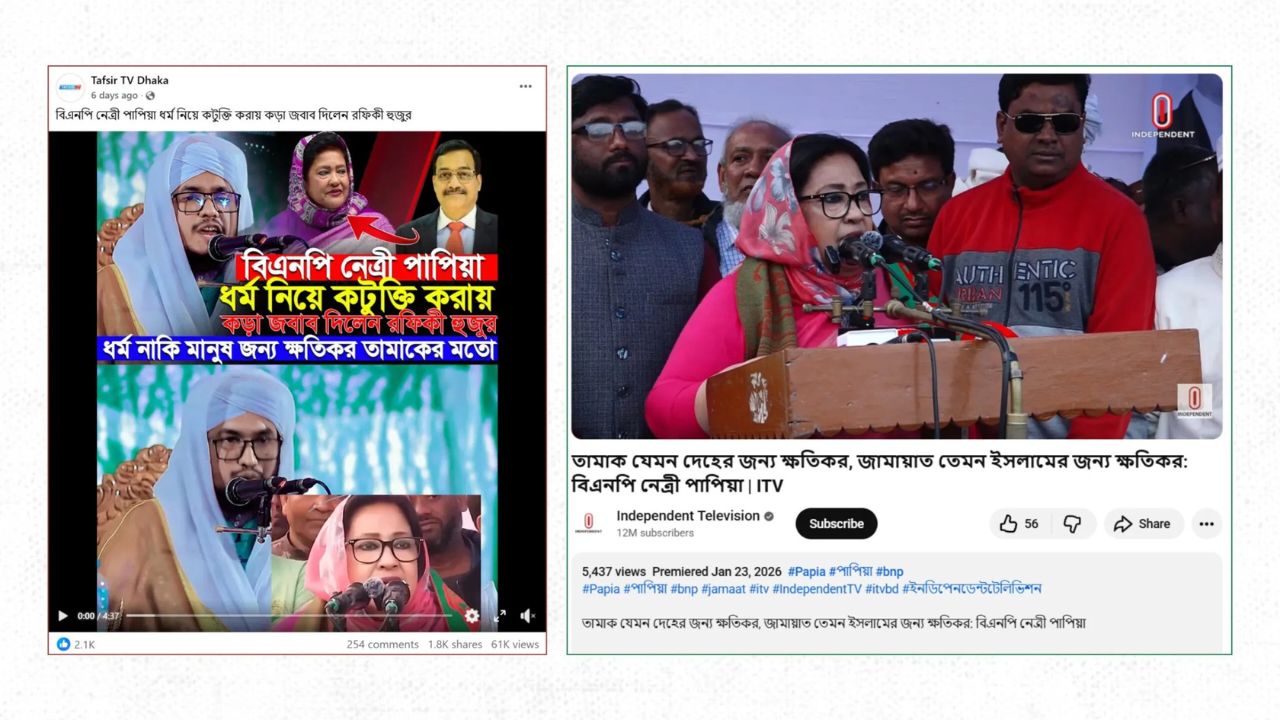
She stated that Jamaat is as harmful to Islam as tobacco is to the human body, comparing the political group to termites attacking wood.
Papia also defended her party’s religious credentials, noting that BNP founder Ziaur Rahman included “Bismillahir Rahmanir Rahim” in the constitution.
She argued that it is political groups spreading confusion in the name of religion that truly harm the faith, while noting that religious thinkers lived in peace under BNP rule.
Case study 4: Habib-un-Nabi Khan Sohel
A 10-second clip of BNP Joint Secretary General Habib-un-Nabi Khan Sohel was viewed approximately 800,000 times. The video allegedly suggested that Muslims could pray at Dhakeshwari Temple while Hindu priests performed puja at Baitul Mukarram.
The original three-minute speech, recorded at the grave of Ziaur Rahman, shows that Sohel was actually mocking his political opponents.
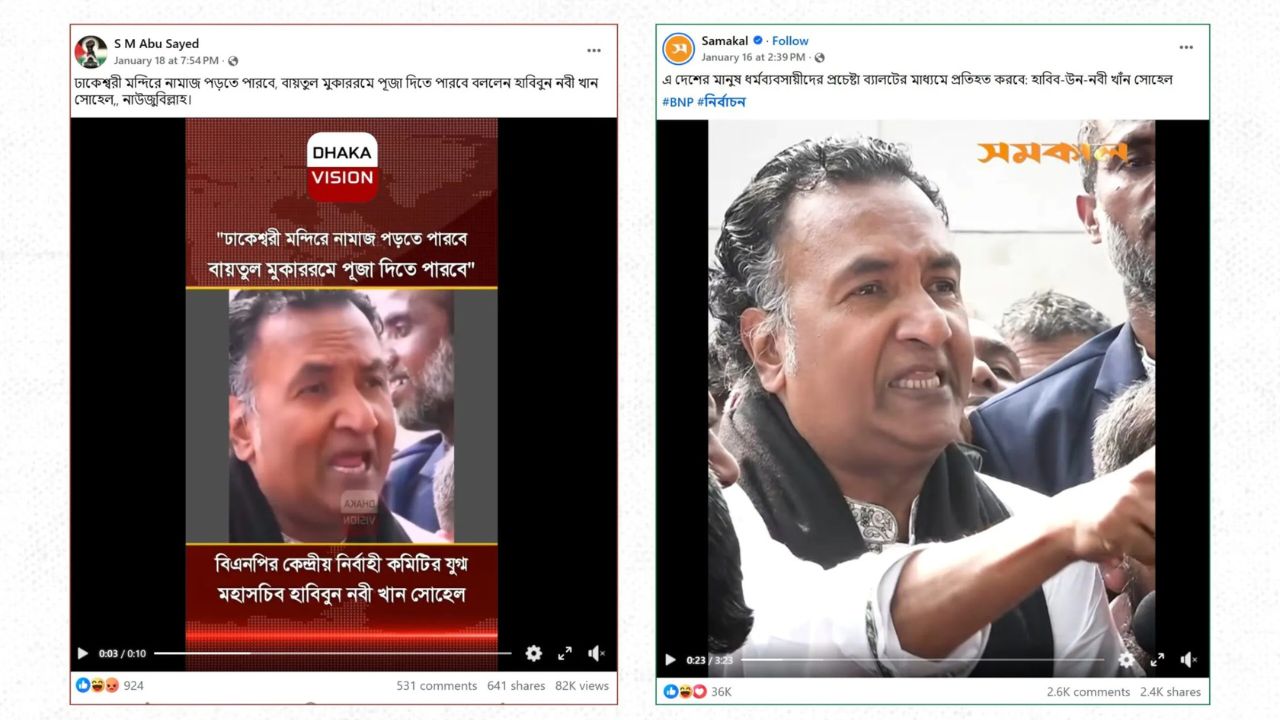
He warned the public that his opponents were so desperate to retain power that they would eventually issue “bizarre fatwas” like the one described in the edited clip.
By cutting the satirical setup, the propagators made his mockery of political desperation look like a genuine religious proposal. He was actually calling on citizens of all faiths to resist “religious traders” through the ballot box.
Case study 5: Mia Mohammad Idris
A 6-second clip of Mia Mohammad Idris, chief advisor of Nangalkot Upazila BNP, showed him seemingly claiming that religious duties like prayer, fasting, Hajj, and Zakat were unnecessary if one voted for the “Sheaf of Paddy”. This video was viewed over 1.2 million times.
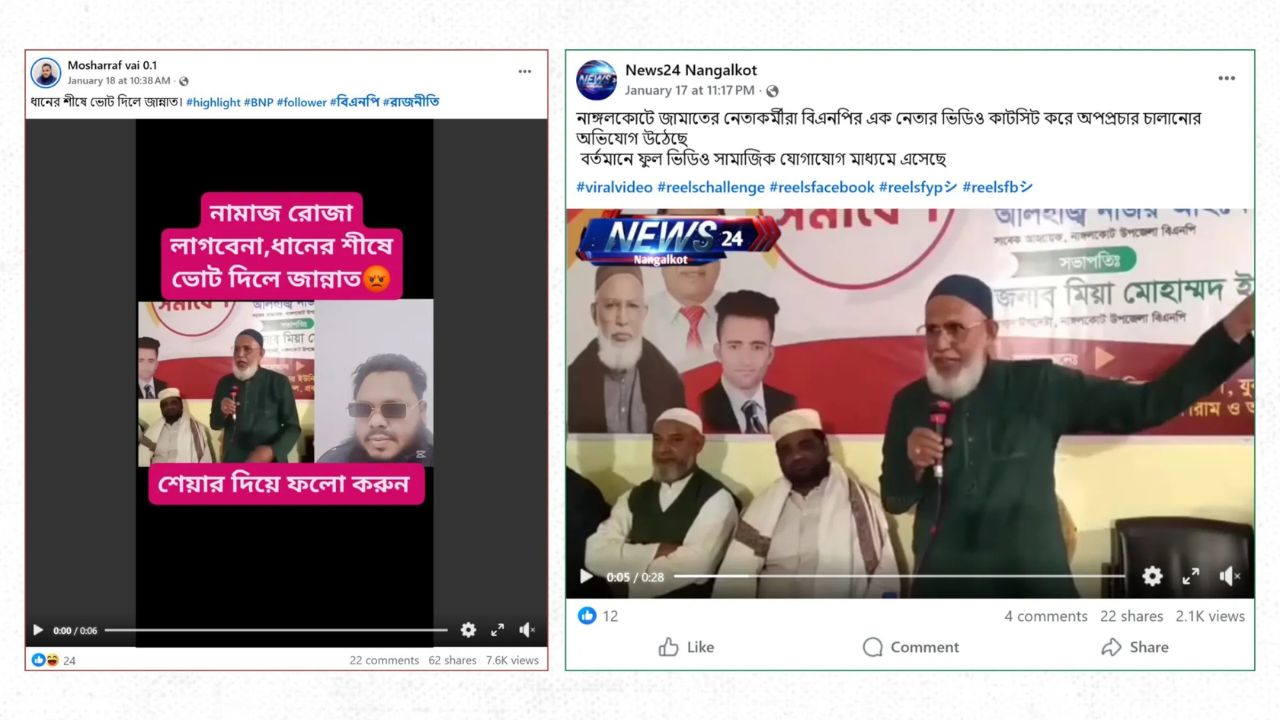
The full 28-second video confirms that Idris was quoting and criticizing a leader from another political party. After reciting the absurd claim, Idris immediately condemned it, saying those who say such things are “destined for hell” and using the phrase “Naozubillah” to express disapproval.
Although he briefly misspoke by mentioning the “Sheaf of Paddy” before correcting it to the “Scales” symbol associated with Jamaat, the context clearly showed he was denouncing the idea that a vote could replace religious obligations.
The impact of propaganda warfare
Dr Sumon Rahman, a professor at the University of Liberal Arts Bangladesh (ULAB), warns that this practice is a form of voter fraud. By providing voters with false information, propagators influence voting behavior based on fabricated premises.
He noted that modern political campaigns involve significant investment in monitoring and recording opponents to find material that can be decontextualized.
Because religion is the most sensitive and dominant discourse in Bangladesh, it is the most effective tool for steering public sentiment. When a candidate is successfully framed as having insulted religion, it triggers an emotional response that is difficult to reverse.
This tactic potentially changes the outcome of elections by depriving voters of the truth and manipulating their most deeply held beliefs.