US Treasury Secretary Scott Bessent on Friday announced plans to meet next week with Chinese Vice Premier He Lifeng in Malaysia to avert a possible escalation of US tariffs on Chinese goods. President Donald Trump has described the existing levies as “unsustainable.”
Bessent disclosed the meeting during a White House cabinet session and later confirmed it following a Friday evening phone call with He, reports Reuters.
On X, Bessent wrote that the two officials had “frank and detailed discussions regarding trade between the United States and China” and would continue talks in person next week.
China’s state-run Xinhua news agency reported that the video call between He and Bessent covered “major issues in bilateral economic and trade relations” and concluded with an agreement to resume trade negotiations at the earliest opportunity.
The US and China previously conducted four rounds of talks across Europe over the past six months, producing a temporary tariff truce that lowered duties from triple-digit levels. That agreement is set to expire on 10 November.

Malaysia, a major exporter to both the US and China, would host the next round of discussions. Its goods currently face a 19% US tariff, and the country could also be hit with a 100% duty on semiconductors and related electronics under a US national security review.
Trump, speaking on Friday, attributed the latest trade impasse to Beijing’s broad new restrictions on rare-earth minerals and magnets.




He warned that an additional 100% tariff on Chinese imports could take effect 1 November if China does not remove the controls. “It is not sustainable, but that is what the number is,” Trump told Fox Business Network.
The US president also threatened new export controls to block shipments of “any and all critical software,” responding to China’s expanded rare-earth export restrictions – materials vital to global tech manufacturing.
Bessent and US Trade Representative Jamieson Greer earlier labelled the measures a threat to international supply chains.
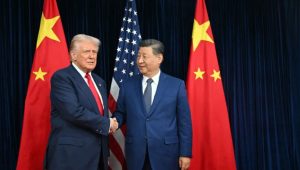
Trump confirmed he will meet Chinese President Xi Jinping in two weeks in South Korea, stressing his commitment to a “fair deal.” He told FBN, “I think we’re going to be fine with China, but it has to be fair.”
Speaking later ahead of a White House lunch with Ukrainian President Volodymyr Zelenskiy, Trump added, “China wants to talk, and we like talking to China.”
Wall Street reacted positively to the signals of dialogue, with major US stock indexes climbing in afternoon trading after earlier losses caused by the sudden re-imposition of tariffs and regional banking concerns.
World Trade Organization chief Ngozi Okonjo-Iweala urged both sides to de-escalate tensions, warning that a split between the two largest economies could cut global output by up to 7% over time.
She told Reuters the WTO had engaged with officials from both nations to encourage dialogue.
Despite the positive signals, tensions remain high. Bessent criticised China’s state-driven economic policies at an IMF steering committee meeting on Friday, calling for tougher scrutiny by the IMF and World Bank to address industrial imbalances and excess manufacturing capacity.
China’s Commerce Ministry responded by accusing the US of undermining the rules-based multilateral trade system and promised to escalate WTO dispute measures. The ministry urged Washington to reverse policies that violate non-discrimination rules and align industrial and security practices with WTO standards.
Earlier in the week, Bessent described one of He is senior aides as “unhinged” in recent negotiations, prompting China to accuse the US of “seriously distorting the facts.”