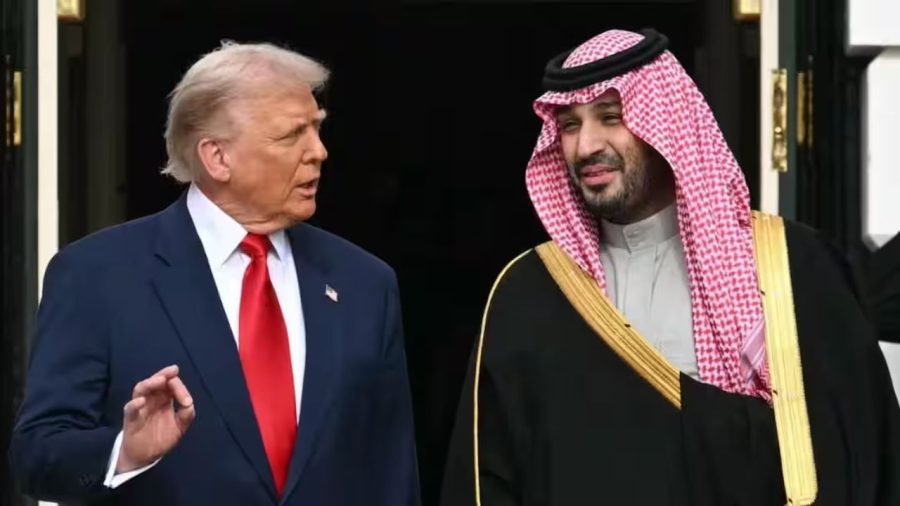

Washington approved a $5 billion sale of bombs, precision-guidance kits and associated equipment to Saudi Arabia on Friday, as the kingdom continues to come under fire during the ongoing US-Israeli war against Iran, the State Department confirmed.
The package, notified to Congress by the Pentagon’s Defense Security Cooperation Agency, is intended to shore up Riyadh’s air defences at a moment when Saudi territory has repeatedly been struck by Iranian forces and by Yemen’s Houthi rebels, who are backed by Tehran, since the conflict erupted earlier this year, reports AFP.
“The proposed sale will improve Saudi Arabia’s airborne defence capability to counter current and future regional threats, strengthen its homeland defence, and improve interoperability with systems operated by US forces and other Gulf region partners,” the State Department said in a statement.
Washington added that the transaction would also “support the foreign policy goals and national security objectives of the United States by improving the security of a Major non-Nato ally” — a designation Saudi Arabia has held since 2019, granting it privileged access to American military technology and cooperation.

According to the congressional notification, the deal centres on thousands of Joint Direct Attack Munition-Extended Range (JDAM-ER) guidance kits, which convert unguided “dumb” bombs into satellite-guided precision weapons, alongside general-purpose bombs of varying sizes.
The package also includes fuzes, target detectors, containers, spare parts and technical and logistical support services, though it does not envisage stationing additional US government or contractor personnel inside the kingdom.
The State Department said it was not currently aware of any offset arrangement tied to the sale and assessed that the transfer would not adversely affect the readiness of American forces.


Under the longstanding US foreign military sales process, lawmakers now have a statutory window in which they could seek to block the transaction, though such interventions are rare given that deals are typically vetted extensively with congressional committees before formal notification is issued.
Approval by the State Department does not itself mean a contract has been finalised or that price and delivery terms have been agreed with Riyadh.
The latest package comes against the backdrop of a broader defence relationship that has deepened considerably this year.
US President Donald Trump had already signalled during a visit to the kingdom that Washington was prepared to offer Saudi Arabia an arms package worth well over $100 billion, and a separate $3.5 billion sale of AIM-120C-8 Advanced Medium Range Air-to-Air Missiles was approved for Riyadh only weeks earlier.
Saudi Arabia has long been one of the largest purchasers of American weaponry, with previous administrations — including under presidents Obama and Trump — approving successive multibillion-dollar munitions packages, often justified by the need to replenish stockpiles depleted by operations against Houthi militants in Yemen.
The kingdom’s exposure to attack has grown sharply since the United States and Israel launched their campaign against Iran, with Saudi territory, including energy infrastructure and population centres, coming under intermittent drone and missile fire from both Iranian forces and allied Houthi units operating from Yemen.
Riyadh has repeatedly pressed Washington to accelerate deliveries of air-defence systems, arguing that its current capabilities are being stretched by the scale and frequency of the attacks.
Friday’s approval represents one of several such requests processed by the State Department in recent months as Gulf allies seek to bolster their defences amid the regional escalation.