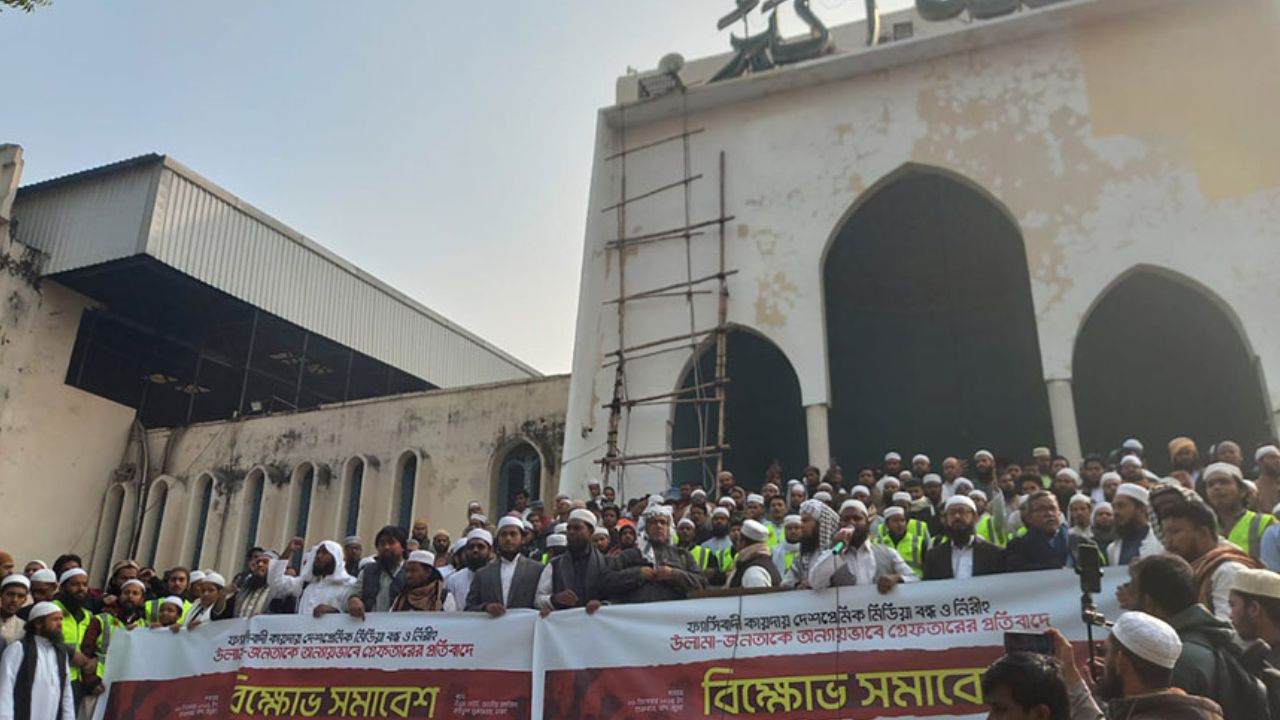

Religious leaders on Friday condemned the alleged manipulation of public opinion by sections of the mainstream media, criticised the arrests of Islamic scholars, and warned against external influences threatening Bangladesh’s sovereignty.
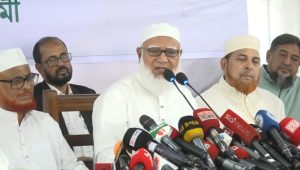
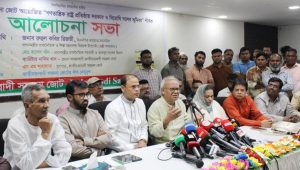
The remarks came during a protest rally organised by the Ulama Janata Oikka Parishad in front of the Baitul Mukarram National Mosque following Jummah prayers.
Speakers at the rally, held at the south gate of Baitul Mukarram after Friday’s Jummah prayers, strongly criticised the current interim government. They alleged that despite coming to power through the blood of martyrs, the government is betraying that sacrifice.
The speakers also said the failure to arrest the main perpetrators in the killing of Osman Hadi remains a glaring example of the government’s incompetence.
Speakers also accused certain newspapers of acting against religious values and public interest while supporting authoritarian governance over the past 16 years.

They demanded accountability for what they described as the media’s harmful role.
Poet Mahmudul Hasan Nizami compared Bangladesh’s leading newspapers to Russia’s former state-controlled daily, Pravda, accusing Prothom Alo and editor Matiur Rahman of undermining religious sentiments through ideological “brainwashing.”
According to him, these publications promoted left-wing extremism and deliberately influenced educated segments of society in ways hostile to Islamic values.


Other speakers echoed similar allegations, claiming Prothom Alo and The Daily Star consistently supported previous authoritarian regimes while portraying religious scholars negatively.
Maulana Saiful Islam and others condemned the arrests of Ataur Rahman Bikrampuri and other ulema, calling them politically motivated and demanding the immediate withdrawal of fabricated cases.
The rally also warned the interim government against using the 1974 Special Powers Act, enacted during Bangabandhu Sheikh Mujibur Rahman’s tenure, to suppress political dissent. Speakers said reviving such “black laws” to silence revolutionaries would not be accepted.
Participants vowed to resist any attempt to restore fascism while ignoring the sacrifices of those killed or injured during the July uprising. They warned that continued arbitrary arrests and what they described as Indian dominance in national affairs could trigger another mass movement.
Several speakers called for legal action against editors of certain newspapers for alleged wrongdoing over the past 16 years.
Retired Colonel Hasinur Rahman highlighted Bangladesh’s independence, achieved through a bloody struggle, and urged citizens to uphold national dignity and self-respect. He criticised what he called the “so-called civil society” and accused certain media outlets of acting against public interest.
Reflecting on the July movement, Colonel Rahman said revolutions are driven by ordinary people and students rather than elites.
While reaffirming Bangladesh’s identity as a Muslim-majority country committed to peaceful coexistence among all religions, he blamed recent violence on orchestrated provocations and administrative negligence.
On foreign policy, he called for an “India-free” political approach, urging stronger ties with Pakistan, China, and Iran, alongside enhanced military preparedness.
He concluded that the spirit of sacrifice among the Bangladeshi people remains their greatest strength, and united public action would ultimately compel any government to meet popular demands.
Among those present were Major General (retd) Mahbubul Alam, Brigadier General (retd) Hasan Nasir, Mufti Fakhrul Islam, Mufti Musa bin Izhar, Mahmudul Hasan Nizami, and Maulana Baizid Khan.