
Behind closed doors on the margins of the 81st United Nations General Assembly (UNGA) in New York, a flurry of high-stakes diplomatic activity concerning the US-Iran war unfolded, offering a glimpse of potential off-ramps even as fierce rhetoric and military threats intensify.
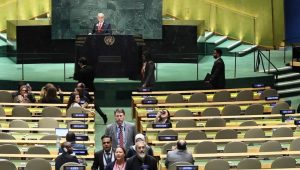
Addressing world leaders, US President Donald Trump stated that he faces a “big decision” on whether to negotiate a deal or “annihilate the Islamic Republic,” against which Washington has waged war since 28 February.
Meanwhile, taking the podium on Wednesday, Iranian President Masoud Pezeshkian directly countered the US stance, declaring to the assembly that Iran is a “victim of terrorism.”
Yet despite the combative messaging, US special envoys Steve Witkoff and Jared Kushner held three hours of indirect talks with Iranian Foreign Minister Abbas Araghchi on Tuesday – a meeting President Trump described as “very good” and “very productive.”
Foreign Minister Araghchi conveyed Tehran’s latest conditions to end the conflict, as reported by Al Jazeera, following the breakdown of the 60-day memorandum of understanding (MoU) finalised in Islamabad, Pakistan, in June.
While parallel efforts involving Gulf Cooperation Council (GCC) leaders and Chinese President Xi Jinping gather momentum, foreign policy analysts warn that an immediate breakthrough deal remains out of reach, as deep-seated structural hurdles continue to stall progress.

A legacy of fractured negotiations, escalating conflict
A major factor making a peace deal so difficult to achieve is the entrenched pattern of collapsed diplomacy quickly giving way to armed violence.
Iranian officials point to previous rounds of diplomatic talks with the US in 2025 and 2026 as proof that Washington can veer abruptly from negotiations to military action.
Most notably, the current conflict erupted on 28 February through joint US-Israeli strikes on Tehran while both nations were actively participating in Oman-mediated dialogue.
The subsequent collapse of the June 60-day MoU signed in Islamabad further reinforced mutual suspicion.


Sanam Vakil, director of the Middle East and North Africa Programme at Chatham House, noted that both sides have been negotiating for over two years under the constant shadow of military conflict and persistent threats, making it exceptionally difficult to build the basic confidence required for renewed diplomacy.
Domestic hardliners, the framing obstacle
Beyond international friction, internal political constraints in both capitals severely restrict room for compromise.
While President Pezeshkian and Foreign Minister Araghchi are conducting discussions in New York, any binding agreement requires the explicit consent of the Islamic Revolutionary Guard Corps (IRGC) and hardline Iranian factions managing the war effort back home.
According to Adel Abdel Ghafar, a senior fellow focusing on the Middle East at the Australian Strategic Policy Institute, diplomacy in New York involves a fair amount of political posturing alongside genuine movement.
Vakil emphasised that the core political challenge lies in constructing a formula that both Washington and Tehran can present domestically as a negotiated compromise rather than a humiliating capitulation.
Inflammatory public statements, including President Trump’s UN speech and Iranian military warnings of “crushing” retaliatory attacks, further harden domestic stances.
High-stakes leverage over global energy corridors
The diplomatic deadlock is further complicated by Iran’s effective closure of the Strait of Hormuz, a critical global oil and gas artery. With energy prices elevated and US midterm elections approaching, reopening the strategic shipping lane is Washington’s primary priority.
However, Abdel Ghafar explained that the waterway represents Tehran’s most powerful bargaining card in the conflict.
Because Washington urgently seeks the restoration of maritime traffic, Tehran remains unwilling to yield this key source of leverage without securing firm, binding guarantees in return.
Moreover, experts warn that even if a de-escalation is achieved in the Strait of Hormuz, calm would not automatically extend to other regional flashpoints such as the Red Sea or the Bab al-Mandeb.
Multilateral deadlock and the limits of mediation
Although third-party actors are actively attempting to broker off-ramps, mediator influence cannot substitute for direct consensus between the primary combatants.
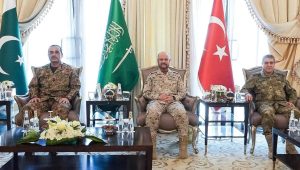
Gulf states such as Qatar and Oman are maintaining open channels with both capitals and promoting proposals for a common regional security framework.
Similarly, China is utilising its position as Iran’s main oil customer to encourage compromise and advocate for a return to the June interim agreement.
However, as world leaders at UNGA voice frustration over the UN Security Council’s failure to function, analysts stress that third-party mediators cannot impose a settlement.
According to Vakil and Abdel Ghafar, moving beyond deadlock will require the US and Iran to move past maximalist demands and agree on specific implementation terms, concrete sequencing, and direct engagement between leadership.