


The University Grants Commission (UGC) has stressed the need to incorporate the ‘One Health’ approach into higher education curricula to safeguard public health by addressing human health, animal health and environmental issues in an integrated manner.
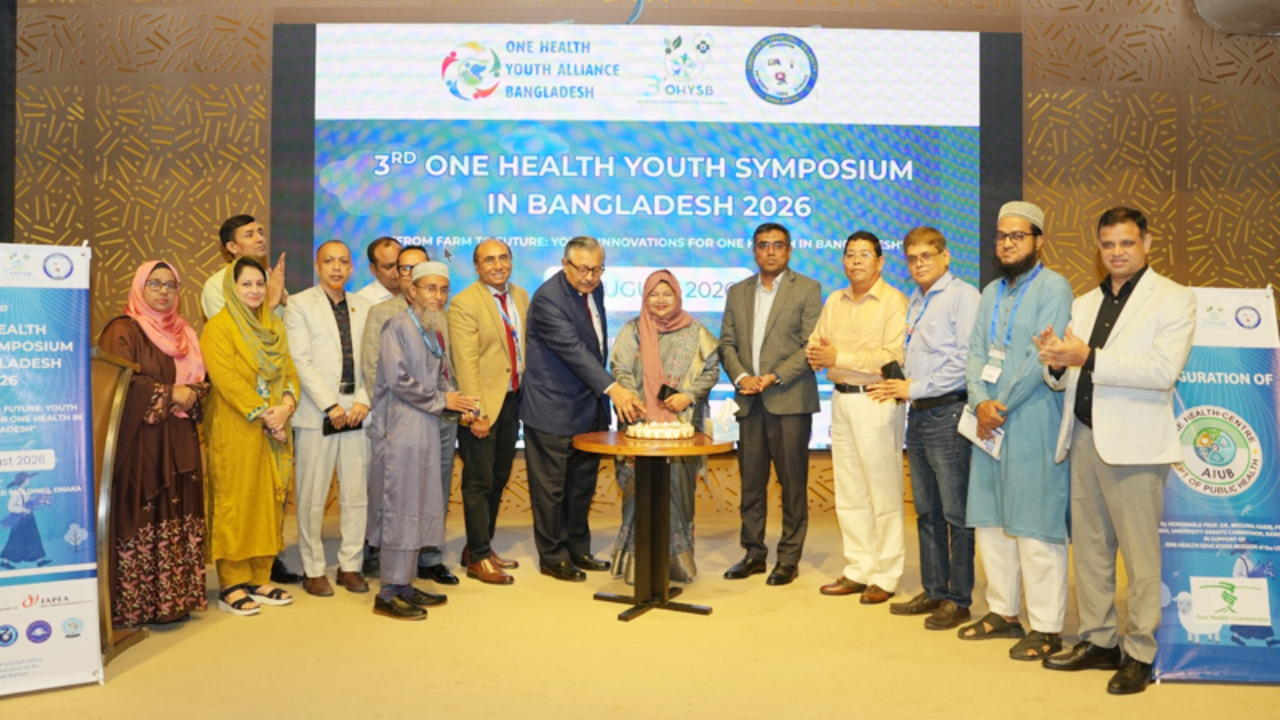
Professor Masuma Habib, UGC member and currently holding the routine charge of chairman, made the call on Thursday (13 August) while addressing a symposium as the chief guest at American International University-Bangladesh (AIUB).
The event was organised by the Third One Health Youth Alliance Bangladesh in collaboration with AIUB.
Masuma said challenges such as the transmission of diseases from animals to humans, environmental pollution, antimicrobial resistance and climate change cannot be addressed by any single sector alone.

She emphasised that tackling these challenges requires coordinated efforts from professionals across different fields, including physicians, veterinarians, agricultural scientists, environmentalists and public health experts.
Rapid urbanisation, high population density, environmental pollution and climate risks are making Bangladesh a critical centre for public health and environmental challenges, she said.
Masuma noted that more than 75 per cent of emerging infectious diseases are linked to animals and the environment. Therefore, the ‘One Health’ concept should be reflected in the curricula of medicine, nursing, pharmacy, microbiology, zoology, agriculture, food science and environmental science, she added.




Highlighting initiatives in Bangladesh, she said Chittagong Veterinary and Animal Sciences University among public universities has taken steps in this regard, while AIUB among private universities has established a One Health Centre.
She expressed hope that the centre would play an effective role in achieving its objectives.
The UGC member also said the current government has undertaken various plans and initiatives to develop young people into skilled and competent human resources and involve them effectively in national governance and development.
She said emphasis is being placed on preparing young people for the job market, encouraging creative activities and improving necessary skills.
Masuma said developing skilled, ethical and innovative human resources is one of the key objectives of the UGC. The commission is working to enhance students’ leadership, integrated thinking, problem-solving and collaborative skills through outcome-based education, she added.
AIUB Vice-Chancellor Professor Dr Saiful Islam and Pro-Vice-Chancellor Professor Dr Md Abdur Rahman attended the symposium.
The event was chaired by Professor Muhammad Wasif Alam, lead of the One Health+ Centre under AIUB’s Department of Public Health and adviser to the One Health Youth Alliance Bangladesh.
Abu Sayed, president of the organising committee, along with teachers from different universities, researchers, students, healthcare professionals and representatives of development partner organisations were also present.