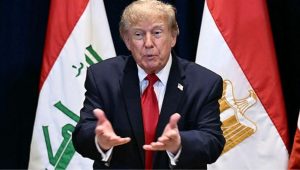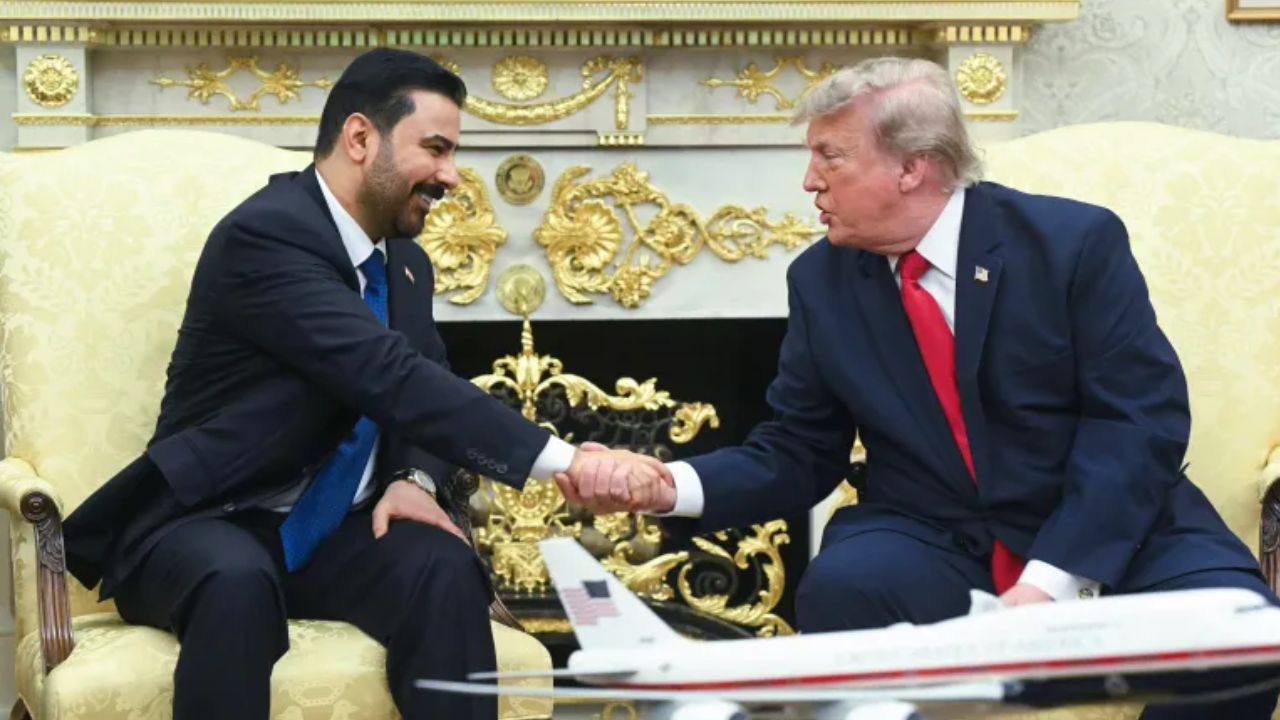

US President Donald Trump hosted Iraqi Prime Minister Ali al-Zaidi at the White House in Washington, DC, on Tuesday, with both leaders pledging to strengthen economic cooperation and expand Iraq’s oil production.
The meeting followed Trump’s public endorsement of al-Zaidi, a businessman with no previous political background, for Iraq’s premiership earlier this year, reports Al Jazeera.
Trump had also opposed former Prime Minister Nouri al-Maliki, a controversial figure widely regarded as close to Iran, for the post.
Al-Maliki later withdrew from the race in April.
Ahead of the visit, the Iraqi government said it expected several oil and gas agreements to be signed during al-Zaidi’s trip to the United States.
During their Oval Office meeting, Trump reiterated his commitment to securing multiple deals.

He described al-Zaidi as “a fantastic champion, a new champion”.
“Iraq has tremendous potential because of their oil and because of other things, but because of their oil, and we’re going to be doing a lot of deals,” Trump said.
“We’re going to create a lot of jobs for both countries, and we’re going to be taking out a lot of oil. A lot of oil is coming out,” he said.
Al-Zaidi said the trip marked the start of a new chapter in bilateral relations.

“The visit was not like any other visit,” he said, describing it as the beginning of an “economic partnership”.
He added that relations between Iraq and the United States were shifting from a military focus to an economic one.
Trump and al-Zaidi also confirmed that the remaining US troops in Iraq, believed to number fewer than 2,000, would complete their withdrawal by 30 September.
Al-Zaidi said the same deadline would apply to the disarmament of armed factions operating across Iraq.
Iraq has long balanced the competing influence of Washington and Tehran, with political tensions centred on the continued presence of US forces, originally deployed during the fight against ISIL (ISIS), and the influence of Iran-backed armed groups.
In his first parliamentary address as prime minister, al-Zaidi pledged to disarm Iraq’s various paramilitary groups, which have held significant influence since the 2003 US-led invasion.
However, he has not explained how he intends to achieve that goal.
Shortly before leaving for Washington, the Islamic Resistance in Iraq, an umbrella group representing Iran-backed armed factions across the region, including Iraq, announced that it would reject any outcomes from al-Zaidi’s visit.
The visit also took place against the backdrop of the ongoing US-Israeli war with Iran, which began on 28 February.
The conflict and its recent escalation remained a key concern throughout al-Zaidi’s visit.
Iraq’s economy has also suffered significantly from Iran’s effective closure of the Strait of Hormuz, through which around 90 per cent of the country’s 3.4 million barrels of daily fossil fuel exports pass.
The recent fighting has also cast doubt over the future of a memorandum of understanding (MoU) reached in June, which had temporarily halted hostilities, reopened the Strait of Hormuz and lifted a US naval blockade on Iran.
Speaking to reporters at the White House, al-Zaidi said Iraq deserved a “fair share” from the Organization of the Petroleum Exporting Countries (OPEC).
Iraq has been seeking a higher oil production quota, with al-Zaidi arguing that the request reflects the scale of destruction caused by the war against ISIL, over which Iraq officially declared victory in 2017.
“The damage suffered by Iraq exceeds $400 billion, and to this day, some Iraqis still have destroyed homes and are living in camps,” he said. “I have a plan to return them to their homes, and that is why I want a fair share for Iraq in OPEC.”