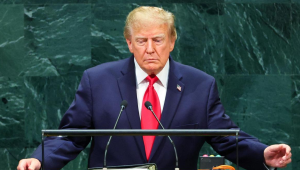
President Donald Trump has announced the lowest refugee admission ceiling in US history, approving entry for only 7,500 people in the 2026 fiscal year.
A presidential memorandum confirmed that US refugee programme will continue operating at a minimum level, leaving millions of displaced people worldwide without access to American resettlement opportunities, reports Al Jazeera.
According to the document, the limited number of refugee slots will be primarily reserved for white Afrikaners from South Africa.
“Admissions shall chiefly prioritise Afrikaners and other individuals subjected to illegal or unjust discrimination in their home countries,” it stated, citing Executive Order 14204.
Trump has long claimed that white South Africans face systemic persecution, an allegation that both the South African government and Afrikaner representatives have strongly denied.

The announcement also noted an administrative overhaul of the refugee resettlement system.
Future grants and contracts that previously went to various aid organisations will now be directed solely through the Office of Refugee Resettlement under the Department of Health and Human Services, reportedly to ensure “better coordination and accountability”.
This marks the lowest refugee limit since the US Refugee Act of 1980 established formal procedures for refugee admissions. Historically, more than two million refugees have entered the United States through the programme, known as USRAP.




By comparison, the final year of former President Joe Biden’s administration saw a cap of 125,000 refugees – nearly 17 times higher than Trump’s new limit. The new restriction will remain in effect from October 2025 to September 2026.
Globally, the UN Refugee Agency (UNHCR) estimates that over 42 million people are currently displaced. The Refugee Act allows the president to set the annual cap, but it does not mandate a minimum figure, prompting concerns that the Trump administration could effectively stall the programme.
Immigration expert Aaron Reichlin-Melnick from the American Immigration Council remarked on social media that Trump’s move “appears to redefine who qualifies as a refugee,” noting that the new criteria focus on “discrimination” rather than “persecution” – a key distinction in international refugee law.
He warned that the decision could transform a humanitarian lifeline into a racially selective immigration pathway.
“For decades, the programme welcomed people fleeing ethnic cleansing and war,” he said. “Now it is being used to promote White immigration – a devastating shift for one of America’s proudest humanitarian legacies.”
The International Refugee Assistance Project (IRAP) also criticised the announcement, saying the administration had bypassed the required consultation process with Congress. “This is not policy, it is politics,” said IRAP president Sharif Aly.
“America’s refugee programme was designed to reflect compassion and opportunity. Closing our doors to thousands means turning away from the very values it was built on.”
The administration offered no detailed justification for the steep reduction, saying only that the number was “in the national interest and consistent with humanitarian concerns.”
Since returning to office, Trump has taken a hard line on immigration, dismantling or restricting programmes that once enjoyed bipartisan backing.
Advocates had hoped the refugee initiative would remain an exception, especially after the US withdrawal from Afghanistan, when many Afghans relied on the refugee system for safe relocation.
However, Trump has continued to focus on white South Africans. Earlier this year, he signed an executive order cutting aid to South Africa, accusing its government of “racial discrimination against Afrikaners.”
The same order prioritised their resettlement in the United States. In May, the first group of white South African refugees arrived in the country under the new directive, a symbolic start to what many observers view as a dramatic reorientation of America’s refugee policy.