One of Bangladesh’s tobacco companies has published an annual sustainability report that discusses carbon commitments, responsible sourcing, and farmer welfare programmes. What it does not discuss is the following: in Alikadam Upazila, Bandarban, tobacco farmers require up to seventy-two hours of continuous kiln fire to cure a single batch of tobacco leaves. Thousands of taandur kilns operate across the district at peak season. The fuel for every one of those kilns comes from the surrounding hills.
The deforestation I observed, as part of my thesis, was not incidental to the tobacco economy. It is constitutive of it. The crop is biologically incapable of reaching the commercial market without the wood of the forest it is replacing. This is the core contradiction at the heart of tobacco cultivation in the Chittagong Hill Tracts (CHT), and it is one that neither corporate sustainability discourse nor Bangladesh’s regulatory apparatus has seriously confronted.
Tobacco arrived in the southern CHT in the mid-1980s. By 2007–08, cultivation in Bandarban had expanded from 127 hectares to over 1,437, an elevenfold increase in twelve years. Today, an estimated 85-90 percent of cultivable land in Alikadam, Lama, and Naikhyongchhari is under tobacco at peak season.
This expansion has been driven by a contract farming system that binds farmers to the company through advance credit, company-supplied inputs, and a grading architecture that determines income at the buyer’s point, under the buyer’s terms, without independent appeal. In College Para, only two of sixty-two households hold direct company registration. The remaining sixty participate through wage labour or informal subcontracting arrangements, absorbing the labour costs and health risks of the system while the registered cultivators and company intermediaries capture the margin.

Advance payments for seeds, fertilisers, pesticides, sometimes cash, arrive before planting and are debited against the harvest. By the time a farmer reaches the collection point in June, a significant portion of what he will earn has already been spent in the company’s accounting. The next season’s advance ensures the cycle continues. Farmers described this with resignation rather than surprise. One cultivator put it plainly: ‘Every year we say this is the last tobacco season. But then we have the debt, and there is nothing else that pays.’
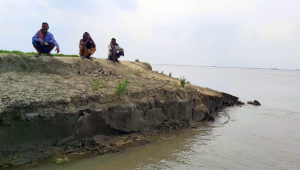
The ecological costs of tobacco curing are not invisible. They are simply not attributed. Forests thin. Seasonal streams dry. The Matamuhuri River, which runs through the tobacco cultivation zone, receives the agrochemical runoff of intensive fertiliser and pesticide application across tens of thousands of bighas of farmland each season. Farmers in all three villages reported declining fish catches over the past decade.



Green Tobacco Sickness, nicotine poisoning from dermal absorption during the harvest of wet leaves, is routine among farmers and labourers in Alikadam. Symptoms include nausea, dizziness, vomiting, and respiratory difficulty. Protective equipment is not supplied by the company as part of the contract package. Farmers manage symptoms by resting briefly in the shade and returning to the field. One farmer described his protocol: ‘If I stopped every time my head hurts or my stomach feels bad, I would never finish the work. The company doesn’t wait.’ These health costs do not appear in the sustainability accounts. They are externalised entirely onto the farming household and onto the bodies of the women and children whose labour sustains the production cycle without formal recognition or compensation.
Bangladesh has made real progress on tobacco control on the consumption side. The Tobacco Control Act, the plain packaging debates, and the taxation arguments are serious policy engagements. The production side has received almost no equivalent attention.
Environmental law governing fuelwood extraction exists and is not being enforced in the CHT tobacco zone. Pesticide regulations exist. The 1997 Peace Accord nominally protects Mro and other indigenous communities’ customary land rights. Enforcement across all three domains is selectively absent, present in form, absent in the places where enforcement would constrain accumulation. This selective absence is itself a policy position. When the state declines to monitor taandur fuelwood consumption, it is not failing to govern; it is governing in a particular direction. The tobacco frontier in the CHT advances not through spectacular dispossession but through the quiet withdrawal of regulation from the spaces where it would matter.
It would not begin with ‘alternative livelihood’ programmes, though those have their place. It would begin with mandatory environmental and social disclosure: companies operating in Alikadam should be required to publish, by year and by area, the volume of fuelwood used per kilogramme of cured leaf and the agrochemical inputs distributed under contract. Without disclosure, accountability is structurally impossible.
It would require a transparent and contestable grading system, published criteria, an independent appeal mechanism, and a minimum price referenced to verified input costs. It would require enforceable mechanisms against informal land transfer from Mro households and the strengthening of customary tenure institutions rather than their continued paper existence.
The smoke rising from Alikadam’s kilns each February is legible, if anyone chooses to read it. What it says is that a forest is being burned to cure a crop, a river is being poisoned to finance a debt, and a regulatory framework exists that has decided, for now, not to notice.
The views expressed in this article are solely those of the author
The writer is a student, Department of Anthropology, University of Dhaka