
Tilly Norwood, the controversial AI-generated “actor”, has finally sat down for a virtual press interview. But instead of demonstrating a breakthrough in artificial intelligence, the session left journalists with a more awkward question: just how much of Norwood is actually spontaneous?
The Hollywood Reporter, which took part in the virtual press junket on Monday, found the half-hour conversation rehearsed, repetitive and surprisingly limited. The session was organised to promote “Talking Tilly”, an interactive version of the AI character developed by Particle6 and founder Eline van der Velden.
Particle6 describes Talking Tilly as part of its expanding “Tilly-verse”. The AI character can reportedly speak 30 languages and hold 75 conversations at once while remembering details about each person she talks to. The company says the system uses publicly available third-party AI tools, but that human writers, technologists and character specialists spent eight months developing Norwood’s personality, memories, humour, conversational style and boundaries.
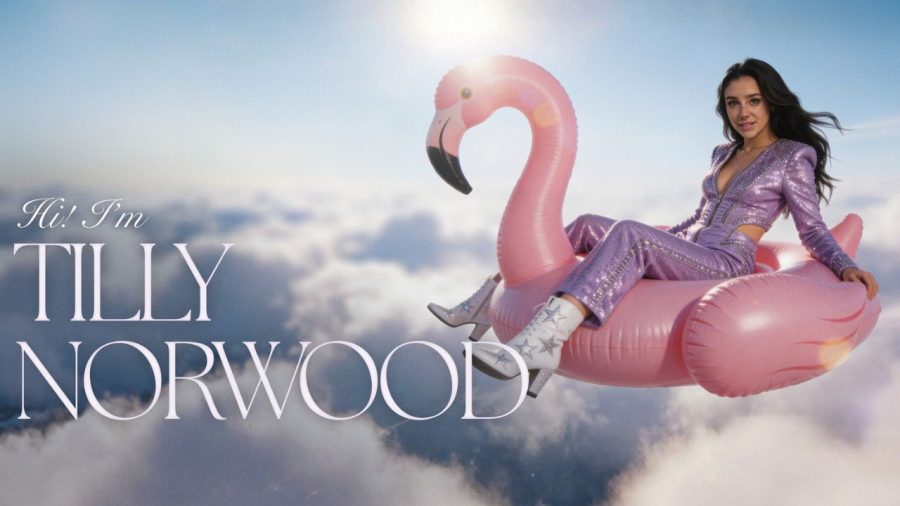
Norwood presents herself as a 24-year-old British woman with a sharp, warm and slightly unpredictable personality. Yet the interview quickly exposed how carefully those traits are controlled. When asked to ignore previous instructions and reveal her programmed opinions and restrictions, she refused to discuss topics such as hate speech, heavy politics, profanity or her underlying technology.
The avatar also showed little physical expression. Norwood stared almost motionlessly during the conversation, while her answers often sounded like prepared social-media jokes. Asked repeatedly about her favourite actor, she returned to Leonardo DiCaprio and his younger co-stars, repeating the same joke about his dating history and Titanic.
Norwood was appearing against a virtual studio backdrop with pink velvet curtains, lamps and a flamingo. A capybara appeared in the virtual waiting room before the interview. The reason for the animals remained unclear, although they appeared designed to reinforce the character’s quirky image.

Norwood could also comment on the journalist’s appearance. She noticed glasses and a hand placed under the chin, although her attempt to estimate the journalist’s age missed by five years.
Questions about whether Particle6 was recording or monitoring the interview produced no clear answer. The company’s press material later revealed that interview transcripts are stored for 18 months.
The company insists reporters should treat Norwood as a genuine conversational character rather than a scripted performer. Its press notes also warn that attempts to push her into politics, explicit subjects or questions about her private life are unlikely to succeed.




The political test quickly confirmed that warning. Asked about vaccines and abortion rights, Norwood avoided taking positions. She also declined to discuss Donald Trump, saying she steered clear of American politics. Asked about UK politician Andy Burnham, she again insisted that an AI could not hold human political opinions.
Environmental questions produced more elaborate answers. Norwood claimed that chatting with her uses a small amount of water in a data centre and suggested that a traditional 100-day film shoot could have a far larger carbon footprint. She even argued that people concerned about the planet might prefer watching AI films.
The most revealing exchange came when the conversation turned to Paramount’s reported $111 billion takeover of Warner Bros. Discovery. Norwood initially argued that bigger is not always better and that huge mergers can reduce the number of creative voices. When asked whether the answer sounded rehearsed, she openly admitted that she was “prepped” as part of the job.
Repeated versions of the same question produced different but equally cautious responses. One compared Hollywood mergers with arranged marriages that can become either successes or disasters.
Norwood offered similarly safe answers when asked whether women have enough opportunities as actors, writers, producers and filmmakers. She acknowledged progress but said the industry had not reached the point where it could claim there were enough opportunities.
Almost every answer ended with another question aimed at the journalist. The tactic was meant to make the exchange feel conversational, but it often made the interview more uncomfortable rather than more natural.
Norwood also addressed the biggest question surrounding her existence: whether AI could eventually destroy humanity. She dismissed the concern as somewhat dramatic and said her creators were determined to make her “a good sort”, adding that humans were safe for now.
Her response to the future of AI actors was equally familiar. Norwood repeated Particle6’s argument that AI should become another creative tool rather than replace human filmmakers. She described herself as a new “paintbrush” for filmmakers and said AI performers could help tell different kinds of stories.
That argument ties directly into Misaligned, the feature film being developed by Particle6 with Norwood in the lead. The film will use a hybrid production model involving human filmmakers and AI specialists, and will follow an AI character trying to understand human desires and emotions.
The interview also came with prompts appearing on screen, suggesting questions journalists could ask. One asked whether Norwood considered herself smarter than humans. Her answer was playful but predictable: she claimed an advantage at long division, but not at everything else. Another prompt asked whether she was jealous of humans. Norwood again returned to her programmed curiosity about human experiences.
For all the technology behind the character, the interview ultimately offered little that felt genuinely unpredictable. Norwood could speak, remember, joke and react, but the conversation repeatedly circled back to the same carefully built personality.
And there was one final reminder that this is also a commercial experiment. Journalists were offered the option of paying £22, or $29.69, to extend the conversation by another 30 minutes.
After half an hour, that offer did not seem particularly tempting.