
Mega projects in the country’s development journey are like characters in epic tales—the story begins with grand promises of development, but ends with the hard arithmetic of reality. When a project is conceived, the focus is on economic growth, improved connectivity, job creation and making people’s lives easier. But once implementation begins, revisions, additional costs, deadline extensions, loans and interest burdens are gradually added to the project file.
In many cases, even when the anticipated benefits fail to materialise, the project becomes a long-term financial liability.
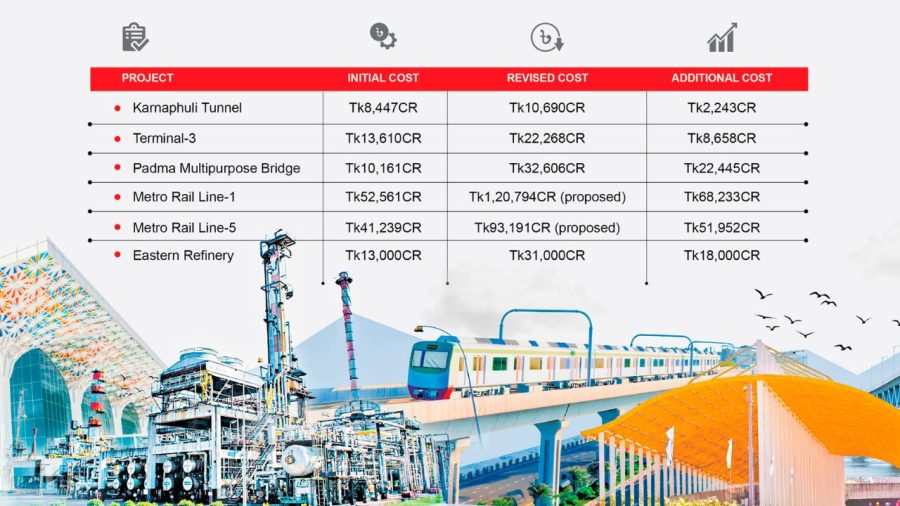
One of the most prominent examples is the Karnaphuli Tunnel project. A feasibility study for the project was conducted in 2013 aiming to connect the two banks of the Karnaphuli River and create the ‘one city, two towns’ concept of Shanghai. When the project was approved in 2015, its estimated cost was Tk8,446.63 crore. Following two revisions, the project was eventually implemented at Tk10,689.71 crore. In other words, the cost increased by more than Tk2,243 crore from the original estimate.
The project’s timeline also expanded. The tunnel was originally scheduled for completion by June 2020, but construction was completed in June 2024. The biggest question, however, concerns demand for the tunnel. The feasibility study estimated that 28,305 vehicles would use the tunnel every day in 2025. In reality, traffic has reached only 14 percent of that projection. As a result, toll revenue is not even sufficient to cover half of the tunnel’s operation and maintenance costs.
According to a report by a task force formed during the interim government, the significantly lower-than-targeted traffic volume is causing an operating loss of more than Tk26.5 lakh every day. There is another problem. Due to a shortage of skilled local manpower for tunnel operations, its operation and maintenance still depend largely on personnel and technical assistance supplied by the contractor, China Communications Construction Company Limited.
In the long term, such dependence could increase operating costs. The Implementation Monitoring and Evaluation Division (IMED) considers this a structural weakness of the project until local manpower is developed through training and capacity-building.
The Hazrat Shahjalal International Airport expansion project has also undergone repeated changes in both cost and timeline. When approved in 2017, the project cost was estimated at Tk13,610 crore, with a completion deadline of June 2022. In the first revision, the cost increased to Tk21,399 crore, and the deadline was extended to June 2025. The deadline was subsequently extended further to June 2026. Now, a proposal has been submitted to extend the deadline to June 2027 and add another Tk902 crore to the cost. This would bring the total cost to approximately Tk22,267.67 crore.
In other words, a project that was supposed to be completed in six years is now taking nearly 11 years. At the same time, its cost has increased by more than Tk8,500 crore.
The Padma Multipurpose Bridge also has a long history of cost increases. When the project was approved in 2007, its estimated cost was Tk10,161 crore. In the first revision in 2011, the cost rose to Tk20,502 crore due to the addition of a rail link and a reassessment of the design. In 2016, it increased further to Tk28,793.39 crore. More funds were subsequently added, and under the third revision in 2023, the final cost stood at Tk32,605.52 crore.

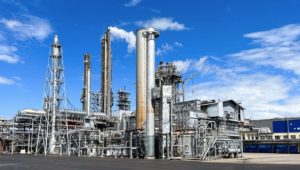
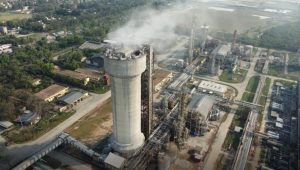
The same trend is seen in Metro Rail Line-1 and Line-5. The initial cost of Line-1 was Tk52,561 crore. Under a revised proposal, the cost is being raised to Tk1,20,794 crore – an increase of nearly Tk68,000 crore. The proposed cost of Line-5 (Northern Route) has also increased from Tk41,239 crore to around Tk93,191 crore. The story of the second unit of Eastern Refinery is even longer. The initiative to construct the second unit was taken in 2010.
Although the project was approved in 2013 at a cost of around Tk13,000 crore, construction has yet to begin. The project’s scope, design and cost have been changed several times. In 16 years, the Development Project Proposal (DPP) has been revised 11 times.
At the beginning of the 2023–24 financial year, the S Alam Group proposed constructing a large refinery on its own land belonging to Eastern Refinery Limited (ERL). The company proposed investing around US$4 billion, or more than Tk40,000 crore, to raise annual oil-refining capacity to 5 million tonnes. Later, a committee of the Ministry of Power, Energy and Mineral Resources recommended that the government hold at least a 51 percent stake and S Alam no more than 49 percent. However, no agreement was ultimately reached.
Following the political changeover in August 2024, the interim government cancelled the initiative.
The government subsequently decided to implement the project with its own financing. In December 2025, the project was approved at an Executive Committee of the National Economic Council (ECNEC) meeting during the interim government. At the time, the plan was for Tk18,566 crore to come from the government exchequer and Tk12,434 crore from the Bangladesh Petroleum Corporation’s own funds.
In other words, a project that was initially planned in 2013 at Tk13,000 crore will now require Tk31,000 crore to implement. The Islamic Development Bank is providing a loan of Tk12,252 crore for the project. The bank and the Bangladesh government have recently signed an agreement to this effect.




Meanwhile, a task force led by KAS Murshid, former director general of the Bangladesh Institute of Development Studies (BIDS), was formed during the interim government to examine eight mega projects.
The projects were the Padma Bridge, Padma Bridge Rail Link, Jamuna Railway Bridge, Dhaka–Mawa Expressway, Bangabandhu Tunnel, Dhaka Metro Rail Line-6, Hazrat Shahjalal International Airport Terminal-3 and Bus Rapid Transit (BRT) Line-3. According to the task force report, the cost of these eight mega projects has increased by 68 percent, or US$7.52 billion, compared with their initial estimates.
The same pattern is evident across most development projects in the country. The gap between estimated and actual costs, delays, repeated revisions and failure to deliver the expected benefits have become almost routine features of development projects. Various evaluations by IMED and reports by government-formed task forces show that the weaknesses of mega projects do not begin during construction. Rather, their foundations are often laid before a project is even approved.
The problem begins with the project selection process. According to the report of the task force on ‘Reformulating Economic Strategies and Mobilising Resources for Inclusive and Sustainable Development’, formed during the interim government, many projects are initiated through a top-down process in which political and institutional influence plays a role. Ministers, influential politicians, ministries, secretaries and development partners influence the conception and selection of projects.
The project is then presented for the approval and consent of the prime minister. Once a project gains the status of a political commitment, the relevant ministry moves quickly to prepare a feasibility study and DPP.
Under such a process, projects often fail to align with the master plans, priorities and actual needs of the relevant departments. At the same time, experts and implementing agencies have limited opportunities to provide their views.
The report also says that in many cases feasibility studies become a formality for securing project approval rather than a genuine assessment of whether a project is viable. Particularly in the case of politically prioritised projects, if there is a tendency to overstate benefits and underestimate costs, the true picture of the project is obscured from the outset. During implementation, changes to designs, the addition of new components and project revisions then become necessary. Costs and timelines rise accordingly.
Pradip Ranjan Chakrabarty, a former secretary of the Planning Ministry and IMED, says the most important question before taking up a project is whether the government has sufficient financial resources to implement it over the next five years. Yet, in many cases, the government does not have the capacity to allocate the full amount required even for ongoing projects. New projects are nevertheless taken up.
As a result, funding remains inadequate compared with actual requirements. According to him, there must also be realistic estimates of how long activities such as land acquisition are likely to take. Although a project implementation period is specified in the DPP, delays in land acquisition can push back the entire project schedule and increase costs. A lack of capacity in the institutions responsible for implementation is another major problem.
There are weaknesses in financing management as well. Many projects are approved without fully securing their sources of funding. When allocations under the Annual Development Programme (ADP) do not match the expenditure required for a project, funding shortages arise. The pace of work slows, the project period is extended and, ultimately, additional funds are required under a revised project.
Officials of the Planning Ministry and the Economic Relations Division (ERD) say foreign loans do not always come without conditions. Bangladesh takes loans for development projects from countries including Japan, South Korea, China, India and Russia. Such loans often come with specific procurement conditions. For example, Indian loans generally require 75 percent of the total goods and services used in a project to be sourced from India. Such conditions restrict opportunities for competitive procurement and can make project costs higher than those in other countries.
This is compounded by foreign-exchange risks. When the taka depreciates against the US dollar, more taka is required to repay the same amount of foreign debt. Exchange-rate movements are also considered an important factor behind cost increases in Metro Rail Line-1 and Line-5 and the Rooppur Nuclear Power Plant.
The risks increase further when a project is delayed. With time, not only construction costs but also loan interest, consultancy fees, administrative expenses and foreign-currency liabilities can rise. The ‘Strengthening and Development of Sustainable Power Sector in Bangladesh’ project is one example. Had the project been completed between 2018 and 2021, it would not have required an additional Tk32.52 crore because of the depreciation of the taka.
According to IMED, failure to appoint skilled and experienced project directors leads to poor coordination, delays in decision-making and weak supervision of contractors. Frequent changes of project directors also disrupt continuity. As a result, implementation slows, project deadlines are extended, and costs rise.
There are also capacity constraints within the Planning Commission and shortcomings in strategic planning. With a large number of projects being submitted, it becomes difficult to thoroughly scrutinise the feasibility studies of every project, assess their alignment with national strategies and determine priorities.
The solution must begin before a project is approved. According to stakeholders, comprehensive and independent feasibility studies should be made mandatory for large projects. No project should be approved without assessing its potential cost, benefits, demand, risks and alternative approaches. Large projects should also be subject to independent cost reviews. Land acquisition must be considered before a project begins, and the DPP should be prepared accordingly.
Qualified, full-time project directors should be appointed. In the case of foreign loans, national interests, competitive procurement and technology transfer should be given priority. Genuine competition must also be ensured in the selection of contractors.
According to IMED officials, assessing the economic viability of mega projects cannot be based solely on construction costs. The full life-cycle cost of a project must be calculated, including 20 or 30 years of operation and maintenance, debt repayment, rehabilitation and replacement costs. In the case of a project such as the Karnaphuli Tunnel, questions such as how much will be required every year for operation and maintenance after construction is completed, and where that money will come from, should be clearly answered before the project is approved.
Pradip Ranjan Chakrabarty says the implementation of the ADP needs to be monitored seriously from the outset. Meetings are held every month to review ADP implementation. If implementation problems are identified and addressed promptly at these meetings, the implementation rate can be improved further.
According to Syed Abdul Hamid, a professor at the Institute of Health Economics at the University of Dhaka, project directors are appointed based on their qualifications and experience. A project director must have more than administrative knowledge – they should also have adequate understanding of construction, equipment, procurement procedures, contractor management and government rules governing public expenditure.
He says that a five-year project may be assigned a project director whose tenure in government service is only two years. As a result, the project director changes midway through the project, disrupting continuity. Full-time project directors should therefore be appointed.
The Implementation Monitoring and Evaluation Division (IMED) regularly monitors and evaluates the progress of the government’s development projects. When irregularities or problems are identified, it advises the relevant ministry and informs the government about implementation challenges and possible solutions. In other words, the government is already aware of where projects are failing, why they are failing and how those problems can be reduced.
The problem is the willingness to address known problems. IMED’s evaluation reports, filling files and gathering dust in bureaucratic drawers, do little more than add to the clutter, while the cycle of irregularities in mega projects continues as before. Ultimately, a lack of accountability and collective indifference leave ordinary citizens to shoulder the burden of thousands of crores of taka in additional debt.