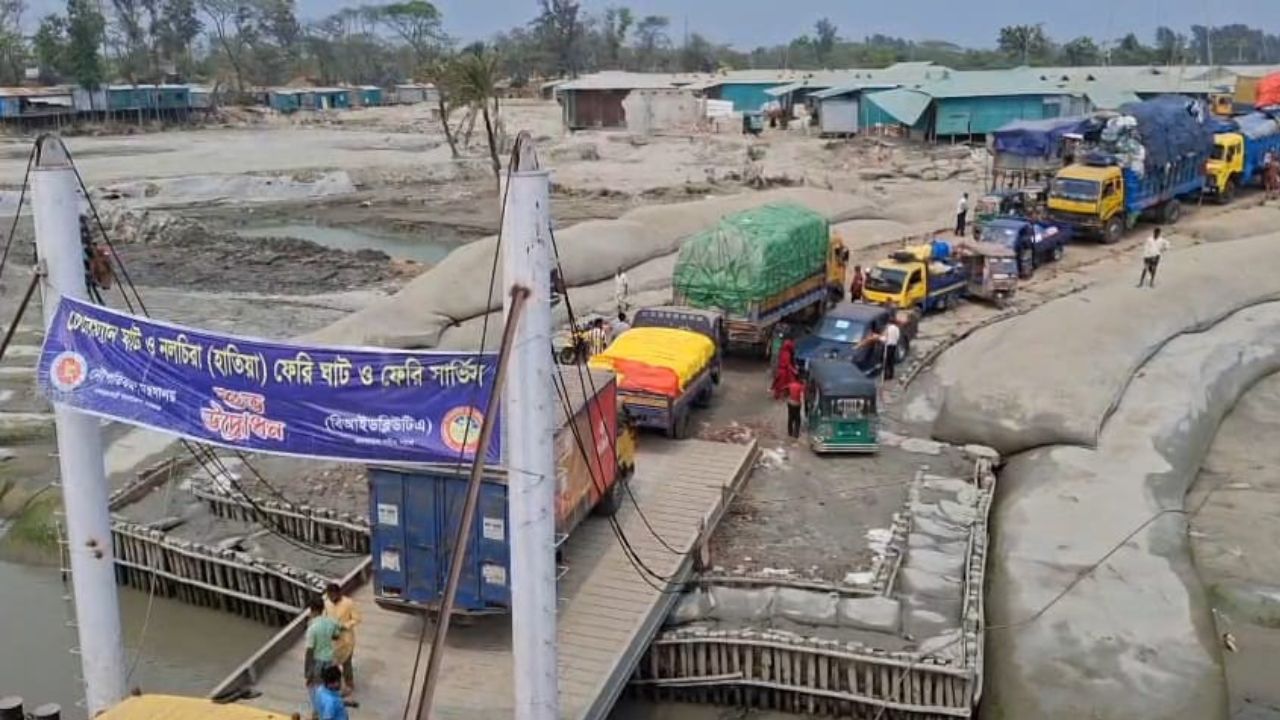



Passengers on the Noakhali-Hatia route are facing severe hardship as tidal water regularly inundates the newly opened ferry terminal and its poorly constructed approach road.
Hatia, an isolated island upazila covering about 2,000 square kilometres, is home to nearly 750,000 people. Surrounded by the Meghna River and the Bay of Bengal, its residents depend almost entirely on waterways to reach the mainland.
For years, they crossed the river aboard trawlers, boats and speedboats, often at considerable risk. The long-awaited ferry service on the Chairman Ghat-Nolchira route was launched in January, raising hopes of safer and easier travel.
However, passengers say the poorly planned terminal and dilapidated approach road have prevented them from enjoying the expected benefits.
During a visit to the terminal, this correspondent found that there was no separate, durable road for boarding the ferry. The main access road goes under water during high tide, leaving the terminal severely waterlogged.
Passengers are often forced to wade through waist-deep water to board or disembark from ferries, causing particular hardship for women, children and elderly people.

Abdur Rahman, a resident of Oskhali in Hatia municipality, said he had hoped the ferry service would end years of suffering.
“But now it seems only the form of our suffering has changed. The road goes under water whenever the tide rises,” he said.
“Even today, I had to wade through waist-deep water with my family to board the ferry. My child was completely soaked and our belongings were damaged. This cannot be called a modern ferry terminal.”
Dhaka-bound passenger Rabeya Khatun said travelling through the terminal had become extremely difficult for women.




“We have to walk through muddy water and then remain on the ferry for hours in wet clothes,” she said. “A raised platform or durable jetty must be built here immediately.”
Drivers of passenger and goods vehicles are also facing serious difficulties. The absence of a designated parking area causes long queues every day, forcing drivers to wait for hours.
Vehicles are also being driven onto ferries through tidal water and strong currents, raising the risk of accidents.
Jasim Uddin, who arrived with a goods-laden truck from Chattogram, said drivers could not see the road beneath the water.
“We have to drive based on guesswork. A wheel could fall into a pothole at any moment, causing the vehicle to overturn and fall into the Meghna,” he said.
“Salt water is also damaging vehicle engines and bodies. We would not have to risk our lives if the terminal and road had been built five or six feet higher.”
The route faces another major concern during natural disasters. Hatia is hit by strong cyclones or tidal surges several times a year, but there is no protected anchorage or safe zone for ferries during emergencies.
Ferry operators fear that vessels and other state property could suffer major damage during severe weather.
Mahananda ferry master Mozammel Hossain said a high-water terminal was urgently needed to protect passengers from tidal flooding.
“A high-water terminal would allow people to travel without wading through waist-deep water even during high tide,” he said.
He said there was also no protected pocket or creek where ferries could be anchored safely during natural disasters.
Nasir Uddin, a local official of the Bangladesh Inland Water Transport Corporation, said the authorities were aware of the problems faced by passengers and drivers.
“The rise in water during high tide is causing temporary difficulties,” he said.
“We have already written to the Bangladesh Inland Water Transport Authority and the Roads and Highways Department, requesting them to raise the terminal and build a durable approach road. We hope a permanent solution will be found soon.”
Residents and transport workers called for the immediate repair of the approach road, modernisation of the ferry terminal and construction of a safe anchorage to protect vessels during natural disasters.
They said the measures were essential to ensure safe travel for Hatia’s 750,000 residents and fully utilise the potential of the Noakhali-Hatia ferry route.