
The journey to Tindu Lower Secondary School is not an easy one.
From Bandarban, it takes around 80 kilometres by road, followed by a one-and-a-half-hour ride on an engine-powered boat along the Sangu River. After reaching the Thanchi ghat, the final stretch requires walking along winding hilly trails to reach the remote Tindu area.
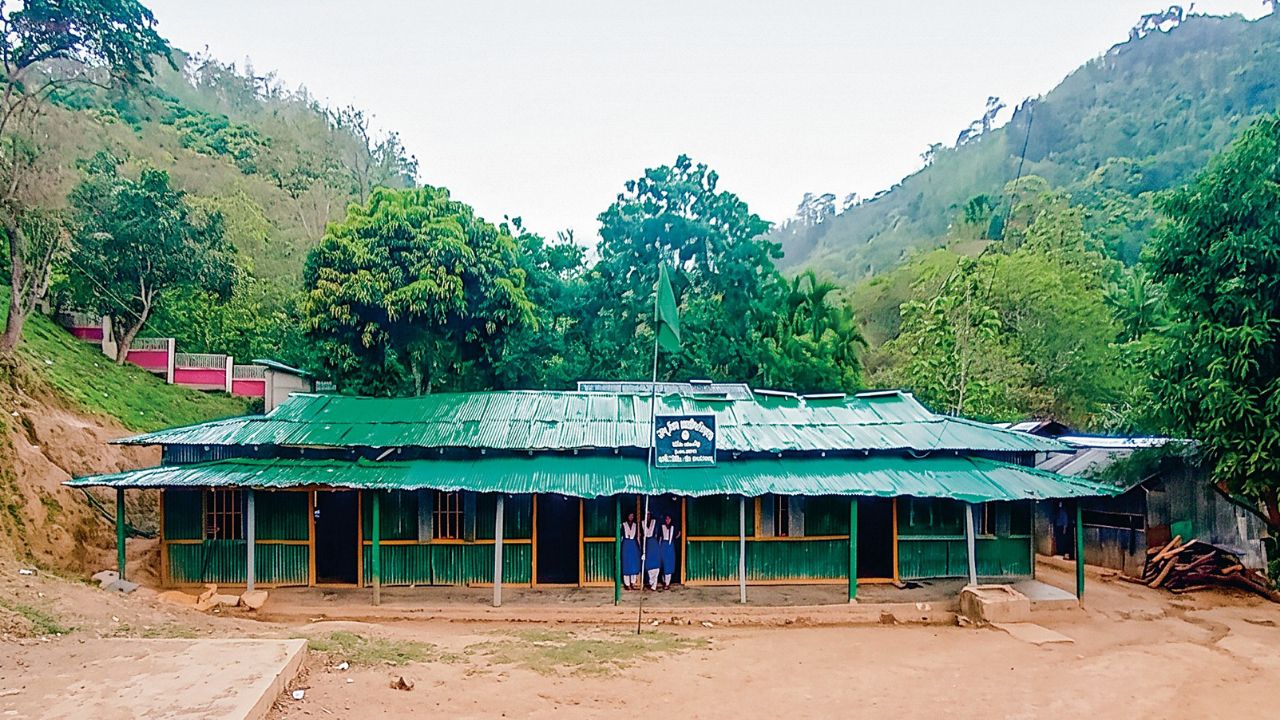
Deep in those hills, inside an abandoned corrugated-sheet-roofed building, a group of teachers has been quietly keeping education alive for children of the remote community for nearly half a decade.
Now, the school they built through local initiative is moving towards nationalisation. The announcement made by the education minister in parliament following the prime minister’s directive has brought celebration to Tindu’s hill communities.
But amid the joy, a question is troubling the teachers who have kept the school running without salaries. Will they still have a place in the institution after nationalisation?
The five teachers currently teaching at Tindu Lower Secondary School all hold bachelor’s degrees, but none has the teacher registration certificate required for formal recruitment.

The school’s story began with an abandoned corrugated-sheet-roofed building of Tindu Bazar Government Primary School. After the primary school moved to a new building, the old structure remained unused.
In 2020, local residents decided to turn that abandoned building into a lower secondary school. Educated young men and women from the area then started teaching students voluntarily.
Over time, the number of students increased. The school now has 56 students receiving regular lessons from five teachers.
For many years, children in Tindu had little opportunity to continue education beyond primary level. The absence of a nearby secondary school meant many had to give up their studies, as travelling to distant schools through mountains, rivers and forest paths was beyond the reach of many families.




To address the problem, local residents decided to establish a school in the abandoned building under the initiative of then union parishad chairman Mong Prue Aung Marma. The responsibility of running the institution was given to Bamong Khyang, assistant headteacher of Remakri High School.
However, the new school had no financial support to continue its operations.
Current chairman Bhagya Chandra Tripura told TIMES of Bangladesh that Thanchi Upazila Parishad provided an engine-powered boat to help meet some of the school’s expenses.
“The boat was rented out to cover some costs of the school. When necessary, headteacher Bamong Khyang himself operated the boat to earn additional money,” he said.
The image of a headteacher operating a boat to support his school later spread on social media. The matter eventually reached the attention of the prime minister, leading to the announcement of the school’s nationalisation in parliament.
For headteacher Bamong Khyang, the decision is a long-awaited recognition of the community’s efforts.
“If the government’s decision is implemented, the school will finally become stable. This is a major source of happiness for thousands of people in this remote hill area,” he told TIMES.
However, for the teachers who worked without pay for years, the announcement has also brought uncertainty.
Assistant teacher Pawong Mro said he fears their contribution may not be recognised after nationalisation.
“I have been teaching since 2020. I have taught without receiving any salary. Now I hear that we may be left out if the school is nationalised,” he said.
Teacher Kain Khumi raised a similar concern.
“Will the government consider keeping us in service by giving us the opportunity to obtain the required qualifications?” she asked.
A senior official of the Ministry of Education told TIMES that teachers in private institutions are currently recruited only through the Non-Government Teachers’ Registration and Certification Authority (NTRCA).
“There is currently no opportunity to continue as teachers in nationalised institutions without registration,” the official said.
However, the official added that considering the difficulties faced in remote areas, the government could introduce a new policy for such institutions.
For the teachers of Tindu, the school’s recognition is a moment of pride. But their future remains uncertain as they wait to see whether their years of unpaid service will also receive recognition.