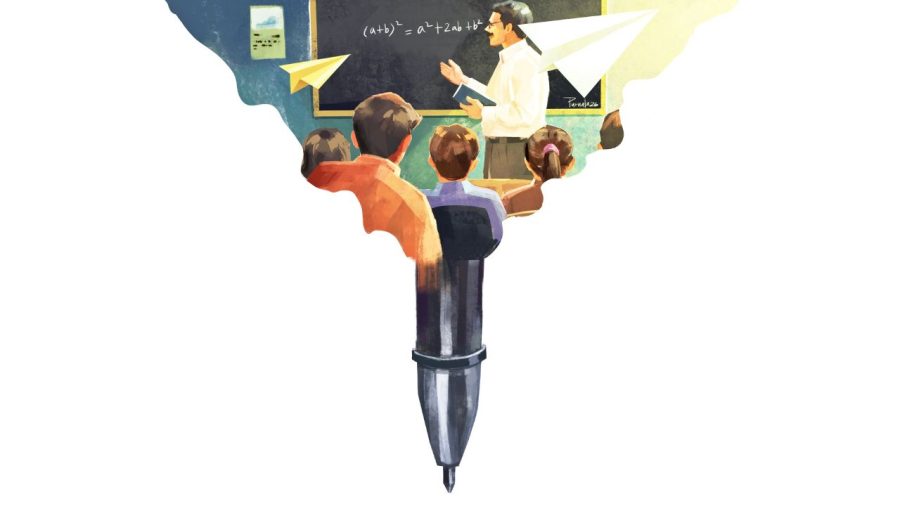



“The human heart can be like the sky / Had I not seen it, perhaps I would never have known / Beyond fairy tales, there exists a vast world / Had I not heard it from them, perhaps I would never have heard.”
How deeply a teacher influences a student’s life is captured in these lines, written by lyricist Zulfiqer Russell and sung by rockstar James. The unique feeling of paying tribute to teachers, tinged with memories of childhood, comes through here. Even today, this song brings a different dimension to programmes at educational institutions, reminding us of the inseparable teacher-student relationship.
Whenever this relationship is discussed, history reminds us of the philosopher Socrates, his student Plato, and Plato’s student, the world-conquering Alexander, a unique example of how a skilled student is built through the initiation of a good teacher. In the Indian subcontinent, Emperor Aurangzeb’s respect for teachers is reflected in Kazi Kader Newaz’s poem “Shikkha Gurur Mardada.”
But today, the reality in our country seems quite the opposite. The sincerity of the teacher-student relationship has been disrupted; it has become confined within the four walls of the classroom. Teachers’ social dignity has eroded, and their financially impoverished lives have turned them into a neglected, marginalised group. But why did this happen?
Educationists say that teachers who flatter power and cannot control their own greed have failed to maintain their personality before students. Moreover, due to inadequate salaries and allowances, they have long been cornered socially and economically. As a result, with their own moral decline and the state’s neglect, teachers have become cornered.
Yet every year, when Teachers’ Day arrives, teachers are remembered across the country. For one day, students recall their teachers. The government also offers words of hope. But as the day ends, so too does the importance of teachers seem to end.

A day of hope, a year of neglect
This time, the day is being observed worldwide with the theme “Standing beside teachers: protecting the profession, enhancing its dignity, and building our future.” This slogan captures the reality of teachers’ current security crisis while emphasising the restoration of their dignity internationally.
On 5 October 1966, at a special conference in Paris, a historic joint recommendation was adopted at the initiative of UNESCO and the ILO to ensure teachers’ rights, responsibilities, working environment, and dignity. Following this, in 1994, at UNESCO’s 26th session, 5 October was declared World Teachers’ Day. Since 1995, the day has been celebrated worldwide every year.
On this occasion, Riaz Parvez, president of the Bangladesh Government Primary School Head Teachers’ Association, told TIMES, “Government primary schools are the backbone of the country’s education. More than one crore children study in about 66,000 government primary schools.




But there is no permanent employee in the schools other than teachers. From cleaning bathrooms to cleaning the school, teachers have to do it in many schools. This is regrettable.”
An assistant teacher of a primary school in Palashbari upazila of Gaibandha, wishing not to be named, said that from election duties to various formalities of the government, teachers have to do the work. On one hand, this reduces attention to teaching; on the other, it increases opportunities for teachers to become involved in various offences.
As a result, the educational environment is disrupted, and opportunities for teachers to lose their dignity are also created.
The research report of the National Academy for Primary Education (NAPE) has also confirmed the truth of this complaint. A government report published earlier this year found that primary school teachers have to do about 37 types of non-professional work besides teaching.
According to the latest data of BANBEIS, about 93 per cent of secondary schools in the country are private. While there are fewer than 700 government secondary schools, there are about 20,000 private secondary schools. In the private sector, more than 80 lakh students study at the secondary level. Lakhs of teachers in these schools are working for very low salaries. Even in many institutions, teachers do not receive regular salaries.
For this, they have to be involved in other alternative professions to support their families.
On this matter, Abul Bashar Howlader, president of the Bangladesh Teachers’ Union, told TIMES, “About 20 million students study in more than 30,000 MPO-listed schools, colleges, and madrasas across the country. Hundreds of thousands are living a subhuman life. Besides, there are at least three to four teachers in several thousand non-MPO educational institutions. Their condition is even worse.
If the country is to develop, the development of teachers must come first. It is never possible to build students as skilled human resources by neglecting teachers.”
He called upon the state to come forward to establish the just rights of teachers if the goals of the fifth industrial revolution are to be achieved.
A system that needs fixing
Professor Mojibur Rahman of the Institute of Education and Research at Dhaka University believes that if teachers are fixed, the country’s education system will be fixed, adding, “The lens through which teachers are viewed in the state and social perspective must be changed. Teachers cannot be evaluated by third or fourth-class jobs or grades.
It is urgent to create a separate pay scale for teachers and a teacher recruitment commission modelled on the PSC for teacher recruitment at all levels. Even teachers need to be considered separately as teachers, rather than keeping them within the state’s conventional warrant of precedence.”
He further said, “The teacher recruitment process is important. For those who are interested in teaching, encouragement must be given to come into teaching, and opportunities must be created for them. There is a big difference between those who come into teaching after failing to get another job and a person interested in teaching coming into teaching. Besides, the promotion process for teachers must be made transparent, so that teachers do not have to give ideas to anyone.”
As the song reminds us, a teacher’s influence extends far beyond the classroom. But for that influence to endure, teachers must be treated with the dignity they deserve – not just on 5 October, but every day of the year. The future of the nation, after all, is built in the hands of those who teach. And if those hands are left empty, the nation’s future will be empty too.