



The narrow lanes of Old Dhaka once carried a quiet, almost unspoken form of generosity.
On painted concrete walls hung shirts, children’s clothes, winter blankets and sarees—left there by those who had more, taken by those who needed. No names were recorded, no questions were asked. The walls functioned on a simple assumption: that people exist for one another.
Today, many of those walls have either disappeared or fallen into neglect.
Some are hidden beneath layers of posters and graffiti. Others have lost their hangers, their colours and their purpose. Walking through the alleys of Old Dhaka now, what stands out is not the presence of that shared compassion, but its slow retreat.
The “walls of humanity” initiative was introduced in Bangladesh more than a decade ago as a voluntary, community-driven effort inspired by similar concepts abroad. In Dhaka, residents, youth groups and local organisations set up designated spaces where donated clothes and essentials could be left for anyone in need. The idea spread quickly, requiring no formal structure—only trust.
In Old Dhaka, where generations have lived side by side and community bonds have traditionally run deep, the initiative found fertile ground.
At the entrance of Shirish Das Lane beside the iconic Beauty Boarding in Sadarghat, one of Old Dhaka’s best-known “walls of humanity” still stands, though barely.
Built with contributions from local residents, the wall was once painted with colourful artwork and lined with hangers filled with donated clothes.

Twenty-one-year-old Mirajul Islam, who grew up in the neighbourhood and now works as a sales representative at a private company, remembers a very different scene.
“During the day, there would be lots of clothes hanging here. By night, everything would be gone,” he said.
Initially, he assumed the clothes were being collected by people in need. Later, he learned that many were being gathered and sold in second-hand markets.
“Some people even exchanged them for kitchen utensils,” he said.
Today, there is little left to suggest what the wall once represented. The paint has peeled away, the writing has faded, and even the hangers have disappeared, reportedly stolen and sold by drifters.


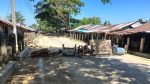

A similar story unfolds near the entrance of the lane beside Shaheed Suhrawardy College in Lakshmibazar.
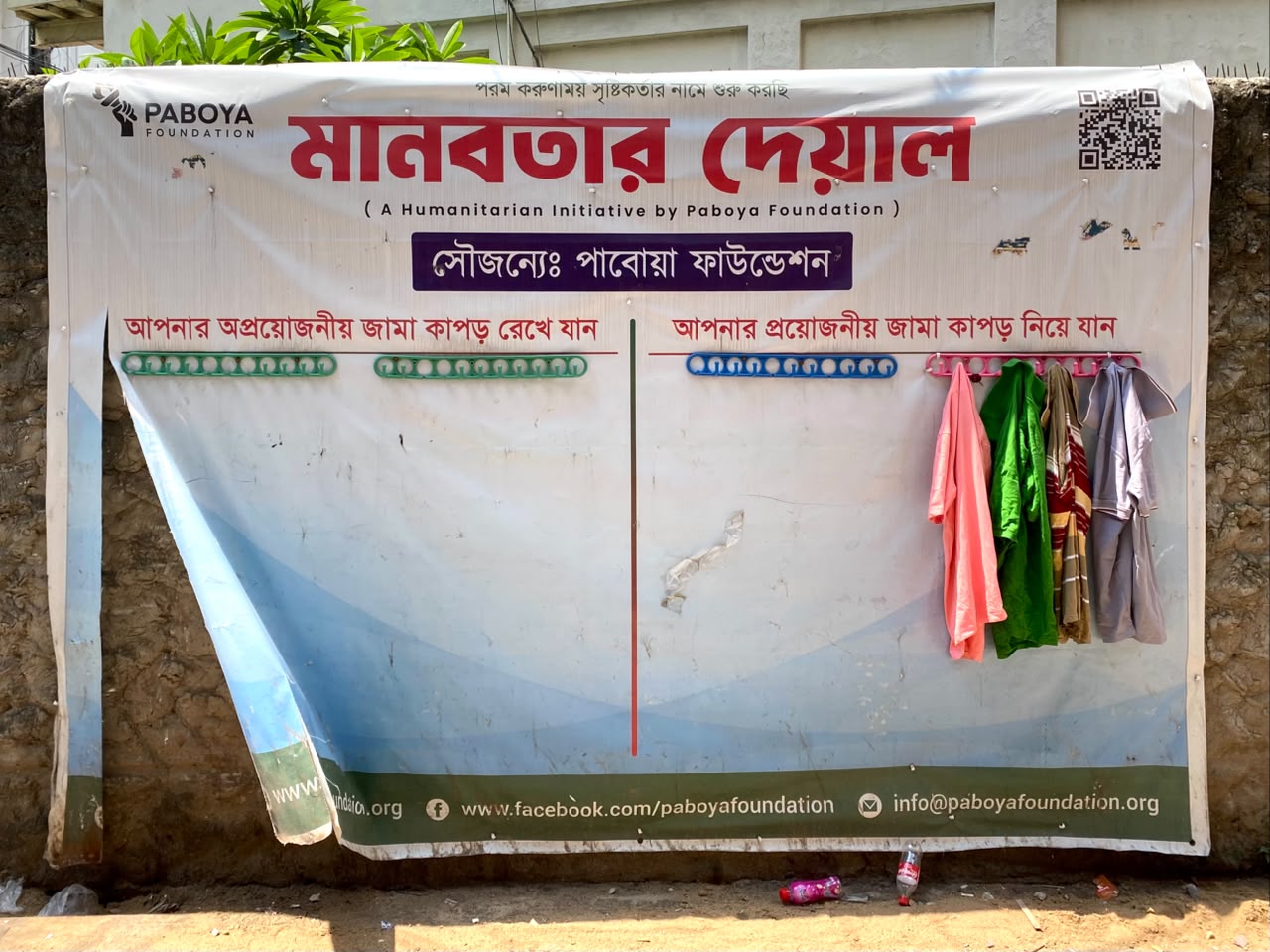
Built with support from the Paboya Foundation, this wall of humanity now bears the marks of neglect. A torn banner flutters overhead. Three of its four hangers remain, but they hang loosely from a single screw.
Only a handful of dusty clothes remain.
As this reporter stood nearby, an elderly woman approached, examined one of the garments quietly and then walked away empty-handed.
Mohammad Manik, a nearby shopkeeper, said the initiative once enjoyed strong community support.
“Local boys used to look after it. Now everyone is busy. Nobody cares anymore,” he said.
But neglect alone does not explain the decline.
“Some people take the clothes and sell them. Others use them as cleaning rags in their shops. The people who need them often never get them.”
The same story repeats itself across Old Dhaka.
In Mawla Bakhsh Lane in Kagojitola, another Wall of Humanity survives in fragments. Built by a local organisation called Hilful Fuzul, the structure once featured iron hangers and a protective tin shade. Now only two of the five hangers remain. Years of exposure have faded the paint so badly that only part of the message can still be read: “Take what you need.”
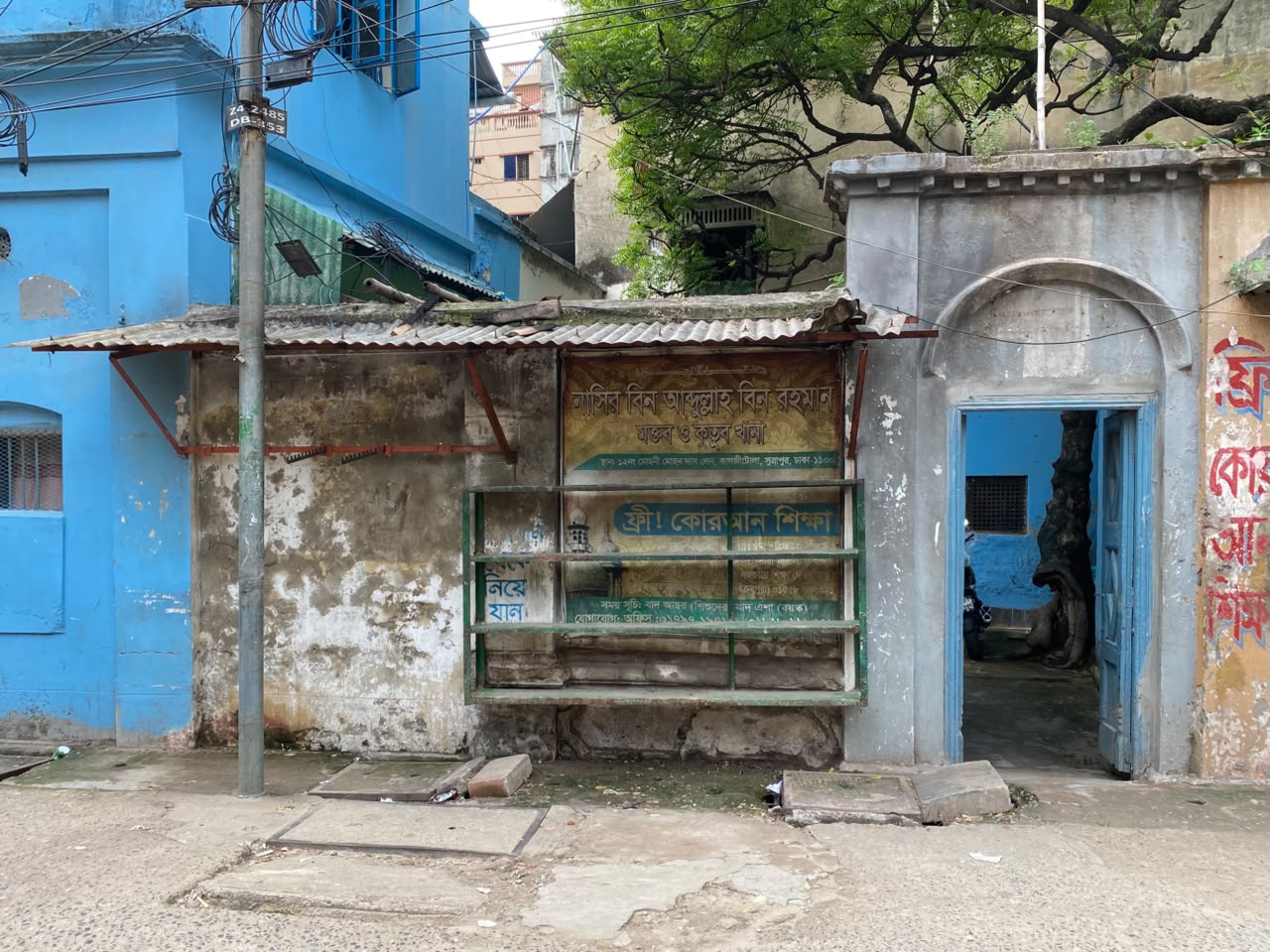
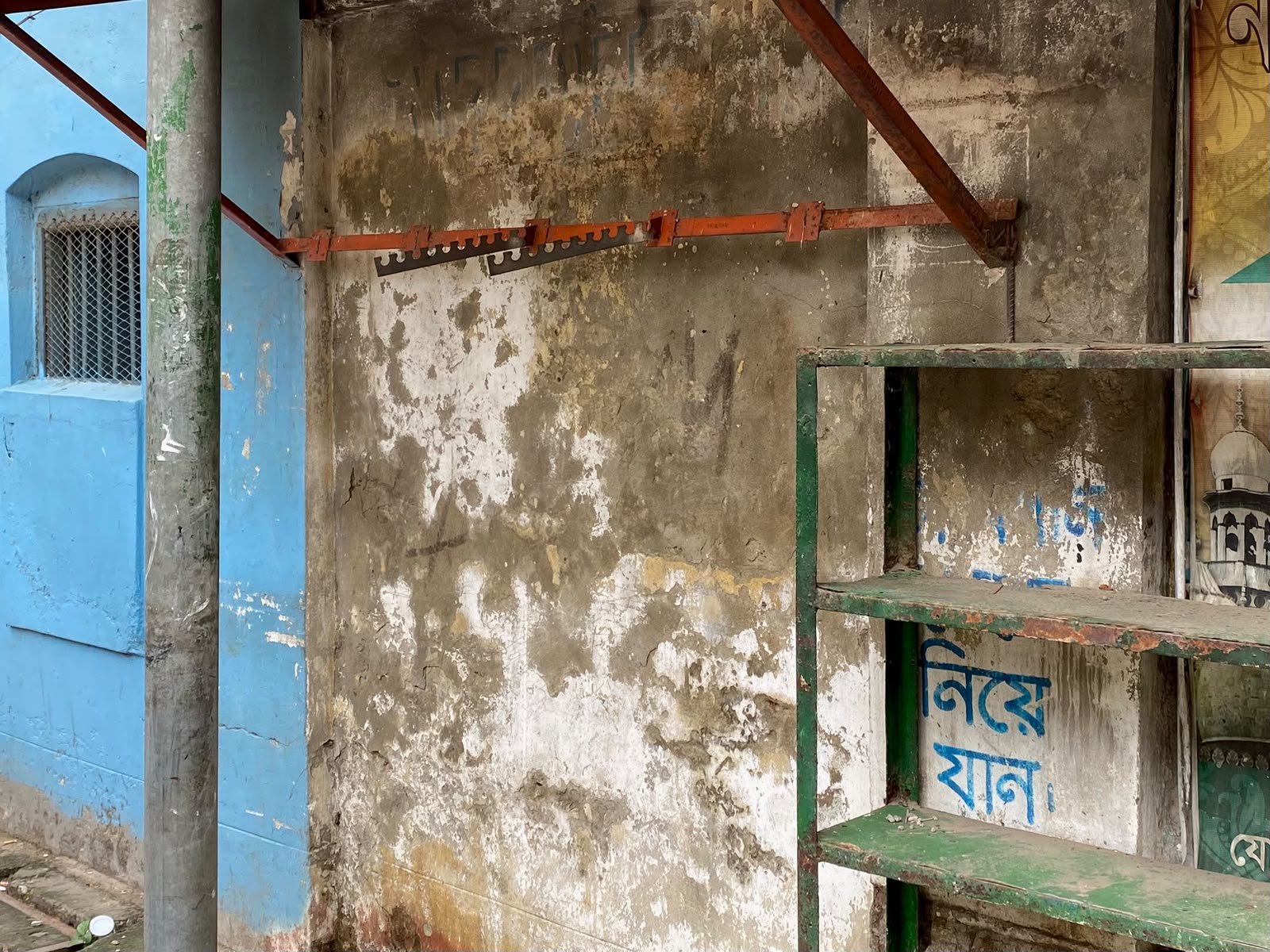
For longtime resident Shukkur Ali, the decline represents the loss of something larger.
He introduced this reporter to Abu Tyeb, one of the founding members of Hilful Fuzul. His disappointment was evident.
“We started this with good intentions,” he said. “Local young people used to maintain the wall. Now they don’t have the time. And because of a few dishonest people, even the good people have lost interest.”
“If someone needed two pieces of clothing, they would take ten or twenty. Some exchanged them for pots and pans. Slowly, everything stopped.”
His observation points to what many residents describe as the deepest crisis behind the disappearance of the walls: the erosion of trust. The “walls of humanity” depended on an unwritten social contract that donors would give sincerely, recipients would take only what they needed, and the community would protect the space. Once that understanding broke down, the walls gradually lost both their function and their meaning.
In Kaltabazar, Pochagoli, Dalpotti and Rokonpur, some Walls of Humanity have disappeared altogether. Others survive only as fading patches of paint.
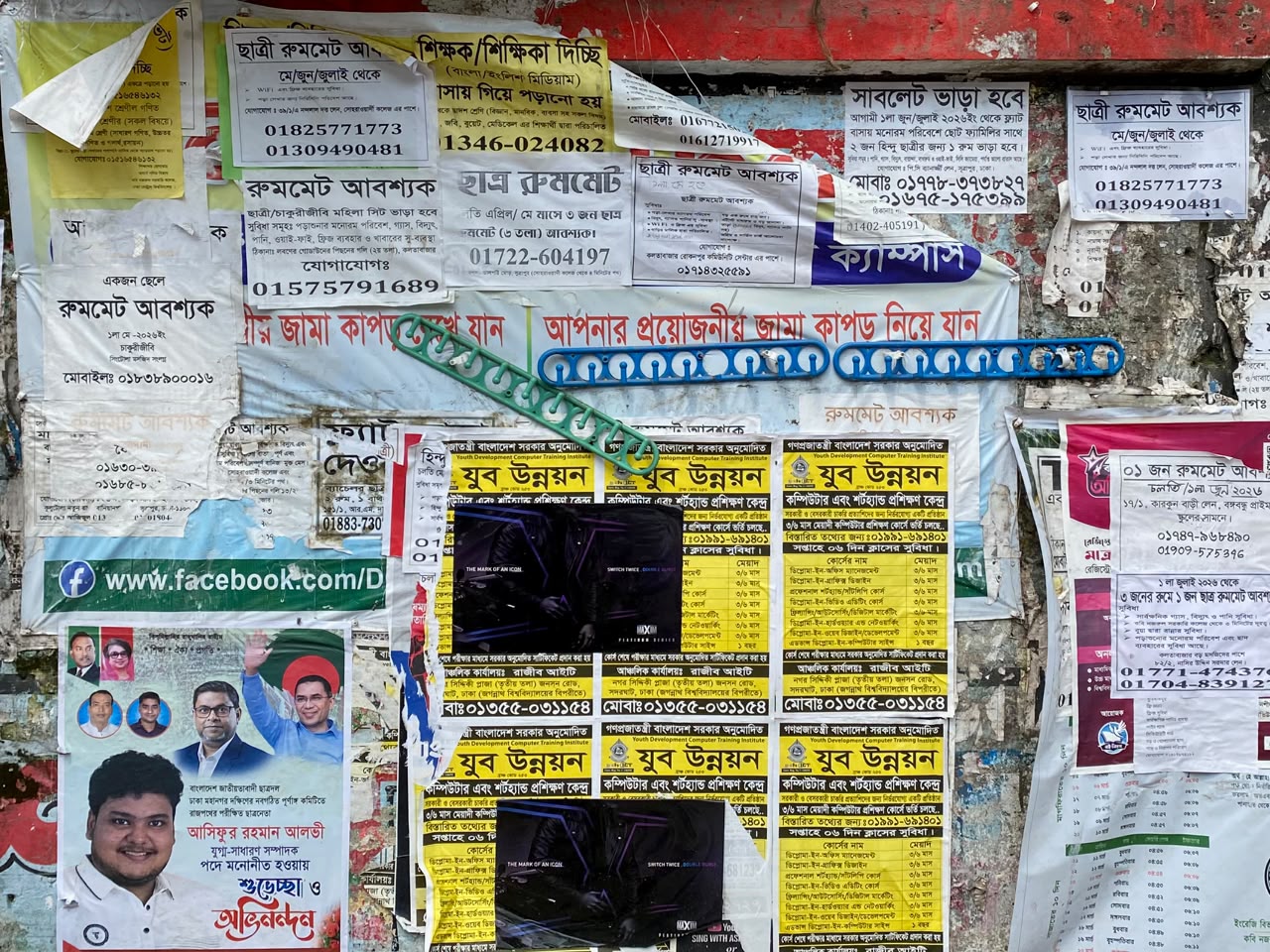
Perhaps the most symbolic example stands in front of Kabi Nazrul Government College.
The structure remains, but its purpose has been buried beneath layers of political slogans, tuition advertisements, rental notices and commercial posters.
Beneath them, barely visible, lies a fading sentence: “Take the clothes you need.”
As evening settles over Old Dhaka and sunlight fades from its narrow lanes, the remaining “walls of humanity” appear lonelier still.
But what has disappeared is the spirit of humanity that once gave them meaning.