The historic Teota Zamindar Bari, associated with the love story of national poet Kazi Nazrul Islam and his wife Pramila Devi, is deteriorating amid a lack of regular maintenance and adequate monitoring.
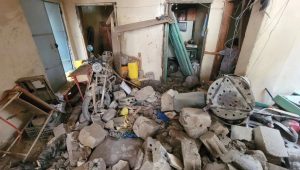
Spread across approximately 7.38 acres in Shibalaya upazila of Manikganj district, the centuries-old estate has crumbling plaster, damaged walls, and unsafe staircases, raising concerns about visitor safety.

The absence of a boundary wall allows cattle to roam freely across the premises. Despite its historical significance, the complex remains vulnerable to further deterioration, with visitors continuing to explore the site on holidays and regular days.
Teota Zamindar Bari is closely associated with Nazrul and Pramila’s romance.


According to local accounts, the poet was captivated by Pramila’s beauty and wrote the lines, “Tumi shundor tai cheye thaki priyo, she ki mor oporadh” (You are beautiful, so I keep gazing at you, my beloved; is that my fault?).
Pramila’s family home stood beside the estate, and Nazrul frequently visited through his friendship with Biren Sen, a nephew of Pramila’s father, Basanta Sen.
The estate is believed to be around 300 years old.



Its architectural complex includes the northern Hemshankar Estate and southern Joyshankar Estate, along with natmandirs, the Laldighi building – once used as the zamindars’ inner quarters – and a four-storey Navaratna temple standing approximately 75 feet tall.
The deteriorating structures threaten the site’s architectural heritage and pose potential risks to visitors. Without timely repairs and regular supervision, further damage could lead to the loss of important historical features.

Recently, a group of schoolteachers from Dohar upazila visited the estate and played cricket on the premises. Mahbub Alam, one of the visiting teachers, expressed concern over the site’s condition.
“Tourist attractions are already limited in the country. I do not understand why such a beautiful place has been left in this condition. The government should pay attention to this historic structure as soon as possible,” he said.

The site needs urgent structural assessments, repairs, a boundary wall, and regular maintenance. A planned conservation programme could protect its architectural heritage, improve visitor safety, and preserve its connection to Bangladesh’s literary history for future generations.
For a country where heritage sites are often neglected, Teota Zamindar Bari stands as both a treasure and a warning.

It is a place where history and romance intersect, where a national poet once gazed upon his beloved and wrote lines that would endure for generations. But unless the authorities act, the estate that witnessed that love story may not survive to tell it.
The plaster is crumbling. The walls are damaged. The staircases are unsafe. And the cattle roam freely where visitors once walked. The question is not whether Teota Zamindar Bari is worth saving; it is whether anyone will take the trouble to save it.