


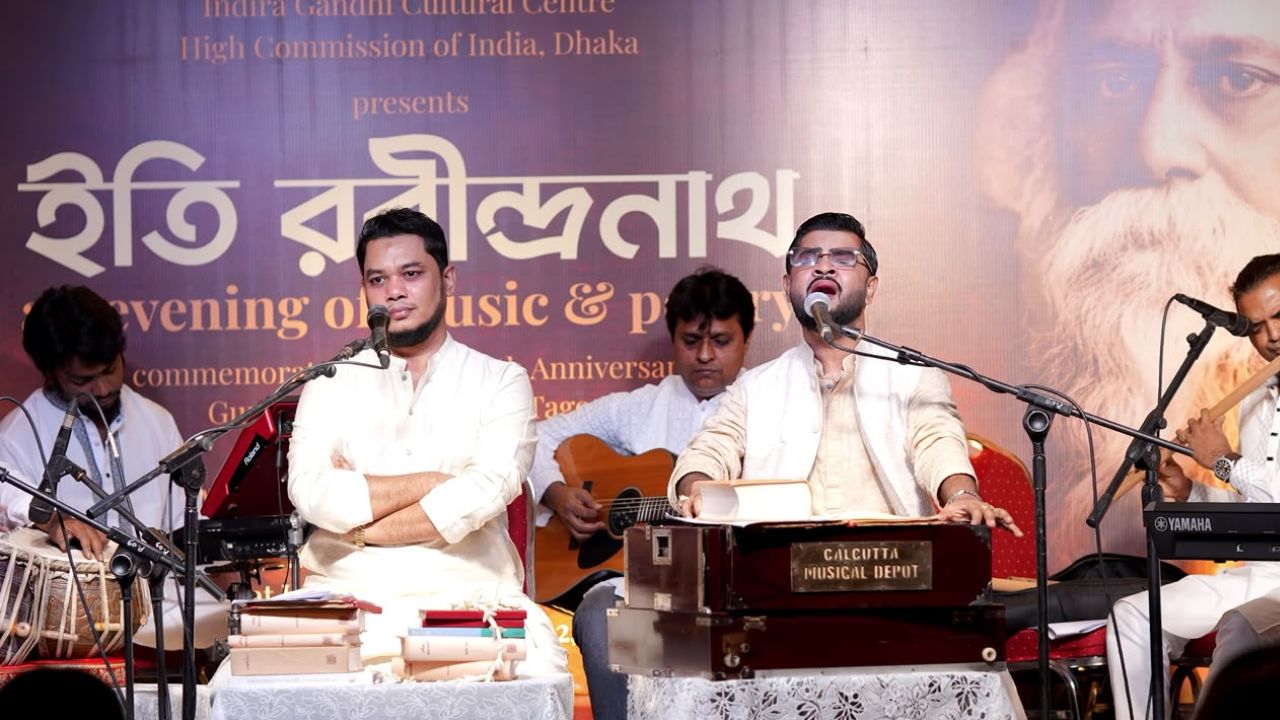
Popular singer Shwapnil Shojib has captivated audiences with his music, particularly through his performances of Rabindra Sangeet.
Having performed the songs of Rabindranath Tagore regularly in Bangladesh and abroad, he has also earned recognition on the international stage.
Two days ago, the High Commission of India in Dhaka and the Indira Gandhi Cultural Centre (IGCC) jointly organised an evening of music and recitation titled Iti Rabindranath at the Indian Cultural Centre in Gulshan, Dhaka, marking the 85th death anniversary of Rabindranath Tagore.
Indian High Commissioner to Bangladesh Dinesh Trivedi welcomed the guests at the beginning of the programme.
In his speech, he recalled Tagore’s universal humanism and his immense contributions to literature and philosophy.
Shwapnil performed several of Tagore’s iconic songs, including Aguner Poroshmoni, Amar Hiyar Majhe, Tumi Robe Nirobe, O Je Mane Na Mana, Maran Re Tuhu Momo Shyam Saman, Bhara Badar, Majhe Majhe Tobo Dekha Pai, Phule Phule Dhole Dhole, Je Rate Mor Duarguli, Labonye Purno Pran, Aji Jhorer Rate and Sokatore Oi Kadiche Sokole.
The recitation segment was led by Samiul Islam Polak, who began with the Mahamrityunjaya Mantra.
He then recited works from Tagore’s Arogya, Maran, letters to Mrinalini Devi, Nimantran, Kripan, Gitanjali, Bhrashtalagno, Shesher Kobita and Bhanusingher Padabali.
Shwapnil has performed Rabindra Sangeet in countries including India, the United States, the United Kingdom and Australia.
His work has earned him recognition both in Bangladesh and internationally, including two national awards from the Bangladesh government and honours from institutions in India, the US and elsewhere.
He has also been invited as a guest lecturer at Rabindra Bharati University, the University of Illinois Urbana-Champaign and the University of Minnesota.
Through Iti Rabindranath, the High Commission of India and the IGCC paid tribute to Tagore’s timeless literature, music and philosophy.
The participating artistes were honoured with commemorative mementoes at the end of the programme.


