


Over the past two years, 555 accused across 77 cases have been brought under trial at the International Crimes Tribunal (ICT), established to try crimes against humanity committed during the 15-year rule of the ousted Awami League regime and the July mass uprising.
However, 352 accused remain absconding.
Verdicts have been delivered in seven cases across two tribunals, 26 cases are under trial, and investigations are ongoing in the remainder. As the locations of many accused cannot be identified, questions surround the execution of sentences even after verdicts are delivered.
According to the Chief Prosecutor’s Office, individuals accused in multiple cases are counted separately in each, meaning the figure of 555 does not represent unique individuals.
In connection with crimes against humanity committed during the July 2024 mass uprising, 68 individuals have been sentenced across seven cases. A significant number of these convicts are absconding.
Most recently, on 15 September, the tribunal sentenced seven individuals to death, including Obaidul Quader, general secretary of the Awami League. All seven remain fugitives.
Across the seven decided cases, 20 of the 68 accused have been arrested while 48 remain at large. Prosecution data shows 23 received death sentences – 20 absconding and three arrested – while 45 received life imprisonment and other sentences.
Fugitives include Sheikh Hasina, ousted prime minister; Asaduzzaman Khan Kamal, former home minister; Aziz Ahmed, former army chief; several serving and former military officers; Benazir Ahmed, former inspector general of police; Habibur Rahman, former DMP commissioner; M Khurshid Hossain, former director general of RAB; and Md Harun-or-Rashid, former police official.

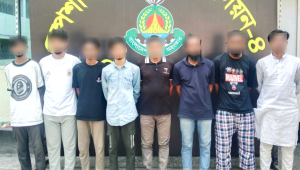
Leaders and activists from the Awami League, Jubo League, Chhatra League, and associate organisations are also fleeing. In two enforced disappearance cases, 17 of 30 accused have not been arrested.
In other cases, the absence of accused has become critical. In a Kushtia murder case, a verdict is expected against four absconding accused, including Mahbubul Alam Hanif, joint general secretary of the activity-banned Awami League.
Similarly, in a Narayanganj crimes against humanity case, all 12 accused, including Shamim Osman, former member of parliament, remain absconding.
Concerns over executing sentences
Questions have intensified over executing sentences if fugitives are not apprehended.
Md Aminul Islam, chief prosecutor of the tribunal, told TIMES of Bangladesh that during trials, the responsibility to arrest accused lies with law enforcement, the prosecution, and the investigation agency.
However, after a verdict, arrest becomes the responsibility of the government and law enforcement, leaving no scope for prosecution initiatives.




Prosecutor Mizanul Islam said executing verdicts is the government’s responsibility, adding that failure to arrest accused prevents execution, frustrating victim families and hampering justice.
He noted that law enforcement cannot be blamed entirely, as many fled abroad using multiple passports.
Following the fall of the Awami League regime on 5 August 2024, top leaders went into hiding and some fled abroad. After trial proceedings began, many could not be traced. Although a few were arrested while in office, the majority remain at large.
Consequently, execution remains uncertain despite advancing trial processes. Visible progress in executing arrest warrants remains absent, leaving questions over the ultimate outcome of trials.
Mounting pressure across two tribunals
Widespread killings occurred during the July mass uprising, with United Nations estimates placing the death toll at 1,400 alongside thousands injured.
Following the fall of the Sheikh Hasina-led government on 5 August 2024, the interim government reconstituted the three-member tribunal on 14 October 2024, with Justice Md Golam Mortuza Mozumder, chairman, heading the panel.
As cases mounted, International Crimes Tribunal-2 was established on 8 May 2025, headed by Justice Nazrul Islam Chowdhury.
Wednesday marked two years since the reconstitution of the tribunal, which conducts trials across both tribunals for July uprising crimes as well as enforced disappearances, murders, and torture during 15 years of Awami League rule.
Pressure on the two tribunals is rising steadily, with over 50 allegations selected for investigation and several hundred complaints submitted.
Logistical delays and capacity shortages
Disposing of a single case takes several months, raising fears of longer waits as cases accumulate, while martyr families and injured fighters demand quick justice. Relevant individuals believe increasing tribunal numbers is essential for speedy trials.
Home Minister Salahuddin Ahmed told Parliament on 14 July that tribunals, prosecutors, investigation officers, and logistical support would be increased if needed; however, months have passed without additional tribunals.
Chief Prosecutor Md Aminul Islam told TIMES that completing a trial takes three to five months, with four to five cases tried daily. He explained that taking witness testimony in one case prevents doing so simultaneously in another, causing delays.
He stressed that increasing tribunals, prosecution members, and investigation officers is essential.
Mohammad Tajul Islam, former chief prosecutor, said limited capacity within tribunals and the investigation agency has significantly slowed progress, adding that infrastructure and manpower are inadequate for full investigation, trials, and appeal disposals.
Delays also stem from logistical support shortages and decision-making delays. The cases taking longest involve enforced disappearances. Trials in two cases involving complaints at RAB’s TFI cell and DGFI’s JIC began last December with charge framing.
Over 10 months have passed, but witness testimony has not concluded. Charges were framed against Ziaul Ahsan, former military officer, on 14 January over enforced disappearance, murder, and torture of over 100 people, with the IO’s statement concluding recently.
Chief Prosecutor Md Aminul Islam noted that defence lawyers for 28 accused in two disappearance cases cross-examining witnesses separately requires extra time.
Growing frustration among victim families
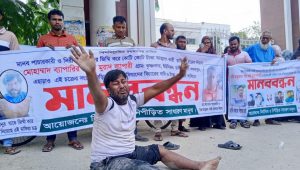
Anxiety regarding trial speed remains high among victim families. At a human chain in front of the tribunal on 23 July organised by an 11-party alliance led by Jamaat-e-Islami and martyr family members, speakers expressed anger over slow trial progress.
Parvin Akter, mother of martyr Mehedi Hasan, said, “We see no justice being delivered for our children’s murder. What crime did our children commit by giving their lives?”
Hasinur Rahman, retired brigadier general and victim of enforced disappearance and torture, said trials are moving at a very slow pace, warning that sensitive cases cannot be investigated properly without skilled manpower and adequate facilities.
Hasnat Abdullah, member of parliament and southern chief organiser of the National Citizen Party (NCP), alleged that no visible progress exists in the July genocide trial process and that trade is taking place over cases.
Speaking at a discussion meeting at the NCP office on Tuesday, Hasnat said, “BNP has July on its lips, but Awami League in its heart.”