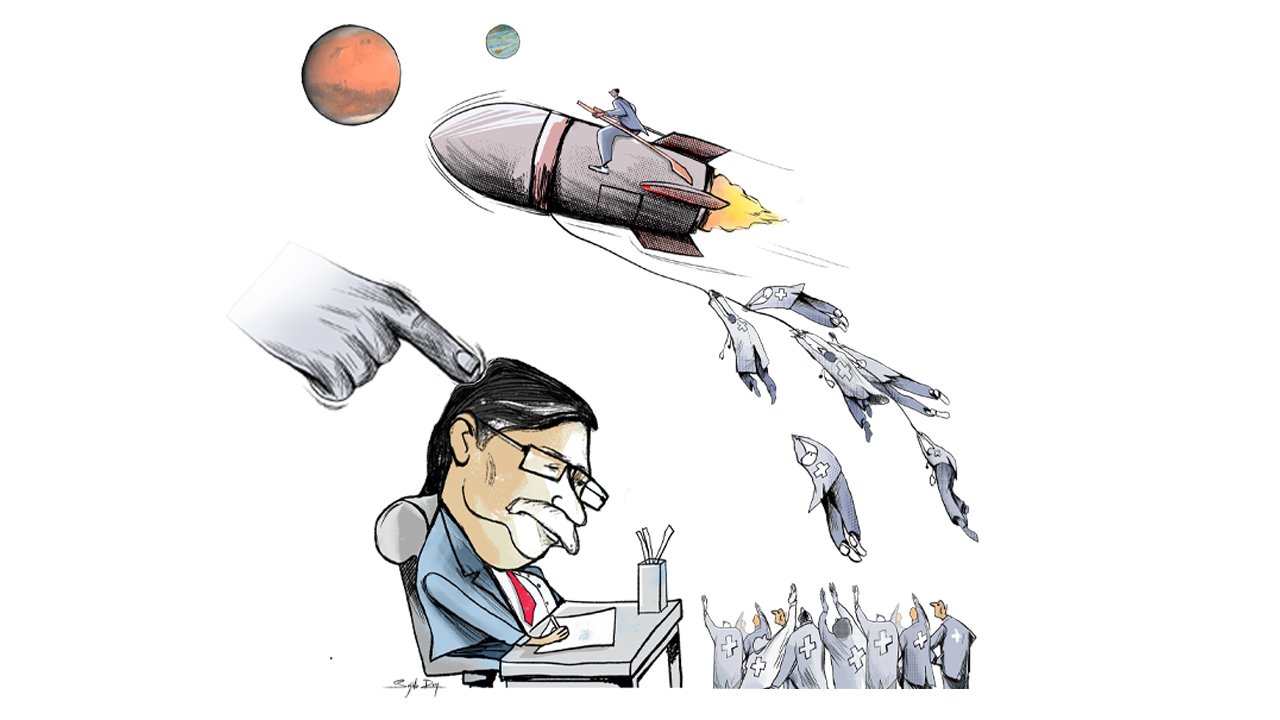

A presidential waiver has created a shortcut to professorship at Bangladesh Medical University (BMU), promoting 10 associate professors—including some with just 18 months’ teaching experience—bypassing the mandatory five-year requirement.
All 10 are leaders or members of the Doctors Association of Bangladesh (DAB), a physicians’ organisation aligned with the ruling BNP.
One of those promoted told TIMES of Bangladesh that files for another 38 academics were also being prepared for submission under the same process to the president, who is also the university’s chancellor.
Under BMU’s recruitment and promotion regulations, candidates must have at least five years of active teaching experience as associate professors before becoming eligible for promotion. None of the beneficiaries fulfilled the criterion. Some had served for only 18 months, while others had about two years’ experience.
A senior BMU professor strongly criticised the decision.
“Waiving academic eligibility requirements and making people professors overnight is entirely unprecedented,” the professor told TIMES seeking anonymity. “It is the result of an influential political syndicate within the university abusing its power.”
On 12 April, the Health Education and Family Welfare Division under the Health Ministry issued a gazette notification, confirming that the president had waived the minimum active teaching requirement.
Those promoted teachers are Sheikh Farhad, Erfanul Haque Siddiqui, Md Ashraful Islam and Muhammad Abdul Awal of Orthopaedic Surgery; AM Shahinur of Paediatric Surgery; Mohammad Abdus Salam and Mohammad Rafiqul Islam of Urology; Umme Kulsum of Feto-Maternal Medicine; Md Zahidur Rahman of Gastroenterology; and Kazi Ashraful Islam of Paediatric Neurology.
Asked why the promotions were approved despite the candidates failing to meet the prescribed criteria, President Mohammed Shahabuddin declined to comment on the individual cases.

“I perform my duties in accordance with the established constitutional process,” he told TIMES. “Where the Constitution requires my signature, I sign. Beyond that, I cannot make any specific comment on the matter.”
The president said files were generally sent to him for formal approval after the relevant authorities had already made their decisions.
Under Bangladesh’s constitution, the president generally acts on the advice of the prime minister.
Promotion before recruitment notice
An unusual development followed. On 1 June 2026, six weeks after the promotions of the 10 teachers, BMU issued a regular recruitment circular for professors.
The advertisement clearly said that applicants must have five years’ experience as an associate professor, 10 years’ active teaching experience at recognised institutions, and at least 12 published research papers.
Mohammad Ali Jinnah, a professor at Institute of Education and Research of Dhaka University, warned that relaxing promotion criteria could set a damaging precedent, noting, “You can buy everything but experience. It has no substitute. And this is particularly critical in medical education, where teaching and clinical practice rely heavily on hands-on expertise; promoting academics with substantially reduced experience could have long-term consequences for healthcare.”
He added that university promotion policies across Bangladesh should remain consistent. While minor discipline-specific differences are justifiable, promoting someone from associate professor to professor after only two years of active teaching is unacceptable.

Another IER professor at Dhaka University, M Wahiduzzaman, described such promotion process as “illegal” and “an abuse of power”.
“There is no provision anywhere in the university’s act or the constitution allowing the president to relax the eligibility criteria for academic appointments or promotions through a waiver,” he told TIMES.
He was of the opinion that this has been done by “sheer force”, and imposing such decisions in this way is itself an “offence”.
Rejecting concerns that the promotions would undermine academic standards, BMU Proctor Sheikh Farhad, who is among those promoted, acknowledged that none of the recipients had completed the required five years of active teaching.
“Some of us have only one or one and a half years of active teaching experience,” he said. “However, many of those promoted completed their MS or other higher degrees in 2010 or 2012.”
He argued that although they earned their specialist qualifications 12 to 17 years ago, many doctors had remained stuck as medical officers for years due to political bias.
“Many of us were denied promotion and kept as medical officers or consultants because of our political identity,” he claimed, adding that some of their former students had already become professors. “Those who say we lack experience should ask why we were denied promotion for so many years.”
Their position in DAB
On 28 October 2025, a press release signed by BNP Senior Joint Secretary General Ruhul Kabir Rizvi approved a 276-member central committee of DAB, alongside a 57-member advisory council.
Several of the promoted individuals hold key roles in DAB. Erfanul Haque Siddiqui serves as president of the BMU chapter of DAB and vice-president of the central committee, while Sheikh Farhad is the BMU chapter’s general secretary and joint secretary general of the central committee. Mohammad Rafiqul Islam is vice-president of the BMU chapter and Health Affairs Secretary of the BNP, and Mohammad Abdus Salam is a former president of the chapter. Additionally, Ashraful Alam Manik serves as joint international affairs secretary, Muhammad Abdul Awal and AM Shahinur are executive committee members, and Umme Kulsum, Md Zahidur Rahman, and Kazi Ashraful Islam are lifetime members.
DAB President Professor Harun Al Rashid denied that the organisation had lobbied for the presidential waivers, saying that university authorities forwarded the files after considering individual circumstances.
He argued that many of the promoted doctors had joined government service in 2002 and 2003 but remained medical officers for years due to political bias, whilst junior colleagues had already become professors.
He asserted that after being deprived of advancement for 17 years, it was reasonable for their requests to receive special consideration. Harun claimed similar waivers had been granted in the past, though he failed to provide documentary evidence when questioned by TIMES.
More files heading to the president
Once the 10 teachers got promotion on presidential waiver, many other teachers became desperate grab the opportunity. Lists of them were being prepared to give promotion in the short-cut way, using political influence, according to multiple sources in the BMU.
However, BMU Proctor Sheikh Farhad insisted the process had been entirely institutional rather than politically influenced.
Explaining the procedure, he said the promotion board consists of 10 members, including the vice-chancellor, pro-vice-chancellor, the relevant dean, the department chair or a senior professor, an external expert in the relevant discipline, and the registrar as member secretary.
“As I am from Orthopaedics, my evaluation was conducted by the chairman of the Orthopaedics Department together with an external expert,” he said.
He added that the university’s 92nd Syndicate meeting had already decided to send another 38 files to the president seeking similar waivers. “In future, if candidates meet all promotion criteria except the active teaching requirement, presidential waivers will also be sought in those cases,” he said.
Ministry, BMU decline to explain
Asked why the Health Ministry proposed relaxing the promotion criteria, BMU Vice-Chancellor FM Siddiqui, who chaired the promotion board, declined to comment. His personal officer told TIMES, “The vice-chancellor does not speak to newspapers, and there is no system for arranging formal interviews with him.”
Later, SM Ahsanul Aziz, Additional Secretary (Administration) of the Health Education and Family Welfare Division, said the government may grant waivers where it considers them to be in the public and academic interest.
“If, after such a decision, the individuals concerned satisfy the remaining qualifications and standards, there should be no problem,” he said, adding that he assumed all other necessary requirements had been met, although he could not confirm the details.
A senior BMU professor, however, warned that the consequences could be serious.
“When these doctors later serve as thesis supervisors or examiners, their academic credentials will become a laughing stock internationally,” he said. “This is a calculated attempt to undermine higher education and medical education in Bangladesh.”
He stressed that a professorship is neither an administrative nor a political position.
“It is recognition earned through years of teaching, research and academic leadership. Appointing people to such positions without adequate experience will directly affect both students and patients,” he said.
The professor further alleged that following the political change on 5 August 2024, many doctors were rapidly promoted from medical officer through successive grades to associate professor within only 18 months, citing claims that they had previously been deprived of promotion.