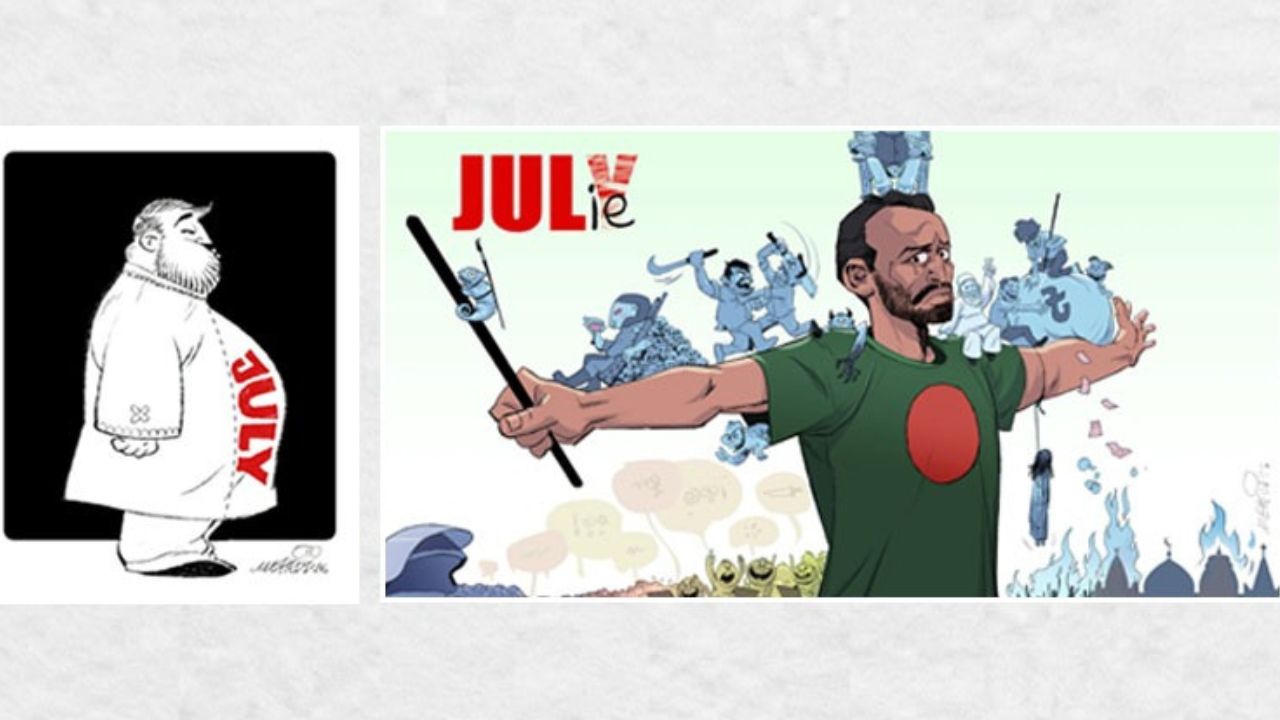



Abu Sayed, one of the most powerful symbols of the July uprising, stands with both arms outstretched. A chameleon perches on the stick in his hand. On one shoulder, armed grey figures fight beside a helmeted character drinking alcohol and a pile of skulls.
On the other sits a man in a white panjabi atop sacks of money. Below them appear monstrous figures, hateful slogans, violence and the silhouette of a hanging woman.
But there is no joy of victory in Abu Sayed’s eyes. He looks tired and uneasy, as if asking what was achieved through his sacrifice.
The burden on his shoulders represents a new reality marked by power grabbing, mob violence, extortion, case-trading, money, opportunism, violence against women, communal tensions and broken promises.
The cartoon, drawn by New Age cartoonist Mehedi Haque, has triggered intense debate on social media. Critics accuse him of insulting Abu Sayed and undermining the spirit of the July movement.
Mehedi drew the Abu Sayed cartoon on August 5, 2025, when it attracted little attention. But after publishing another cartoon this July depicting National Citizen Party Convener Nahid Islam with the word “July” written across his belly, he became the target of attacks.
Mehedi, however, says the work was intended not to mock a martyr but to question the political and social order that emerged after his sacrifice.

“The cartoon shows how opportunists are using Abu Sayed for their own interests while he watches it all with sorrow,” Mehedi told TIMES of Bangladesh. “It exposes who is really dishonouring him and how.”
The dispute has raised a broader question: how much space remains for political cartoons and criticism in post-July Bangladesh?
“The cartoon did not belittle the movement,” he said. “It symbolised what happened afterwards, such as robbery, looting, mob violence, extortion, the business of transferring cases and money laundering.”
The controversy raises a broader question. Does the standard for freedom of expression change whenever political power changes hands?
Notably, in the 2026 Reporters Without Borders (RSF) World Press Freedom Index, Bangladesh dropped three places to 152nd, falling into the “very serious” category.


Two decades of challenging power
Mehedi has been drawing political cartoons since 2003, challenging successive governments, institutions and centres of power.
During the Awami League’s rule, he criticised elections, the voting system, the administration, the Digital Security Act and abuses of state power.
After the 2014 election, he portrayed a ballot box as Aladdin’s magic lamp and the chief election commissioner as its genie. He also drew cartoons on the 2018 election and used George Orwell’s “Big Brother” in 2023 to criticise the Digital Security Act.
His work did not change after the 5 August changeover. He continued to draw cartoons about the then BNP acting Chairman Tarique Rahman, the then chief adviser and advisers of the interim government, journalists, intellectuals and even New Age editor Nurul Kabir.
Yet some who once praised him as a fearless defender of free expression are now branding him a “collaborator” or a “sold-out” artist for questioning the post-July reality.
“Since 5 August, politics based on hatred and division has grown many times over,” Mehedi said.
“There is a planned campaign of abuse against art and good taste. Those leading these attacks are frightened people enjoying temporary, fake power.”
Among those criticising the Abu Sayed cartoon was Press Institute Bangladesh Director General Faruk Wasif.
“This cartoon humiliates both July and its hero, martyr Abu Sayed,” Faruk wrote on Facebook.
His remarks drew attention because, after writer Mushtaq Ahmed died in custody and cartoonist Ahmed Kabir Kishore was imprisoned, Faruk had called for a gathering demanding “Freedom for Life and Speech”.
Asked why his position appeared to have changed, Faruk said, “The limit of freedom of expression is where hate speech begins. A cartoon is not a holy scripture. People are free to criticise it or interpret it differently.”
Freedom after the uprising
Activist Baki Billah said people like Mehedi had opposed authoritarianism long before the July 2024 uprising.
“If the very freedom that people struggled so long for becomes questionable, then where does the core spirit of the movement stand?”
The debate has also raised fears that the “spirit of July” could be used in the same way the “spirit of the Liberation War” was once used to silence dissent.
Saiful Alam Chowdhury, associate professor of mass communication and journalism at the University of Dhaka, said pressure on cartoons and journalism had not disappeared, although its form had changed.
“After 5 August, part of the pressure once exercised by the state has shifted to social media mobs,” he told TIMES of Bangladesh.
“Mehedi was praised on 5 August. Now that he criticises the new reality, he is being turned into an enemy. Yet one powerful cartoon can have more impact than a hundred news reports.”
“Celebrating someone as a symbol of free expression one day and then trying to strip away that freedom because of criticism the next is nothing but hypocrisy.”
The dispute is therefore has become a test of whether post-July Bangladesh can tolerate uncomfortable art, political satire and criticism of those claiming ownership of the uprising.