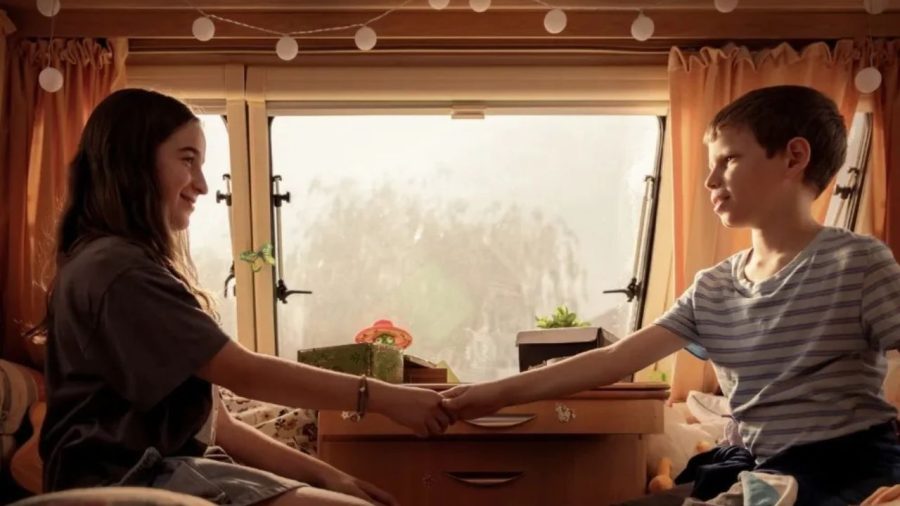



Romanian-Bulgarian drama Atlas of the Universe won best feature film at the 13th Sharjah International Film Festival for Children and Youth, while Brazilian animation My Grandfather Is a Nihonjin took the award for best animated feature. The festival also introduced its first Audience Award and doubled the size of its pitching platform as it expanded opportunities for young audiences and emerging filmmakers.
According to Variety, the festival wrapped up on Sunday after screening 71 films from 38 countries. The selection came from 1,802 submissions representing 72 countries, with Italy serving as the Country of Honour. Beyond the awards, this year’s edition placed greater emphasis on industry development, regional connections and youth participation.
Directed by Paul Negoescu, Atlas of the Universe follows a 10-year-old boy whose errand to buy school shoes becomes a journey towards independence. The jury described the coming-of-age drama as “the essence of this festival”.
Celia Catunda’s My Grandfather Is a Nihonjin follows a Japanese-Brazilian boy as he explores his family history and cultural identity. The jury recognised the animated film for its treatment of tradition and “the difficulty of starting a new life in a foreign place”.
Saudi filmmaker Areej Alghamdi won best documentary for The Path of Memory, Between the Lands of Jasmine and Basil, which explores cultural memory and heritage through a young girl and her mother. Emirati director Abdulrahman Al Madani’s Oug, about a childless couple facing family pressure and gendered blame surrounding infertility, won best Arabic short.
Shweta Parakh and Rakesh E Nair’s Little Big Dreams received the award for best international short. The film follows a girl in Ladakh, India, who uses a wheelchair and is determined to pursue her education and be seen with “pride rather than pity”. The jury praised its portrayal of “resilience, friendship and the power of the human spirit”.
Thai feature Gohan, directed by Chayanop Bunprakob, Baz Poonpiriya and Atta Hemwadee, won the festival’s inaugural Audience Award. The film follows a stray dog through the lives of three owners over more than a decade. It also received a special mention from the feature film jury.

Other winners included South Korea’s The Monster for best child and youth-made film, Raeda for best student-made short, Fellow for best student short animation and The Great Dreamscape for best animation short. Saudi documentary Marjooj received a special mention.
Building a pathway into the film industry
The festival continued to develop opportunities for young people beyond watching films. Its Junior Jurors programme allows young participants to serve on festival juries, while the Festival Ambassadors programme gives them experience representing and covering the annual event.
The Industry Hub connects emerging filmmakers with established professionals through panels, workshops and other activities. It also addressed the decisions behind film selection. During a panel, programmers explained that acceptance or rejection does not necessarily reflect a film’s quality. Decisions can also depend on a festival’s overall line-up, geographical balance and intended audience.
“For those who do want to pursue filmmaking, we want SIFF to remain part of their journey, from their first experience of cinema to their first professional opportunities,” festival director Sheikha Jawaher bint Abdullah Al Qasimi told Variety ahead of the event.




Pitching platform doubles in size
The festival doubled its pitching platform in its second year, selecting six projects compared with three in 2025.
Instead of awarding cash prizes, the platform connects filmmakers with industry professionals who may offer financing, production support or other forms of collaboration. The selected projects ranged from completed screenplays seeking financing to films requiring post-production support and international partners.
Emirati filmmaker Khalid Al Mahmoud’s The Mangrove House demonstrated the platform’s potential. Al Mahmoud pitched the project at the inaugural edition in 2025 while seeking post-production support. FANN – Media Discovery Platform, the festival’s parent organisation, later backed the film. It returned this year to open the festival with its world premiere.
Young filmmakers strengthen regional ties
The festival also used its youth programmes to encourage connections across the region. Egyptian actors Ali Beialy, 12, and Retal Abdelaziz, 15, travelled to Sharjah as junior jurors.
They took part in jury duties, introduced films and covered festival events. Beialy said the experience changed how he watched films, prompting him to consider cinematography, lighting and directing alongside the story.
“We all come from different backgrounds, but we share the same interest, which gives us a great opportunity to learn from each other and introduce our own visions, cultures and experiences,” he told Variety.
Abdelaziz, who watches older films to study different aspects of acting and filmmaking, said representing Egypt brought a sense of responsibility.
“I am proud to represent my country, Egypt, and I see the exchange of ideas and experiences between countries as very important,” she said.
The festival’s regional connections extended to its pitching platform, which featured projects from the UAE, Oman and the Palestinian diaspora in the US. Its competition also included a dedicated section for Arabic short films.

Emirati filmmakers call for stronger support
The two Emirati films in competition raised questions about the country’s film sector and the infrastructure needed to help local filmmakers sustain their work.
Al Mahmoud’s The Mangrove House and Al Madani’s Oug draw on distinctly local experiences. Their directors, however, pointed to continuing challenges involving financing, production support, distribution and audience reach.
The discussion comes as the UAE’s film landscape continues to evolve, with the Dubai International Film Festival set to return in December 2027 after a decade-long hiatus.
During the festival, FANN signed a memorandum of understanding with the UAE’s National Media Authority. The agreement covers film-screening procedures, media coordination, regulatory processes, training and technical support. The federal body also became an official supporting partner of the festival.
For a festival increasingly focused on filmmakers’ prospects beyond workshops and screenings, the agreement brings a federal media partner into a local industry that directors say still has room to grow.
Audience Award gives filmgoers a voice
For the first time, the festival introduced an Audience Award, allowing filmgoers to influence the results directly. After each screening, audiences could scan a QR code to rate the film.
Thai feature Gohan won the inaugural award. The film received its Middle East premiere as part of the festival’s Green Carpet screenings.
“We wanted to give them a greater role in the festival and make their opinions count,” FANN deputy director Huda Al Harmoudi told Variety. “The response has been very positive, and we’re pleased to see audiences taking part.”