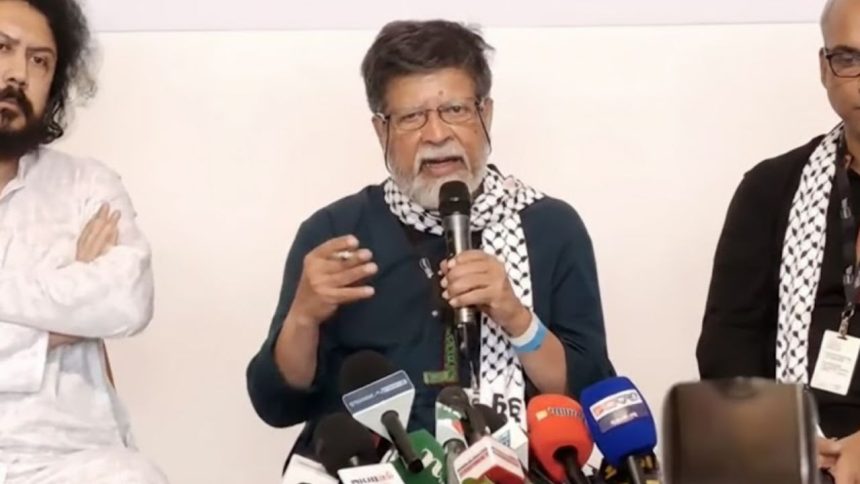

Renowned Bangladeshi photographer Shahidul Alam has returned safely to Dhaka after being detained in an Israeli prison for his participation in the Global Sumud Flotilla – a humanitarian voyage organised to express solidarity with the Palestinians, victims of genocide by Israel.
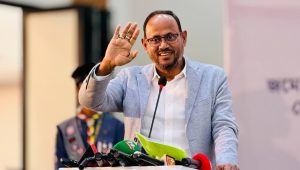
At a jam-packed press conference held at the Drik Gallery Saturday, Alam appeared healthy and in high spirits. He reaffirmed his commitment to the Palestinian cause, declaring his intention to return to Gaza – “this time with a thousand ships.”
Expressing deep disappointment with global media, Alam accused mainstream outlets of being “complicit in genocide.”
“Firstly, I should say – shame on you,” he said. “Shame on you for being complicit in genocide, for aiding and abetting the genociders, and for not being on the flotilla when you had the chance to prove you were different. The opportunity still exists — join the future flotilla.”
Alam noted that the voyage was primarily intended for journalists and health workers, yet no one from the mainstream media participated.
“They did not take the risk – whether personal or political – but their absence was telling,” he added.
Plans for future

Discussing future initiatives, Alam revealed plans to form a global activist network.
He added, “Some extraordinary people have come together, and we have decided to create an international network. Since world leaders refuse to act, we activists are preparing to do what we can. I won’t elaborate now, but we have a blueprint.
“We plan to go again – this time with a thousand ships.”
Voyage and detention


The flotilla had set sail on 30 September and was intercepted by Israeli forces on 8 October. There were 92 participants aboard, all of whom were detained and taken to a high-security prison in the Israeli desert.
Alam was held for two days before being released and flying to Istanbul.
Bangladeshi participants
Alam mentioned that two other Bangladeshi-origin British citizens also joined the initiative.
One of them, Ruhi, was on board in the Sumud Observer, though that vessel turned back before reaching the danger zone.
Another participant, Liaqat (real name Mohammad Ali), a Quran teacher from England, joined the mission after purchasing a ship with three friends for €28,000. Initially, the Sumud organisers used their ship but refused them onboard.
Liaqat later joined another vessel and sent Alam a voice message in Sylheti dialect saying, “Bhai kenon asen?” (Brother, why aren’t you here?).
A fragile vessel
Conscience, the vessel that carried Shahidul, was a modest ship built in 1972 for short-distance travel — more like a ferry with only seating arrangements. Only the crew had sleeping space, and there were inadequate facilities for restrooms or drinking water.
The ship could barely accommodate 100 people, yet it was the largest among all flotillas.
“Most of the activists were journalists and health workers – the very people Israel has targeted, restricting media coverage and attacking hospitals,” Alam explained.
Extraordinary participants
The flotilla carried several remarkable individuals – true fighters for justice.
Among them was Hubaida Ara, who lost 10 colleagues to Israeli fire but still chose to join the mission. One of the two co-captains, Madeleine, an Australian, had taken part in multiple similar missions and provided the team with safety training.
Another participant, Johra, had an amputated leg but traveled with an artificial one.
An 84-year-old French woman, known to be close to President Emmanuel Macron, broadcasted live from the boat, questioning her president’s silence over Israel’s actions.
“These were truly extraordinary people who chose courage over fear,” Alam said.