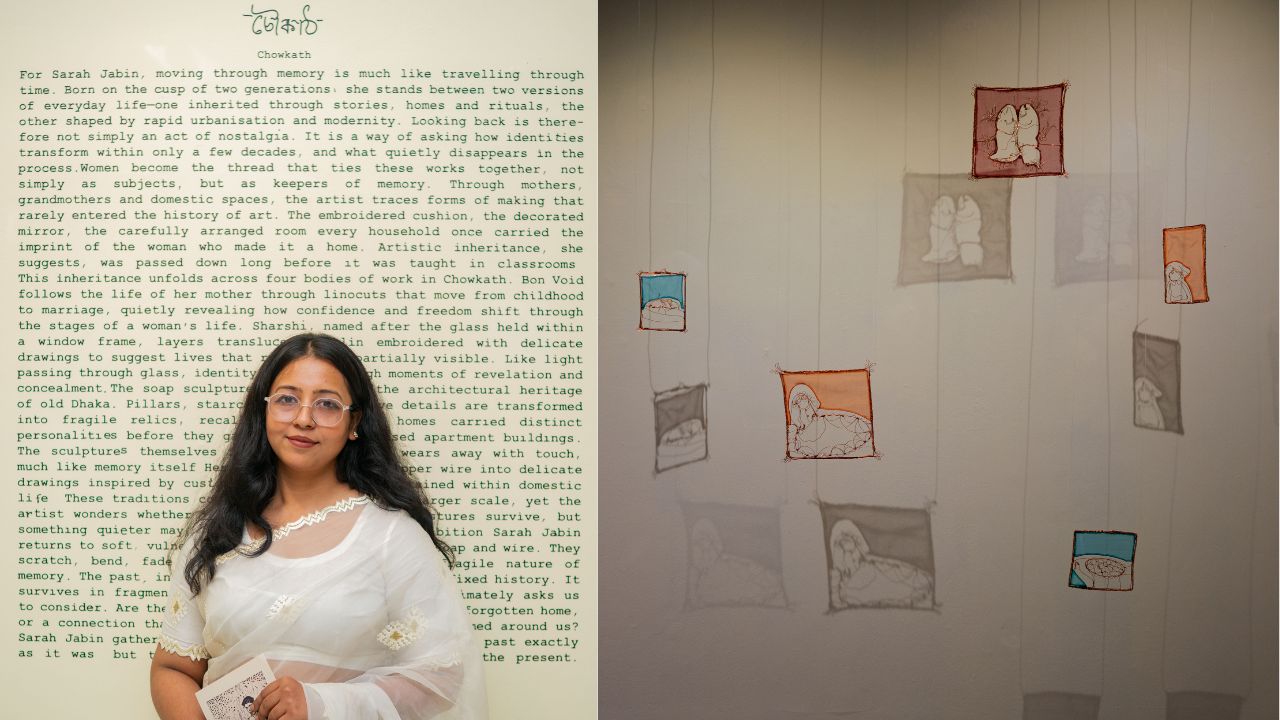



When Sarah Jabin lost her childhood home in Khilgaon, she began looking differently at ordinary homes, family photographs and forgotten traditions.
Built in 1962, the house was not officially historic. Yet its disappearance made the Dhaka-based multidisciplinary artist realise that ordinary homes carry their own cultural identity and are slowly vanishing.
In an exclusive interview with the Times of Bangladesh, Jabin said the loss shaped her artistic journey into disappearing architecture, women’s lives, domestic traditions and memory.
“I grew up in a house in Khilgaon that was built in 1962. That house no longer exists,” Jabin said.

“Its disappearance made me realise how ordinary homes from a certain era, although not officially historic, carry their own cultural identity. They are slowly vanishing, and preserving them is often beyond the owners’ means. We could not save our own house either.”
The loss became the foundation of Biyog Shomoy, where soap sculptures recreate fragments of Old Dhaka’s disappearing architecture.
After completing her Master’s at the Faculty of Fine Arts, University of Dhaka, Jabin explored different media. Soap first fascinated her during Covid-19 and became a metaphor for memory — fragile, temporary and destined to erode.




“I began reading about Dhaka’s history and researching the city more deeply,” she said. She also returned to family photographs, including her cousins’ ear-piercing ceremony and childhood gatherings. “The more I looked, the more I wanted to understand where those memories belonged.”
That search shaped Chowkath, her second solo exhibition at Alliance Française de Dhaka, inaugurated at La Galerie on Friday. Named after the Bengali word for threshold or doorway, it explores private and public, past and present, and personal memory and collective history.
Bon Void uses linocut prints to trace a woman’s journey from childhood to adulthood, exploring freedom, identity and selfhood.
Biyog Shomoy recreates Old Dhaka homes from the 1950s to the 1990s in soap, reflecting their disappearance amid urban growth.
Sharshi revisits domestic interiors through embroidered muslin and household objects, honouring women’s unseen labour. Unforgotten preserves fading rituals and celebrations that once strengthened neighbourhood and family bonds.
Jabin’s connection with textiles began at home. Her mother, a homemaker who later started a small home-based boutique, used to stitch their clothes by hand and make table mats, bedsheets and embroidered household items.
“I grew up helping her. Working with fabric and stitching never felt like learning something new. It has always been part of my life,” Jabin said.
“I always choose materials based on the concepts they represent. Muslin, thread, soap or wire, each one belongs to a particular story,” she said.
Chowkath remains open at La Galerie until 8 August.