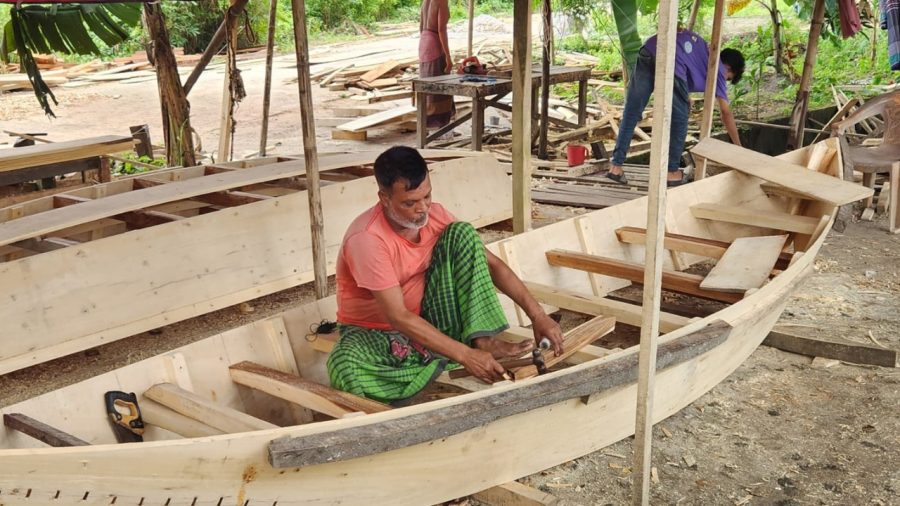



Traditional boatmakers in Shibchar, Madaripur, are struggling to keep their ancestral trade alive as shrinking waterways reduce demand for wooden boats, while rising timber costs and falling sales leave families facing financial hardship.
Although the monsoon brings more work, many craftsmen struggle to earn enough throughout the year. Some have switched professions, while others continue building boats despite mounting financial pressure.
For generations, Shibchar’s Sutradhar community has depended on boatmaking and carpentry. But siltation, declining water levels and shrinking navigable waterways have reduced the need for traditional boats.
Around 50 families near Shibchar municipality continue making boats throughout the year, while others work as carpenters to supplement their income.
Craftsmen said demand increases during the monsoon, keeping them busy for about two months. Orders remain scarce during the rest of the year.
Each boat takes approximately three days to build. An 11-hat-long wooden boat sells for Tk8,000 to Tk10,000, leaving around Tk1,500 in profit after covering timber, labour and other costs.

Dilip Sutradhar, a boatmaker, said his family had worked in the trade for generations.
“Everyone in our family makes boats or works as carpenters. Those who build boats generally do not take up other work,” he said.
“We make boats throughout the year, but work increases during the monsoon. Most craftsmen remain unemployed for much of the rest of the year.”
Dilip said demand had fallen sharply.



“We used to make 20 to 25 boats a month. Now, during the off-season, we get orders for only one or two,” he said.
Another craftsman, Dinesh Sutradhar, said he currently received orders for 10 to 12 boats a month.
He said he paid workers Tk2,000 per boat, but rising timber costs without corresponding increases in selling prices had reduced earnings.
Dinesh said carpentry opportunities had also declined as fewer wooden houses were being built.
“There is hardly any demand for carpenters like us anymore,” he said.
For some families, continuing boatmaking means taking on debt.
Nupur Rani, wife of boatmaker Mahadev Sutradhar, said her family borrowed money to buy timber because they lacked sufficient capital.
“We borrow money to buy timber and then make small wooden boats,” she said.
“But sales have fallen, and we cannot make enough profit to build up our own capital,” she added.
She said the family remained trapped in debt, borrowing repeatedly to continue production.
“Every year, we carry the burden of debt. We cannot escape this cycle,” she added.
Shibchar Upazila Nirbahi Officer HM Ibne Mizan said the government’s nationwide canal excavation programme could restore water flow and help revive the trade.
He said he would also discuss possible financial assistance with the Department of Youth Development, Palli Sanchay Bank and other microcredit providers.
Despite these difficulties, many craftsmen remain committed to preserving their ancestral trade, hoping improved waterways will restore demand and help them support their families.