


Bangladesh expects a decision by the end of October on its request to delay graduation from the least developed country (LDC) category by three years, as the government races to secure new trade agreements and address investment barriers before the country loses preferential trade benefits.
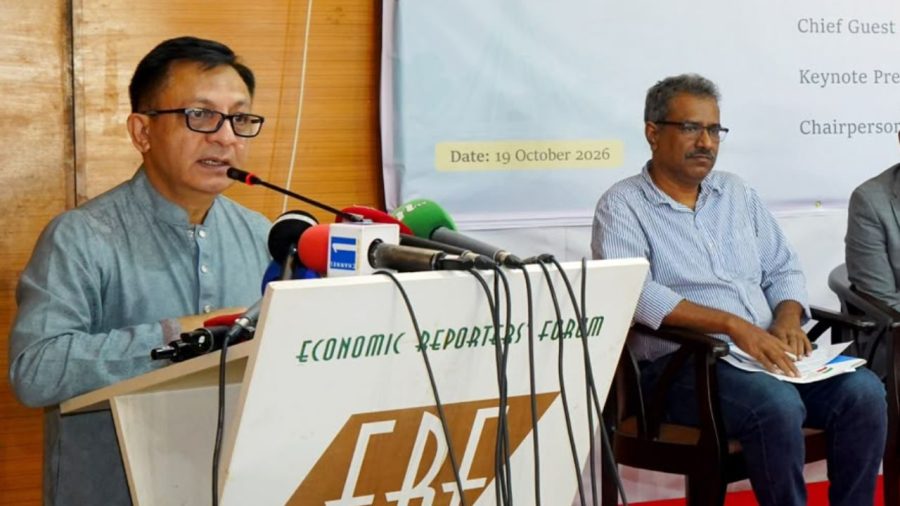
Commerce Minister Khandakar Abdul Muktadir said on Monday that the proposal had cleared a key United Nations review stage and was awaiting further consideration, with the government preparing a time-bound action plan to use the additional period.
“I am very optimistic that next week or the week after, we will see a resolution to this matter,” Muktadir said at a seminar organised by the Economic Reporters’ Forum (ERF) and Bangladesh Foreign Trade Institute (BFTI) in Dhaka.
He expressed confidence that a decision would come before the scheduled graduation date of 24 November.
The decision would determine how much time Bangladesh has to prepare its export industries for the loss of trade preferences and other advantages linked to LDC status.
The United Nations Committee for Development Policy cleared the proposal earlier this year, which was subsequently placed before the United Nations Economic and Social Council.

Relevant international stakeholders, including the European Union (EU), had also agreed to Bangladesh receiving additional time, the minister said.
He acknowledged that Bangladesh was not adequately prepared for the economic and financial challenges of graduation, saying earlier efforts had focused more on politically celebrating the transition than strengthening the country’s ability to manage its consequences.
The government has already shared with the EU a time-bound action plan outlining how it intends to use the proposed extension.




A central priority is preserving access to overseas markets.
Bangladesh aims to conclude comprehensive economic partnership agreements or free trade agreements (FTAs) with eight to 10 countries during 2026–27, Muktadir said.
A lead negotiator has been appointed for FTA talks with the EU, while preparations are under way for the first round of technical discussions. No date has been fixed yet.
The government wants to conclude an agreement before LDC graduation, potentially reducing the need to rely on the EU’s Generalised Scheme of Preferences Plus arrangement.
“However, I hope we won’t need to take the GSP Plus option; we will complete the FTA before that,” Muktadir said.
Bangladesh is also moving towards joining the Regional Comprehensive Economic Partnership, with policy approval already secured and procedural work continuing.
But market access alone will not be enough to attract investment, the minister warned.
The minister said the government was pursuing energy security and process simplification measures as part of an integrated strategy to rebuild domestic and foreign investor confidence, improve business conditions and protect access to international markets.
For Bangladesh’s exporters and manufacturers, a three-year extension would provide more time to prepare for tougher trading conditions.
Failure to secure the deferral could carry substantial economic costs. Bangladesh is set to lose duty-free access to the EU, its largest apparel market, in November 2029. While competitors such as Vietnam and India are securing fresh duty-free access, Bangladesh is at risk of ending up 10-12 per cent in fresh duties.
According to the South Asian Network on Economic Modeling (SANEM), an unprepared LDC graduation could reduce Bangladesh’s overall exports by 11.8 per cent, with apparel exports potentially falling 14.7 per cent.
Graduation would also end exemptions from intellectual property obligations under the Agreement on Trade-Related Aspects of Intellectual Property Rights, potentially raising pharmaceutical manufacturing costs significantly.
Bangladesh would also face the loss of concessional financing benefits available to least developed countries from multilateral lenders.