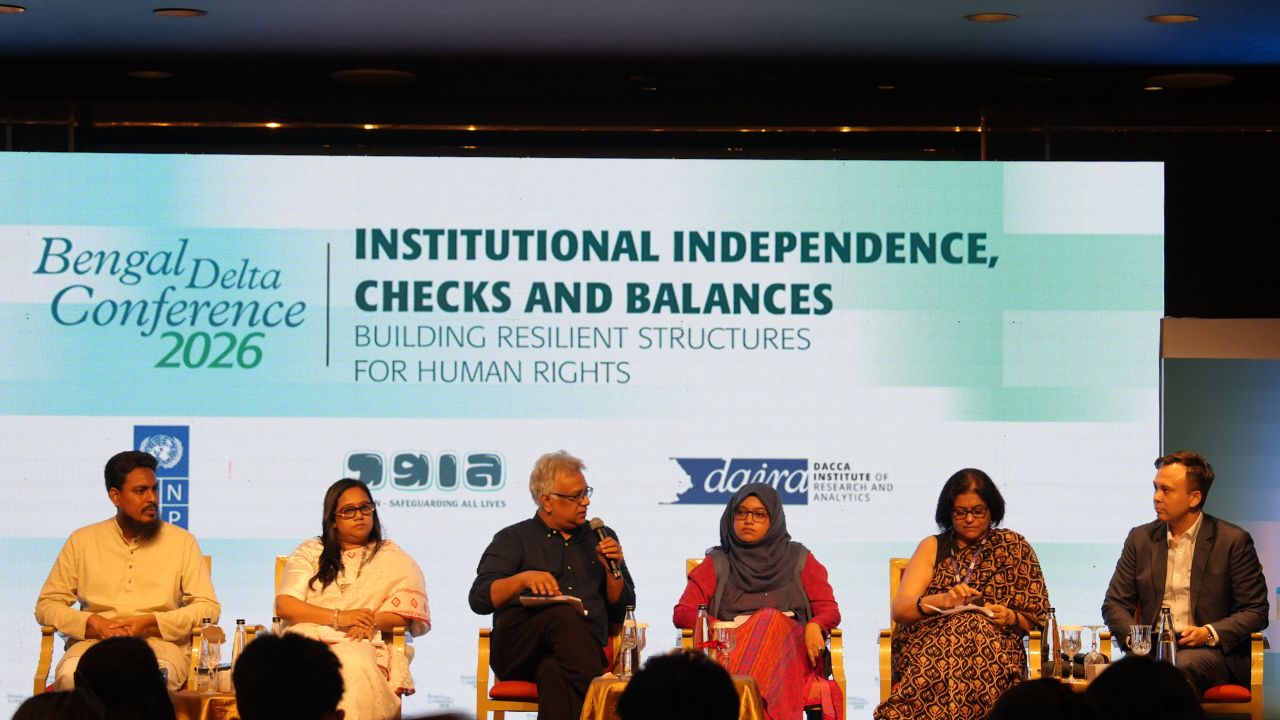



A panel discussion titled “Institutional Independence, Checks and Balances: Building Resilient Structures for Human Rights” was held on Saturday at Crystal Ballroom of Hotel InterContinental Dhaka. The event was jointly organised by Sapran (Safeguarding All Lives) and UNDP Bangladesh.
The session, moderated by Dr Asif Shahan, professor of Department of Development Studies at Dhaka University, brought together experts and policymakers to discuss the necessity of independent and accountable institutions.
Opening the session, Sonali Dayaratne, deputy resident representative of UNDP Bangladesh, said democracy depends on effective checks and balances between the executive, legislature, judiciary, and independent constitutional institutions, read a press release.
She said bodies such as National Human Rights Commission (NHRC) and Anti-Corruption Commission require transparent appointment processes, operational independence, and protection from political interference.

Durdana Chowdhury, researcher at Sapran, presented a background paper reviewing Bangladesh’s institutional reform efforts following the July Uprising.
She said, as seen in previous political transitions, reform initiatives often weaken or stall once stability returns. Drawing lessons from South Korea, she stressed the need for legally protected and durable institutional safeguards.




Dr Nabila Idris, former commissioner of NHRC, argued that recent amendments have weakened the Commission’s independence and increased executive influence. She expressed concern over the reduced representation of women and minorities and the Commission’s limited authority to investigate security agencies.
Sara Hossain, senior advocate of Supreme Court of Bangladesh, described the judiciary as the country’s most vital institution for protecting fundamental rights. She called for transparent judicial appointments, an independent judicial secretariat, stronger internal accountability, and greater civic oversight.
Sanjida Islam Tulee coordinator of Maayer Daak, highlighted the importance of including victims and families affected by enforced disappearances in reform processes. She called for truth-seeking, witness protection, and sustained state assistance, including psychosocial and economic rehabilitation for affected families.
Diepak Elmer, chargé d’affaires ai of Embassy of Switzerland in Bangladesh, said institution-building is a gradual process that legislation alone cannot achieve. He added that lasting reform requires political commitment, capable leadership, and public trust.
Akhter Hossen, member secretary of NCP, called for more transparent and bipartisan appointment mechanisms for constitutional bodies. He also stressed the importance of strengthening parliamentary standing committees to enhance executive accountability.
The discussion concluded with a consensus that building independent and resilient institutions is the only way to safeguard democracy. Participants emphasised that such independence can only be sustained through strong legal protections, effective parliamentary oversight, and active civil society participation.