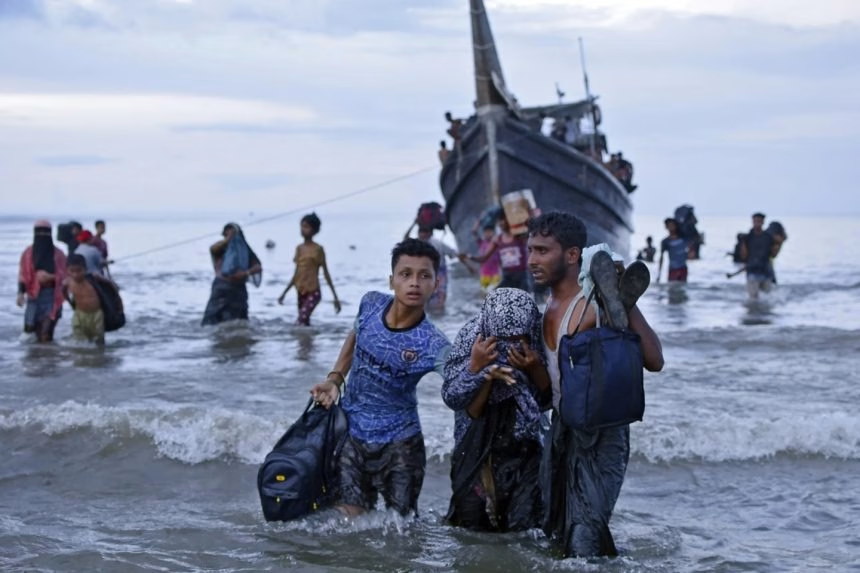



Rohingya communities in Myanmar’s northern Rakhine State face escalating abuse, forced labour, food shortages, health crises, severe restrictions on movement, and ongoing armed conflict, reports Amnesty International.
The organisation warned that premature repatriation of over a million Rohingya refugees from Bangladesh to Myanmar under these conditions could be disastrous.
On Tuesday, the UN General Assembly will convene a High-level Conference to discuss the situation of Rohingya Muslims and other minorities in Myanmar.
This conference aims to devise a strategy for the return of Rohingya refugees, many of whom were violently expelled by the Myanmar military in 2016 and 2017.
However, Amnesty International’s investigation casts doubt on the readiness of Myanmar’s northern Rakhine State to safely facilitate the return of these refugees.
Dire conditions in Northern Rakhine State
Amnesty International conducted interviews with 15 Rohingya refugees who arrived in Bangladesh as recently as July 2025.
The refugees, who came from Maungdaw and Buthidaung Townships, were part of the influx of more than 150,000 Rohingya refugees over the past 20 months. They fled escalating violence and grave violations by the Myanmar military and the Arakan Army, a rebel group that controls much of northern Rakhine State.
The refugees described conditions in northern Rakhine as unbearable, with severe restrictions on movement, lack of access to basic services, forced labour, and the looming threat of violence.
According to Joe Freeman, Amnesty International’s Myanmar Researcher, “Existing conditions in northern Rakhine State are nowhere near ready for Rohingya to return safely.”

He warned that the Myanmar military continues to use Rohingya civilians as pawns in its fight against the Arakan Army, with the Arakan Army itself becoming a new oppressor for many Rohingya.
“While it is vital to bring global attention to the Rohingya crisis, pushing for repatriation without addressing the acute dangers faced by all communities – Rohingya, Rakhine, and other ethnic minorities – could be catastrophic,” Freeman added.
The role of the Arakan Army
The northern part of Myanmar’s Rakhine State is now under the control of the Arakan Army, following a successful offensive against Myanmar military forces in November 2023.
The Arakan Army, aligned with opposition armed groups resisting the military junta that took power in 2021, now controls Myanmar’s entire border with Bangladesh. The military still holds control of the state capital Sittwe, a key entry point for aid and transportation.
The Arakan Army’s offensive has left many Rohingya civilians trapped between two warring forces.
The military’s blockade of humanitarian aid, coupled with indiscriminate airstrikes, has worsened the humanitarian crisis. Recently, a military airstrike killed at least 19 Rakhine students while they slept.




This attack underscores the vulnerability of civilians who are caught in the middle of this armed conflict.
Life under Arakan Army control
Despite the end of Myanmar military rule in parts of northern Rakhine, life for the Rohingya under the Arakan Army’s control has not improved significantly. Many Rohingya communities report suffering from severe restrictions on their movement, forced labour, and discriminatory practices.
The Arakan Army, which the Rohingya previously viewed as an ally against the Myanmar military, is now accused of conducting widespread abuses, including arbitrary detentions and indiscriminate attacks on civilians.
One refugee in his 20s recalled witnessing the horrific consequences of the conflict, as landmines severely injured several people in his community.
Another 60-year-old man described the conditions in an IDP camp in Buthidaung Township, where the Arakan Army forcibly recruited civilians for labor, including tasks at frontline conflict areas. “If we refused to work, they would beat us severely,” the man recalled.
Rohingya civilians living in these camps also reported facing starvation, with inadequate access to food, water, medicine, or education. “They seemed happy when anyone died,” one refugee said.
“They would say, ‘This is not your country. This is our country. Get out.’” These statements highlight the extent to which Rohingya are treated as outsiders, despite living in the region for generations.
A humanitarian crisis
The United Nations World Food Programme (WFP) has warned of a rising hunger crisis in northern Rakhine, where conflict, blockades, and funding cuts are driving dramatic increases in food insecurity.
In central Rakhine State, the WFP reported that 57% of families cannot meet their basic food needs. Conditions in northern Rakhine, where international organizations are absent, are likely even worse.
A 45-year-old man who fled to Bangladesh in July 2025 described how ethnic Rakhine people in Buthidaung were allowed to fish and move freely, while Rohingya were not.
He was also forced to work without pay under the Arakan Army’s coercion, and any refusal to comply with these demands resulted in punishment. This included being detained, beaten, and denied food.
Forced labour, discriminatory policies
Rohingya refugees reported being forced to provide night guards and unpaid labour for the Arakan Army. “Every family was required to send someone aged 15 to 70 for forced labour,” said one woman.
Young men were also forcibly recruited to fight. Those who refused were threatened with expulsion from Myanmar or physical punishment. Amnesty International documented numerous cases where families were forced to clean up the aftermath of military clashes, picking up bodies and debris, often without compensation.
The lack of humanitarian aid has led to further suffering, particularly in the areas controlled by the Arakan Army.
Refugees have had to rely on sporadic and dangerous means to gather food. In one instance, a man was beaten by Arakan Army soldiers after attempting to catch fish to feed his family. “They took the fish away from me and beat me with a rifle,” he said.
This highlights the extent of restrictions placed on basic survival activities.
Repatriation concerns
Amnesty International expressed grave concerns over efforts to repatriate refugees back to Myanmar under the current conditions. “There is no guarantee of safety for the Rohingya, Rakhine, or other ethnic minorities under the current environment,” said Freeman.
The humanitarian conditions in northern Rakhine State, combined with ongoing armed conflict and ethnic tensions, make it impossible for the Rohingya to return safely at this stage.
Dr. Zahid Hussain, a Rohingya rights advocate, further stressed that the Arakan Army’s denial of Rohingya identity, alongside its harsh treatment of civilians, makes repatriation a dangerous prospect.
The international community must insist on structural reforms in Myanmar and ensure that refugees are not sent back to a volatile situation.
The way forward
While the international community has turned its attention to the Rohingya crisis, the situation remains dire. Repatriation should not be rushed before addressing the root causes of the violence and ensuring the safe return of refugees.
Amnesty International’s Freeman concluded, “The international community must not let the urgency of returning refugees overshadow the risks that exist in Myanmar. Until Rohingya and other ethnic minorities can live without fear of violence, forced labour, and discrimination, repatriation must remain off the table.”
The High-level Conference at the UN General Assembly could play a pivotal role in advancing a strategy that prioritizes the safety and dignity of the Rohingya, ensuring that their return to Myanmar is voluntary, safe, and dignified.
However, as this report has shown, more must be done to address the critical situation in northern Rakhine before any discussions about repatriation can be meaningfully pursued.