Policymakers have indicated that the upcoming national budget may introduce special revenue incentives, tax exemptions, and initiatives to strengthen domestic industry in order to boost investment in the renewable energy sector.
Energy sector researchers and analysts said that addressing long-standing structural issues and reducing dependence on fossil fuels to create a sustainable energy mix should now be one of the government’s top priorities.
At a dialogue titled “Renewable Energy in the Upcoming Budget: Expectations and Realities” in Dhaka, organised by the Centre for Policy Dialogue (CPD) and Dhaka Stream on Sunday, government advisers, researchers, economists, and energy entrepreneurs discussed the sector’s key hurdles and opportunities.
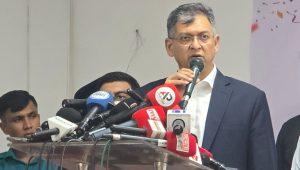
Speaking as the chief guest, Finance and Planning Adviser Rashed Al Mahmud Titumir said the country’s energy sector is currently trapped in a long-standing structural limitation or “vicious cycle”, where inconsistencies in policy formulation, contract implementation, and production management result in the waste of public funds.

He noted that there is a significant gap between electricity generation capacity and actual demand, leading to additional expenditures, including capacity charges, across multiple areas.
Titumir added that many past energy sector contracts were not executed properly, further complicating the current situation. He described overcoming this challenge as one of the government’s major tasks.
He also emphasised that, in line with the country’s broader economic goals—particularly the plan to achieve a trillion-dollar economy by 2034—the share of renewable energy in the energy mix must be increased. Efforts are also being made to enhance domestic gas exploration, establish energy security standards, and develop domestic manufacturing of renewable energy equipment.




In a keynote presentation at the dialogue, CPD highlighted that in the revised development budget for FY2024–25, Tk795 crore was allocated for renewable energy in the power and energy sectors, representing only 4.6 per cent of the total allocation. During the same period, Tk13,709 crore was allocated for fossil fuel infrastructure, highlighting the significant challenge of energy transition.
CPD Programme Associate Khalid Mahmud noted that over the past decade, 92–98 per cent of the energy sector budget has been spent on fossil fuels, while renewable energy accounted for only 3–4 per cent.
He added that without rapid investment in grid modernisation, rooftop solar expansion, and battery storage technologies, energy sector transformation will not be possible.
Experts at the dialogue said high import duties, regulatory complexities, long delays in project approval, and financing constraints remain major barriers to the renewable energy sector.
Shahriar Ahmed Chowdhury, director of the Centre for Energy Research at United International University, said substantial subsidies are currently provided to the power sector, which, if used more efficiently, could have supported large-scale solar power generation. He noted that nearly Tk62,000 crore was allocated to subsidies in the power sector last year, enough to install approximately 10,000MW of solar power.
Alamgir Morshed, managing director and CEO of IDCOL, said the biggest challenge for the renewable energy sector is the lack of long-term, low-interest financing. He added that introducing limited-time feed-in tariffs, as done in other countries, could accelerate investment.
Planning Commission Member Monjur Hossain said the recent global energy crisis has once again demonstrated the need for Bangladesh to accelerate energy transition. Increasing investment in renewable and domestic energy sources over the next five years could significantly enhance the country’s energy security and stability.
Representatives from various sectors participating in the dialogue said that due to new European Union environmental policies, Bangladesh’s export sectors, especially the ready-made garment industry, may fall behind in competitiveness if they fail to transition rapidly to renewable energy. They also called for timely payment for renewable energy projects, resolution of customs issues, and assurance of investment protection.
The dialogue was moderated by economist Khandakar Golam Moazzem, with Dhaka Stream Editor Golam Iftekhar Mahmud in attendance, among others.