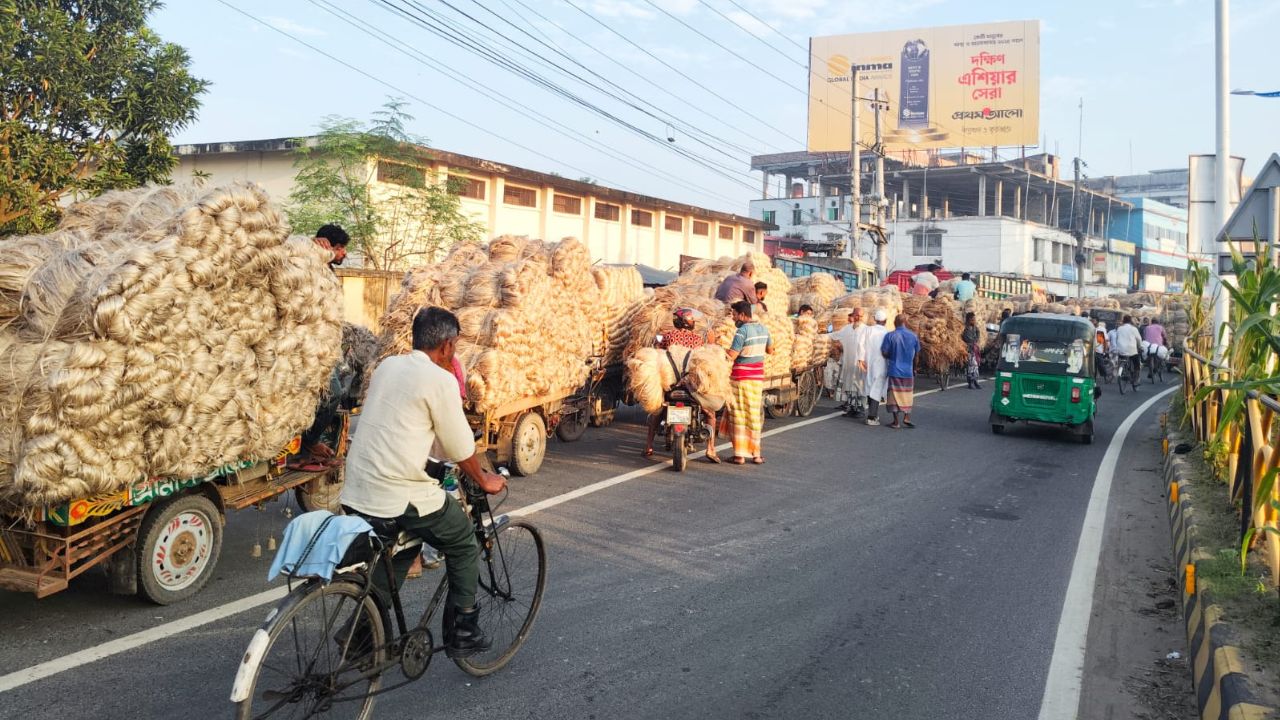



Jute cultivation is expanding in Rajshahi as rising global demand for environmentally friendly products, efforts to reduce plastic use and relatively favourable market prices renew farmers’ hopes of reviving the fortunes of Bangladesh’s once-dominant “golden fibre”.
Jute was once Bangladesh’s main source of foreign exchange earnings and formed the backbone of the country’s industries, exports and rural economy. Its prominence faded over the years amid the growing use of synthetic fibres and plastic products.
The sector, however, is showing signs of a revival, with farmers in Rajshahi increasingly returning to the cash crop.
Jute cultivation in the district has exceeded the government target this season. Rows of green jute plants now cover fields across the region, raising hopes of a good harvest. Farmers are expected to begin harvesting early varieties within two weeks.
According to the Department of Agricultural Extension in Rajshahi, jute has been cultivated on 18,399 hectares of land in the district this season, compared with 17,305 hectares last year. The acreage has increased by 1,094 hectares within a year.
The district has set a production target of 49,333 tonnes of jute this year. Production stood at 48,677 tonnes last year, meaning this season’s target is 656 tonnes higher.
In a separate estimate, the Department of Jute said Rajshahi could produce around 381,696 quintals of jute this year, up by 21,202 quintals from last year.
Agriculture officials said favourable weather, adequate rainfall, sufficient soil moisture and the use of improved seed varieties had contributed to the healthy growth of jute plants this season.

Jute seeds are generally sown in Rajshahi during the Bengali months of Chaitra and Baishakh. Harvesting, retting and fibre extraction continue from Shraban to Bhadra, while early varieties are usually harvested from mid-July.
Officials are optimistic about production this year, as the height, density and overall condition of the plants in the fields remain satisfactory.
Farmers are also encouraged by current market prices. A visit to the Naohata jute market found that jute was selling for between Tk4,500 and Tk5,000 per maund.
The price, which is higher than in several previous years, has created renewed optimism among growers. Farmers said cultivation could expand further next year if the current price level continued.
Liton Ali, a farmer from Ashrafpur in Bagha Upazila, said he had cultivated jute on 15 bighas of land this year.
“Fertiliser, seed, irrigation, labour and other expenses have cost me around Tk18,000 to Tk20,000 per bigha. The weather has remained favourable, and I am expecting a good yield,” he said.



“If I can sell jute for Tk5,000 to Tk6,000 per maund, I will be able to recover my production costs and make a good profit.”
Nasir Uddin, a farmer from Chandpur Bengari in the same upazila, said he had cultivated jute on 10 bighas this year.
“The plants have grown very well because of timely rainfall. Many of them have reached between seven and nine feet in height, and the yield outlook is promising,” he said.
“The golden days of jute can return if the government ensures fair prices, reduces plastic use and promotes jute products. But it will become difficult to continue cultivating jute if farmers do not receive prices that reflect their production costs.”
Rabiul Islam, a farmer from Paba Upazila, said he had planted an early variety of jute on four bighas of land. The plants had grown well, he said.
“Early varieties reach the market sooner and usually fetch better prices. However, labour shortages and difficulties in retting jute remain major challenges,” he added.
Hridoy, a farmer from Charghat Upazila, said the condition of jute fields was much better than last year.
“More farmers will take up jute cultivation next year if they receive fair prices,” he said.
Despite the growing prospects, farmers continue to face several obstacles. These include shortages of water and suitable water bodies for retting, rising labour costs, a scarcity of workers, market price fluctuations, inadequate storage and marketing facilities, and a lack of modern jute-processing technology.
Farmers said resolving these problems would make jute cultivation more profitable and sustainable.
Mohammad Nasir Uddin, deputy director of the Department of Agricultural Extension in Rajshahi, said jute cultivation had increased significantly in the district this season.
“There is a strong possibility of good production this year because of improved seeds, farmers’ growing interest and favourable weather,” he said.
“Jute is not only a cash crop; it is also one of the foundations of an environmentally sustainable agricultural economy.”
Md Nadim Akter, assistant director of the Department of Jute in Rajshahi, said jute was currently selling for between Tk4,500 and Tk5,000 per maund.
Farmers’ interest in jute cultivation was increasing as the government had taken various initiatives to ensure fair prices for growers, he said.
The international market is also offering new opportunities for the sector as efforts to reduce single-use plastics intensify around the world. Demand for natural and biodegradable fibres is growing, while the global market for jute bags, geotextiles, composite materials, home textiles, carpets and fashion products is expanding.
Experts said Bangladesh must focus not only on producing raw jute but also on modernising jute-based industries, increasing value addition and expanding export-oriented production to take advantage of the emerging opportunities.
Agricultural economists said Rajshahi could become one of the country’s leading jute-producing regions if farmers received improved seeds, regular training, easy access to loans, modern retting technology, storage facilities and stronger marketing support.
They said the establishment of jute-based industries, development of small entrepreneurs and expansion of export capacity could create thousands of jobs and significantly increase farmers’ incomes.
The rise in cultivation, prospects of a good harvest and encouraging market prices have strengthened hopes that jute could again become an important source of economic prosperity for Rajshahi’s farmers.
Those involved in the sector, however, said the potential could only be transformed into lasting success by ensuring fair prices, expanding modern technology, promoting jute-based industrialisation and strengthening Bangladesh’s competitiveness in the international market.