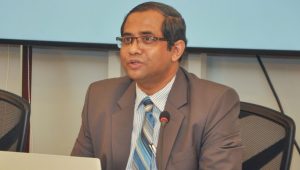
Chief Election Commissioner (CEC) AMM Nasir Uddin on Thursday said preventing violence and bloodshed in local government elections remains the Election Commission’s biggest challenge, as the country prepares for a series of grassroots polls across thousands of local bodies.
Speaking at a programme in the capital during the publication ceremony of the Asian Network for Free Elections (ANFREL) observation report on the 13th parliamentary election and referendum, the CEC said the Commission is prioritising efforts to ensure peaceful, transparent and conflict-free elections.
“Our main objective is to stop bloodshed,” Nasir Uddin said. “We want voters to cast their ballots in a safe environment and return home without fear.”
The CEC noted that local government elections in Bangladesh have historically been more violent than national polls, often resulting in deaths and widespread injuries.
“Violence during local government elections has become a serious concern. In many places, not only have people lost their lives, but many others have also been injured. This culture of violence must end,” he said.

Calling for cooperation from political parties and stakeholders, the CEC said the Election Commission would launch awareness campaigns and hold consultations aimed at building consensus against electoral violence.
“We will engage all stakeholders and try to unite everyone to ensure peaceful local government elections,” he added.
Citing data from civil society organisations, Nasir Uddin said 236 people were killed during the 2016 local government elections, according to Sushashoner Jonno Nagorik (Sujan), a civil society platform for good governance.
He also referred to statistics from Ain o Salish Kendra (ASK), which reported 116 deaths during the 2021 Union Parishad elections.




The CEC stressed the importance of grassroots democracy, saying local government institutions play a direct role in delivering public services.
“Democracy does not exist only at the national level. Grassroots democracy is equally, if not more, important because local representatives are closely connected to people’s daily lives,” he said.
Responding to a question about whether the Election Commission might face pressure under a political government, Nasir Uddin said elections cannot be conducted without government support, as state agencies including the police, administration and security forces are involved in the process.
“We received full cooperation from the interim government, and we hope democratic governments will continue to support free and fair elections in the greater interest of the country,” he said.
Describing the upcoming polls as a major administrative undertaking, the CEC said Bangladesh currently has 4,581 Union Parishads, 495 Upazila Parishads, 61 Zila Parishads, 13 city corporations and nearly 330 municipalities.
“Organising elections at all these levels is a huge responsibility. Greater cooperation will be essential,” he said.
On the issue of loan defaulters participating in elections, the CEC declined to comment, noting that related cases are currently pending before the higher judiciary.
Nasir Uddin also said the Election Commission is documenting experiences and lessons from previous elections to help future commissions improve electoral management and address recurring challenges.
He reiterated that the Commission remains neutral and is committed to ensuring a safe voting environment for all citizens.
“The Election Commission is neither for nor against anyone,” he said. “Our goal is to create an atmosphere where people can vote freely and safely.”
Emphasising the need for democratic continuity, the CEC said elected representatives must ultimately hold state power to ensure stability, governance and national development.
Reflecting on his experience in handling electoral challenges, Nasir Uddin said cooperation from all sides had been instrumental in carrying out the Commission’s responsibilities.
“I have received support from everyone,” he said. “No one has turned away from the effort to ensure credible elections.”