


After three hours of disruption, Dhaka Polytechnic Institute students withdrew their blockade from Tejgaon roads at 2pm Wednesday and returned to campus.
The blockade, enforced from 11am at the busy Saat Rasta intersection, had brought traffic to a standstill, causing severe trouble for hundreds of commuters.
Speaking to reporters, the students said they would resume their demonstration at the same spot on Thursday from 11am to 2pm in support of their four-point demand.
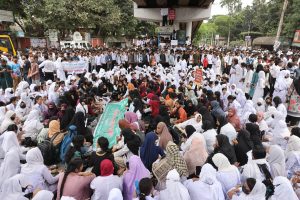
On Wednesday morning, polytechnic students in different parts of the country also staged blockades on roads and railways in solidarity.
Their demands include punishment for those who threatened diploma engineers with shooting and slaughter, halting all activities supporting what they termed as the “irrational” three-point demands of BSc engineering students.
They also sought full implementation of the six-point charter of the technical students’ movement, and the introduction of a one-channel education system for engineering.
Blockade in Gazipur
In Gazipur, diploma engineers blocked the highway protesting what they called continued conspiracies over the designation of sub-assistant engineers. The demonstration, organised by Diploma Engineers’ Welfare Foundation, began at noon.
Participants warned of a nationwide programme if the government failed to take clear initiatives to protect their position and meet their demands.
The protest disrupted highway traffic, causing trouble for passengers and drivers. On Tuesday evening, the group had also blocked rail lines. Gazipur Metropolitan Police said efforts were underway to ease the situation.
Shahin Alam, Officer-in-Charge of Basan Police Station, said agitating students gathered in the Chowrasta area and police were negotiating to restore traffic flow.
A look at previous protest
On 16 April, students from government and private polytechnic institutes, Technical School and Colleges, and other institutions under the Bangladesh Technical Education Board staged a six-point protest at Saat Rasta.
Their demands included cancellation of the 30% promotion quota for craft instructors, reform of admission policies, an end to discriminatory recruitment, technical staff in administration, the creation of a separate ministry and reform commission for technical education.
They also sought the establishment of a full-fledged technological university with admission opportunities in four newly built engineering colleges.


