


The Purchasing Managers’ Index (PMI) can give Bangladesh an early read on economic momentum by tracking changes in demand, production, employment, costs and supply conditions before official data are released, according to a PMI seminar presentation on Monday.
Bangladesh’s PMI rose 4.9 points to 57.8 in July from 52.9 in June, signalling faster private-sector expansion. Manufacturing led the rebound, with its PMI jumping 16.6 points to 65.4, while services rose to 56.0 and agriculture to 55.2. Construction improved to 49.3 but remained in contraction.
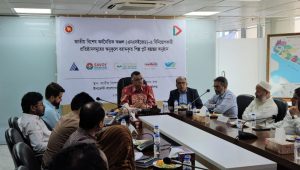
The findings were presented at a seminar organised by the Metropolitan Chamber of Commerce and Industry and Policy Exchange Bangladesh (PEB). A PMI reading above 50 indicates expansion from the previous month, while below 50 signals contraction.
Unlike gross domestic product, industrial production and other official indicators that take longer to compile, PMI is based on monthly business responses and can flag economic turning points earlier.
Bangladesh’s PMI has reflected major economic shocks. In July 2024, nationwide protests, a curfew and a 10-day internet shutdown drove the index down 27 points to 36.9.
It fell 8.8 points between March and April 2025 amid prolonged government holidays, US tariff pressures and fuel-supply constraints. Between October and November that year, weaker global demand, declining export competitiveness and investment delays ahead of the national election pushed it down another 7.8 points.
In June 2026, PMI fell 9.9 points to 52.9 amid the prolonged Eid holiday, the start of the monsoon, weaker pre-Eid demand and a new 15 per cent value-added tax (VAT).

What PMI measures
The monthly survey covers 400 firms: 46 in agriculture, 92 in manufacturing, 50 in construction and 212 in services.
It tracks new orders, output, employment, input prices, supplier delivery times, inventories, outstanding orders and future business expectations, providing a snapshot of current activity and the outlook.
The data can help businesses plan production, procurement and investment, while investors can use it to assess conditions across financial and commodity markets.




International research cited in the presentation found an 82 per cent correlation between PMI and the latest eurozone GDP estimate and an 83 per cent correlation between quarterly PMI and the first GDP estimate before the pandemic.
PMI is widely used by policymakers, central banks, businesses and investors in major economies including the United States, United Kingdom, eurozone, China, India and Japan.
Manufacturing drives July rebound
July’s improvement was broad-based. Manufacturing recorded gains in new orders, export orders, output, imports, input purchases, employment and supplier deliveries, although outstanding orders remained in contraction.
Services extended its expansion streak to 22 months, while agriculture recorded its 11th consecutive month of expansion. Construction improved but remained below 50.
“The July PMI signals broad-based strengthening of Bangladesh’s economy, led by a sharp manufacturing rebound and continued expansion in agriculture and services,” said M Masrur Reaz, chairman and CEO of PEB.
The manufacturing recovery coincided with the highest monthly export earnings in 12 months. Improved foreign-exchange conditions and expectations of a more supportive business environment following the FY2026-27 budget also supported confidence, he said.
The presentation called for sector-specific PMI data for major growth areas such as ready-made garments, micro, small and medium enterprises and services, as well as combining PMI with business-confidence indicators.
A broader, timely PMI system could help policymakers identify weakening demand, rising costs and supply disruptions earlier, while giving businesses and investors more time to adjust production, investment and risk strategies.