Eight months into the BNP government’s tenure, leaders of several parties that joined its simultaneous movement to oust the Awami League say the new administration has fallen short on law and order, public safety and good governance, while making insufficient progress on state reforms.
They say commitments under the July National Charter and referendum remain largely unfulfilled, raising questions about the government’s willingness to honour the political consensus that emerged after the July 2024 mass uprising.
While some leaders believe the government can still regain public confidence through stronger action against crime, upholding the rule of law and implementing its reform pledges, they warn that continued failure to deliver on these commitments could deepen public discontent and trigger fresh protests.
In late 2022, various parties and alliances launched a simultaneous movement under the leadership of the BNP, demanding the resignation of the Awami League government and a national election under a non-partisan government. The parties held coordinated programmes around common demands while retaining their respective party identities and positions. On 12 July 2023, the BNP and like-minded parties announced a one-point demand.
Despite the joint movement against the government, the Awami League returned to power following the controversial election held on 7 January 2024. The BNP and most opposition parties boycotted the election, leaving it effectively without the participation of major opposition parties.
The Awami League government fell during the July 2024 mass uprising.

Following the uprising, the 13th parliamentary election was held under the interim government on 12 February 2026.
The BNP returned to power after a long gap, winning more than two-thirds of the seats.
After its election victory, the BNP pledged to form a national government with its allies in the simultaneous movement. But the party later appointed only a few leaders from its alliance partners as ministers and state ministers.
Eight months after the election, the assessments of parties that once stood alongside the BNP in the anti-government movement suggest that the government must fulfil not only its electoral mandate but also the expectations for change created by the mass uprising.




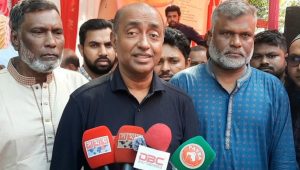
Biplobi Workers Party General Secretary Saiful Haque says the BNP government has yet to deliver on public safety and the rule of law despite some progress on social and economic issues in its first eight months, raising questions about its capacity to fulfil its commitments.
“While there is no question about the government’s sincerity, questions have already arisen about its capacity,” he told TIMES.
Haque said expectations of improved law and order remained unmet, citing allegations of extortion, land grabbing, corruption and violence involving ruling party members.
Haque said the BNP’s independent political activities were less visible than those of opposition parties, including Jamaat-e-Islami, despite its pre-election pledge to keep the party and government separate.
“On paper, the party and the government may be separate. But in reality, the party’s independent activities are not particularly visible,” he said.
He also raised concerns over trade policy, container management at Chattogram Port and the agreement with the United States, urging the government to act more decisively while allowing it a reasonable amount of time.
Meanwhile, Nagorik Oikko President Mahmudur Rahman Manna said the BNP government had failed to meet expectations on good governance, financial sector reform and law and order in its first eight months, accusing it of backtracking on commitments to state reform.
Speaking to TIMES, Manna said the government had yet to complete many expected tasks and was moving away from the BNP’s 31-point reform agenda, the July Charter and its commitments linked to the referendum.
“The government is not acting according to the commitments it made. It is thinking anew,” he said.
Manna said the government’s reform efforts had fallen short of the mandate it received from voters, with progress on constitutional reform and other changes based on public opinion and political consensus remaining elusive.
Rastro Songskar Andolan President Hasnat Kaiyum accused the BNP government of abandoning consensus-based reforms and pursuing unilateral legal changes, warning that the shift could undermine hopes for democracy and state reform after the mass uprising.
Kaiyum told TIMES that the government was backtracking even on areas of consensus that did not require constitutional amendments.
“We believe the government is moving in an extremely dangerous direction,” he said.
Kaiyum said his party had urged the government to return to its earlier position, adding that it still had an opportunity to amend laws and take other necessary steps to fulfil its reform commitments.
“If the government abandons its reform commitments, it could pave the way for an authoritarian rule in the future. Such an approach goes against the democratic aspirations which emerged from the mass uprising. The government still has an opportunity to change course and return to the path of reform,” Kaiyum said.