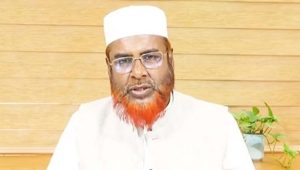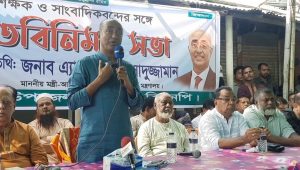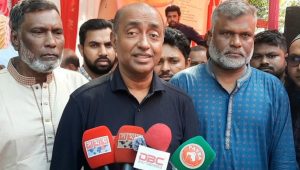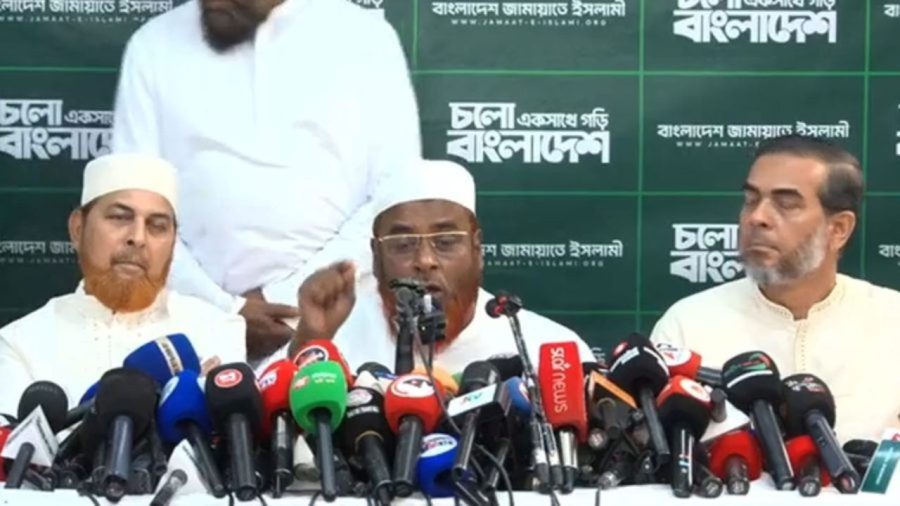



Jamaat-e-Islami Secretary General Mia Golam Parwar has alleged that the invitation to the inauguration of the July Monument failed to clearly specify the seating arrangements and position of party Ameer Shafiqur Rahman, despite his entitlement to the rank of a full minister under official parliamentary protocol.
For this reason, Jamaat has rejected Prime Minister Tarique Rahman’s remarks concerning the opposition leader’s absence from the ceremony.
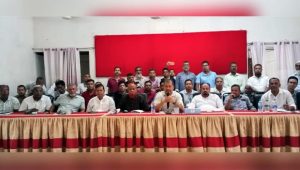
Speaking at an emergency press conference at the party’s central office on Tuesday afternoon, Parwar said the invitation specified the positions of the chief guest, the presiding official, the state minister, the Local Government Division secretary and others, but failed to ensure appropriate recognition for the Leader of the Opposition.
“In this situation, it was unclear whether he would attend the event and sit among the general audience or whether a designated seat would be reserved for him on the stage. We believe that merely sending an invitation without according due respect to the Leader of the Opposition was treated as a formality,” he said.
Parwar alleged that the arrangement was intended to belittle the opposition.
“We believe this arrangement was made to belittle the opposition. We therefore reject the allegations raised over the Leader of the Opposition’s absence from the event,” he said.
Earlier, referring to the opposition leader’s absence from the July Monument inauguration, Prime Minister Tarique Rahman had said that the opposition did not embrace the spirit of July.

Responding to the remarks, Parwar said 11 political parties, including Jamaat-e-Islami, were campaigning for implementation of the July Charter and enforcement of the referendum verdict.
He alleged that BNP government was disregarding the referendum verdict and acting contrary to the spirit of the July Charter.
Parwar said one of the main expectations of the July movement was to end politicisation, corruption and repression of dissenting voices.
However, he alleged that BNP, Chhatra Dal and Jubo Dal leaders and activists were being appointed to government and autonomous institutions.




He also criticised the initiative to remove the chairman and members of the Public Service Commission.
Parwar alleged that the National Consensus Commission had reached an agreement to establish a committee comprising representatives of the ruling party, the opposition, the judiciary and experts to oversee appointments to constitutional positions.
However, he said the government was not following that principle.
Regarding implementation of the July Charter, Parwar said consensus had been reached on 84 issues at the National Consensus Commission.
Although Jamaat had expressed dissent on five issues, it had not remained inflexible on those matters in the interest of broader consensus, he said.
He alleged that the BNP was maintaining its objections, avoiding implementation of the charter and pursuing constitutional amendments instead of constitutional reform.
Responding to Home Minister Salahuddin Ahmed’s allegations of non-cooperation by the opposition, Parwar said opposition parties were prepared to cooperate in implementing the referendum verdict.
However, he said cooperation would not be possible if the government attempted to amend the Constitution unilaterally while disregarding the people’s verdict.
Referring to remarks by BNP Acting Secretary General Ruhul Kabir Rizvi, Parwar said disregarding the referendum verdict, politicising state institutions, filing politically motivated cases, making arrests and allegations of extortion and killings were raising fears of authoritarian rule.
He claimed that the BNP government was following the path of the previous Awami League government in these matters.
Parwar also rejected allegations that Jamaat had acted alongside the Awami League during the 1994–95 movement demanding a caretaker government.
He said a liaison committee had existed at the time to coordinate programmes among various opposition parties.
Jamaat had not formed a political alliance with the Awami League but had participated in programmes alongside different parties demanding neutral elections, he said.
Parwar also alleged discrimination in development allocations for constituencies represented by Jamaat lawmakers.
Claiming that ruling-party MPs were receiving larger allocations, he called for equal treatment of all elected representatives.
Regarding the execution of two Bangladeshis in Saudi Arabia, Parwar said the Saudi judicial system operated according to the country’s own laws.
However, he questioned the role of the Bangladesh Embassy before the executions and described the incident as a diplomatic failure of the government.