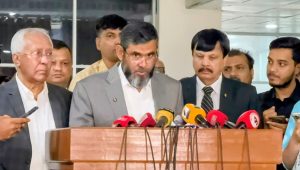

Of the BNP’s eight election pledges on public administration, the government has taken a clear initiative on only one – a new pay scale for government employees.
On four of the remaining seven, its actions have run counter to the promises. There has been no visible progress on the other three.
BNP unveiled its manifesto six days before the 12 February national election, promising equality, human dignity and social justice through sound policy, good governance and good government.
It also pledged a merit-based, transparent, efficient and people-friendly public administration, with reforms in anti-corruption efforts, the rule of law, the judiciary, police and local government.
But contractual appointments on partisan considerations, the placement of party loyalists in top state positions and moves to change the recruitment examination system have raised questions over those promises.
Badiul Alam Majumdar, a member of the National Consensus Commission under the interim government, told TIMES, “Political parties seek people’s votes on the basis of their manifestos. It can be called an unwritten contract. Therefore, breaking a promise is effectively a breach of contract.”
Former secretary AKM Abdul Awal Mazumder said, “Political parties say all sorts of nice things before elections and forget everything after coming to power. Their words and actions did not match in the past, and we are seeing the same thing now.”
Steps contrary to the pledges
The first pledge, “Building a Meritocratic Bangladesh”, promised to make qualifications the sole criterion for recruitment, transfers and promotions in the civil and military administrations, taking into account merit, integrity, creativity, efficiency, experience and training.
But some of the government’s actions tell a different story.
On 9 July, the public administration ministry promoted 179 officials from deputy secretary to joint secretary. Several had faced serious allegations substantiated by government investigations, while some had been punished.

Mainul Haque, who had been sent into retirement, was among those promoted.
Mohammad Nazrul Islam was also promoted despite having his annual increment suspended for three years over misconduct while serving as assistant commissioner (land) in Demra.
Md Shahinur Islam was made a joint secretary despite having been demoted to the lowest step of his pay grade for one year over a sand quarry scandal while serving as additional deputy commissioner (revenue) in Nilphamari.
Deputy Secretary Md Sadekur Rahman was also promoted after being suspended on the prime minister’s instructions on 28 May over allegations of negligence in removing waste from sacrificial animals. An investigation into departmental action against him remains under way.
Around 80 officials currently hold secretary-level rank, and one in four is serving on a contractual appointment.
They include Cabinet Secretary Nasimul Ghani, the country’s highest-ranking civil servant, and Principal Secretary to the Prime Minister ABM Abdus Sattar.
Md Shamsul Alam, who previously worked for BNP, has also been appointed on contract as an additional secretary at Election Commission.



The government has sent many officials into compulsory retirement after 25 years of service. At the same time, numerous others have been made officers on special duty or attached to different offices.
BNP acting secretary general Ruhul Kabir Rizvi has publicly defended appointments based on party considerations.
At an event at the Prime Minister’s Office, he asked, “In which country in the world are there no partisan appointments?”
The second pledge was to recruit 500,000 government employees swiftly and transparently on the basis of merit and qualifications.
The government has since moved to increase marks for oral examinations while reducing those for written tests. The proposal has raised concerns over recruitment transparency and sparked protests at universities.
Under consideration are 50 viva voce marks against 100 for the written examination for grades 11 and 12, 40 against 60 for grades 13 to 16, and 25 each for grades 17 to 20.
Before coming to power, the current home minister had advocated reducing BCS oral examination marks from 200 to 50 or 100.
“If this can be done, there will be no opportunity for corruption,” he had said.
The government has also formed a four-member committee, headed by State Minister for Public Administration Md Abdul Bari, to expedite recruitment to vacant posts of sub-assistant agriculture officers.
Public Service Commission (PSC) previously conducted examinations and made recommendations for these posts. The decision, coupled with the proposed increase in viva voce marks, has raised fresh concerns about government interference in recruitment.
The fifth pledge was to build an accountable and people-friendly public administration through recruitment reforms, a civil service law in line with the Constitution and e-governance at every level.
But access to information on where Ministry of Public Administration officials are posted and their current service status has been blocked.
The ministry’s gems.gov.bd website previously carried information on more than 6,000 BCS administration cadre officials, including those on contractual appointments and those made officers on special duty.
Dhaka University Public Administration Professor Sadik Hasan told TIMES, “By removing officials’ information from the website, the government is undermining the people’s right to information. It also goes against the Right to Information Act.”
The eighth pledge was to increase professionalism in state institutions and prevent politicisation.
The manifesto promised to ensure the effectiveness and accountability of the administration, police and other state institutions by basing recruitment on “integrity, efficiency, merit, qualifications, patriotism and experience” rather than political loyalty.
Within months of taking office, however, BNP began appointing party leaders to state bodies.
On 23 July, the Ministry of Public Administration appointed 12 BNP leaders on one-year contracts to top positions in 12 government agencies, boards and corporations.
On 10 June, the government also appointed BNP leaders as chairmen of eight development authorities.
Pledges with no action
The fourth pledge was to establish an “Administrative Reform Commission”.
Before the election, BNP said reforms undertaken by the interim government were insufficient and promised a commission comprising “qualified, experienced and knowledgeable individuals” to carry out “adequate” reforms.
The sixth pledge was to establish a strong Public Service Commission and restructure it as an effective recruitment body for education, health and other sectors.
The seventh was to formulate private-sector service rules to ensure employees received the benefits and facilities to which they were entitled.
There has been no visible government initiative on any of the three pledges.
Professor Sadik told TIMES, “Over the past six months, we have seen the government trying to bring the administration under its control. To do so, it is placing party people in many positions.”
He said the government was trying to establish control over the entire system.
State Minister for Public Administration Md Abdul Bari could not be reached for comment. He did not answer his phone or respond to questions sent via WhatsApp.
Mir Solaiman, assistant private secretary to Prime Minister’s Adviser on Public Administration Md Ismail Jabiullah, said, “Sir is busy. He cannot comment at the moment.”