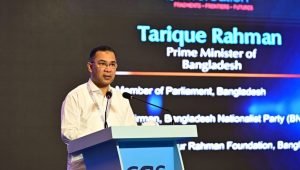
Prime Minister Tarique Rahman is set to formally launch the Farmer Card on a pilot basis on 14 April, coinciding with the first day of the Bangla New Year 1433.
The announcement was made following a review meeting chaired by the Prime Minister at the Cabinet Division Conference Room in the Bangladesh Secretariat on Wednesday.
Prime Minister’s Press Secretary Saleh Shibly confirmed the development, stating that a four-member secretary committee, led by the finance secretary, has been formed to oversee the programme.
Agriculture Minister Mohammad Amin Ur Rashid, State Minister Sultan Salahuddin Tuku, and State Minister for LGRD and Cooperatives Mir Shahe Alam were also present at the meeting.

Shibly described the Farmer Card as more than just a card; it will represent the entitlements, dignity, and security of every farmer in the country, giving them the highest priority and respect.
Through the card, farmers will gradually gain access to a variety of services, including subsidised agricultural inputs, government incentives, affordable agricultural machinery, irrigation facilities, easy-term agricultural loans, insurance benefits, fair market access, agricultural training, real-time weather and market updates via digital platforms, and advice on crop diseases and pest control.



The programme will also benefit fish farmers, livestock rearers, and dairy farmers in addition to crop producers.
Under the pre-pilot phase, farmer data will be collected over the next 45 days, and Farmer Cards will be distributed in nine blocks across nine upazilas in eight divisions of the country.
Financial grants, as determined by the government, will also be provided to specific categories of farmers to support crop production during the Kharif-1 and Kharif-2 seasons.
The designated upazilas for the pre-pilot are Tangail Sadar, Shibganj in Bogura, Panchagarh Sadar, Islampur in Jamalpur, Shailkupa in Jhenaidah, Nesarabad in Pirojpur, Juri in Moulvibazar, Cumilla Sadar, and Teknaf in Cox’s Bazar.
The programme will be implemented by the Department of Agricultural Extension (DAE) under the Ministry of Agriculture. Shibly noted that under the initiative, each landless, marginal, and small farmer will receive an average subsidy or agricultural input assistance of Tk2,500.
Following the completion of the pre-pilot phase, the formal inauguration of the Farmer Card programme will take place on Pahela Baishakh, marking the start of wider implementation.
After the pre-piloting and pilot phases, the initiative aims to reach all upazilas across the country within the next four years.