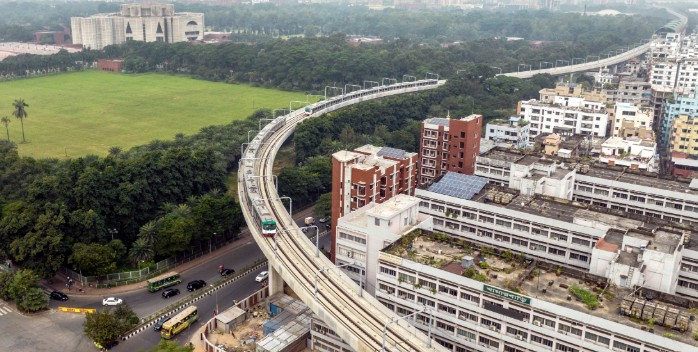

Sohanur Rahman, a student at Dhaka University, regularly travels from the campus station to Mirpur-10. In the first week of February, he tapped his Rapid Pass while exiting the station. However, when he tried to enter the next morning, his card failed to work. Officials told him he had not exited the station the previous day, forcing him to pay a Tk100 fine.
“I tapped my card properly while exiting. But the system did not show the exit, and the station authorities charged me Tk100. This was unfair,” he said.
Sohanur is not alone. Many passengers report similar incidents. A technical fault in metro rail exit gates has left many commuters in Dhaka paying fines despite following proper procedures.
Metro rail authorities, however, deny responsibility. They say passengers often leave too quickly, preventing machines from reading the cards properly.
Government employee Rafiqul Islam shared a similar experience. He said the machine failed to record his exit despite tapping his card, and he had to pay a fine on his next journey.
“The authorities say there is no record of my exit. Does that mean I stayed inside the station all night? Their mistake cost me money,” he said.

Regular metro user and teacher Shimul Ahmed, who travels to Uttara North station, said commuters now face more inconvenience than benefits.
“Even after tapping the card, the gate sometimes fails to read it. I have paid fines three times,” he said.
Earlier, passengers could exit the same station within 15 minutes without any charge if needed. This commuter-friendly facility remained in place for a long time.
However, authorities later found that an organised group misused MRT and Rapid Pass cards to travel between stations without paying fares, causing financial losses.




Following the discovery, metro rail authorities withdrew the ‘free entry-exit’ facility on 20 October last year.
In a notice, Dhaka Mass Transit Company Limited (DMTCL) said passengers entering and exiting the same station would face a Tk100 charge.
The decision has triggered further dissatisfaction among passengers. Many said the previous system allowed them to enter and exit stations easily in emergencies. Under the new rule, they must now pay Tk100, which many consider harassment. They argue that all commuters are suffering due to the misuse by a small group.
Metro rail authorities maintain that passengers must remain careful while exiting and ensure proper card validation.
“Passengers often leave quickly, and the machine does not get enough time to read the card. They should wait for the confirmation sound before leaving,” said Nazrul Islam, director of operations and maintenance at DMTCL.
According to Nazrul, authorities charge the fare equivalent to a trip from Uttara North to Motijheel as a penalty.
“We deduct the fare of a round trip. Earlier, it was double with an additional penalty. Considering passengers, we have reduced it by half,” he added.
According to Hadiuzzaman, Professor of the Department of Civil Engineering at Bangladesh University of Engineering and Technology, the problem lies in the quality of the Automatic Fare Collection (AFC) gates in metro rail systems.
According to specifications set by Japanese contractors, only one failure should occur per one lakh passengers.
Experts say the supplied gates fall short of that standard, and authorities failed to ensure quality during procurement. As a result, frequent malfunctions now occur.
“Passengers are paying fines due to machine faults. This is not their fault; it is a system failure. Penalising commuters for technical errors is unjust,” said Hadiuzzaman.
He added that the idea that passengers would skip tapping out is unrealistic, as they know it leads to fines.
He urged authorities to quickly repair the faulty machines and raise awareness among passengers. Otherwise, commuters will continue to bear the burden of fines.
While authorities urge caution and patience, the recurring faults and fines reveal a deeper systemic issue. With repeated glitches, rising complaints and no immediate solution in sight, the metro’s promise of smooth, commuter-friendly travel risks being undermined by a system where passengers pay for errors they did not commit.